Paikuli preserves a Sasanian king’s account of gaining the throne. Its scattered stones, two inscription languages and museum collection reveal both royal politics and the work of reconstructing a damaged monument.

A royal claim at a mountain pass
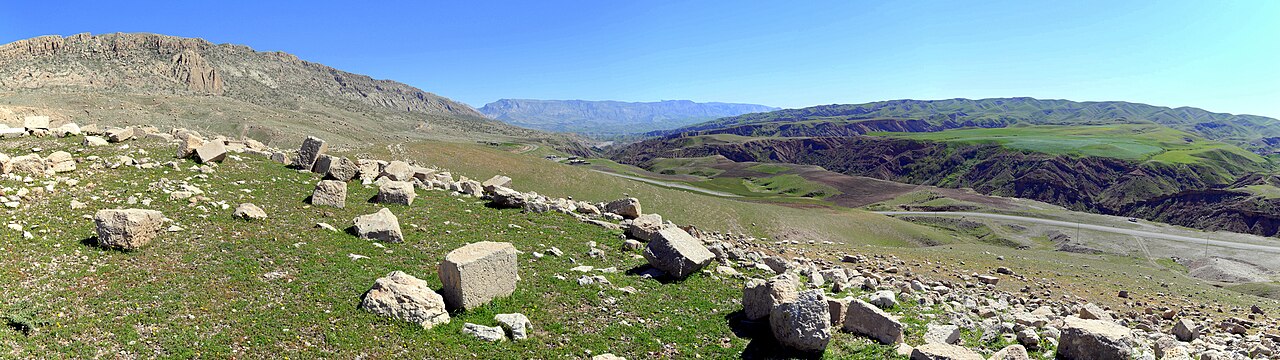
The monument stands near the Paikuli pass at the southern end of the Qaradagh range, south of Sulaymaniyah in the Kurdistan Region of Iraq. The archaeological mission dates its construction probably to the first years of Narseh’s reign, around 293–294 CE. [1] The inscription celebrates his victory in the succession struggle following Wahrām II’s death. It situates the meeting with nobles who pledged allegiance to Narseh at the border of Asōrestān. The text is a royal presentation of legitimacy: its account and list of supporters communicate how the new ruler wished his accession to be understood. [2]
Two languages that help recover one text
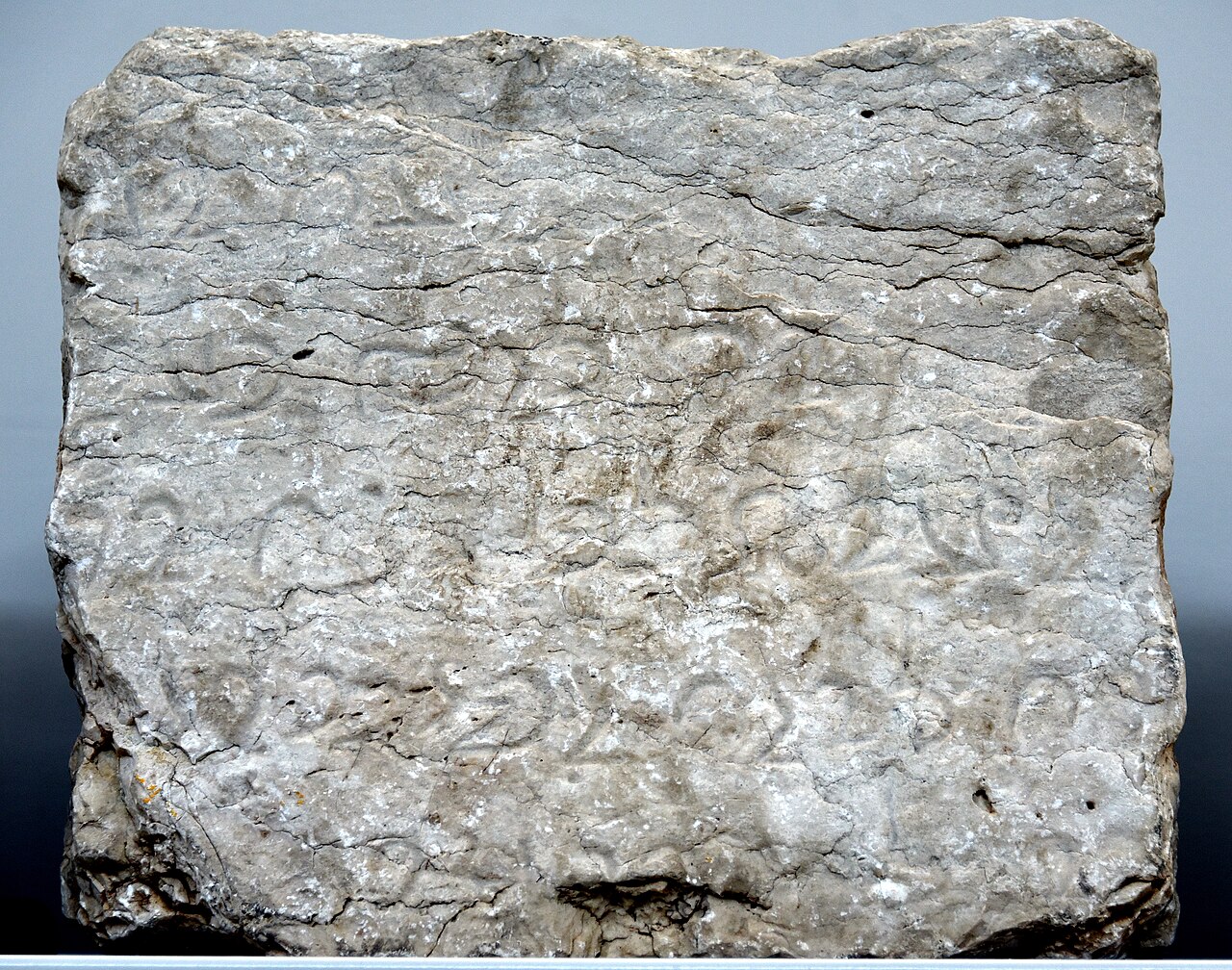
The eastern face bore the Middle Persian version; the northern face carried Parthian. MAIKI describes 46 lines in eight tiers for Middle Persian and 43 lines in seven tiers for Parthian. The versions largely overlap, so a surviving passage in one can help reconstruct a gap in the other. [1] Cereti and Terribili’s 2014 study divides the narrative into the succession dispute and the list of nobles and dignitaries supporting Narseh. It presented 19 newly identified inscribed blocks: eleven Middle Persian and eight Parthian. [2]

What survives, and what must be reconstructed
The monument has lost its external stone facing, leaving a core of smaller stones and mortar. Its original appearance remains a research problem. MAIKI distinguishes the four royal busts in high relief from a fifth carved in the round. [1] A reconstruction drawing should therefore be read as an archaeological proposal rather than a photograph of an intact ancient tower.
Recording before digital photography
The Smithsonian’s Herzfeld archive traces study of the site from Rawlinson’s 1844 visit to Herzfeld’s campaigns in 1911 and 1913. Herzfeld arranged scattered blocks, made inscription squeezes and proposed a reconstruction. [3] A squeeze is an impression made by pressing a mouldable material, such as wet paper, into an inscription and letting it dry. It preserves a relief record of letter shapes. Such records can help scholars read inscriptions when the original stone has deteriorated or is difficult to access. The Smithsonian’s imaging project makes this earlier documentation available for study. [4]
Field survey and the Slemani Museum
ISMEO’s account of the June 2018 campaign records 221 blocks or fragments documented with drawings, photographs and positions for the project database. They included inscribed pieces and shaped architectural stones. The team worked with the Slemani Antiquities Directorate and transferred the inscribed and selected moulded pieces to the museum for safekeeping. [5] A dedicated Paikuli gallery opened at the Slemani Museum in June 2019. [1] The site and museum preserve complementary evidence: the pass and ruined structure provide context, while study and display of individual blocks make the inscription’s surviving words accessible.
Sources and further reading
- Italian Archaeological Mission in Iraqi Kurdistan (MAIKI), Paikuli Project: monument, languages, sculptures and 2019 museum gallery.
- Carlo G. Cereti and Gianfilippo Terribili, “The Middle Persian and Parthian Inscriptions on the Paikuli Tower: New Blocks and Preliminary Studies,” Iranica Antiqua 49 (2014), pp. 347–412: authors’ abstract.
- Smithsonian, Freer and Sackler Archives, Squeeze Imaging Project, “Archaeological Sites: Paikuli”: Herzfeld’s campaigns, reconstruction and archival records.
- Smithsonian, Squeeze Imaging Project, “Squeeze Making”: materials, recording method and scholarly use of inscription impressions.
- ISMEO, Italian Archaeological Mission in Iraqi Kurdistan: report of the June 2018 documentation campaign and transfer of selected blocks to the Slemani Museum.