Siirt, known in Kurdish as Sêrt, is a provincial capital linking the Mesopotamian plains with the eastern Anatolian uplands. Its history can be traced through changing rulers, Kurdish and Arabic writing and speech, Christian scholarship, religious architecture and goat-hair weaving.

A city between plains and uplands
Siirt occupies sloping ground enclosed by steep hills on several sides, opening towards the west and southwest. Metin Tuncel places it on routes linking the Jazira plains with the eastern Anatolian highlands. Its exact foundation date is unknown. He records Marwanid control in 1079–1080, the Seljuk takeover in 1085 and incorporation into Ottoman territory following the 1514 battle of Chaldiran. [1] These changes connect the city to the wider history of the Upper Tigris region.
The Great Mosque and its rebuilding
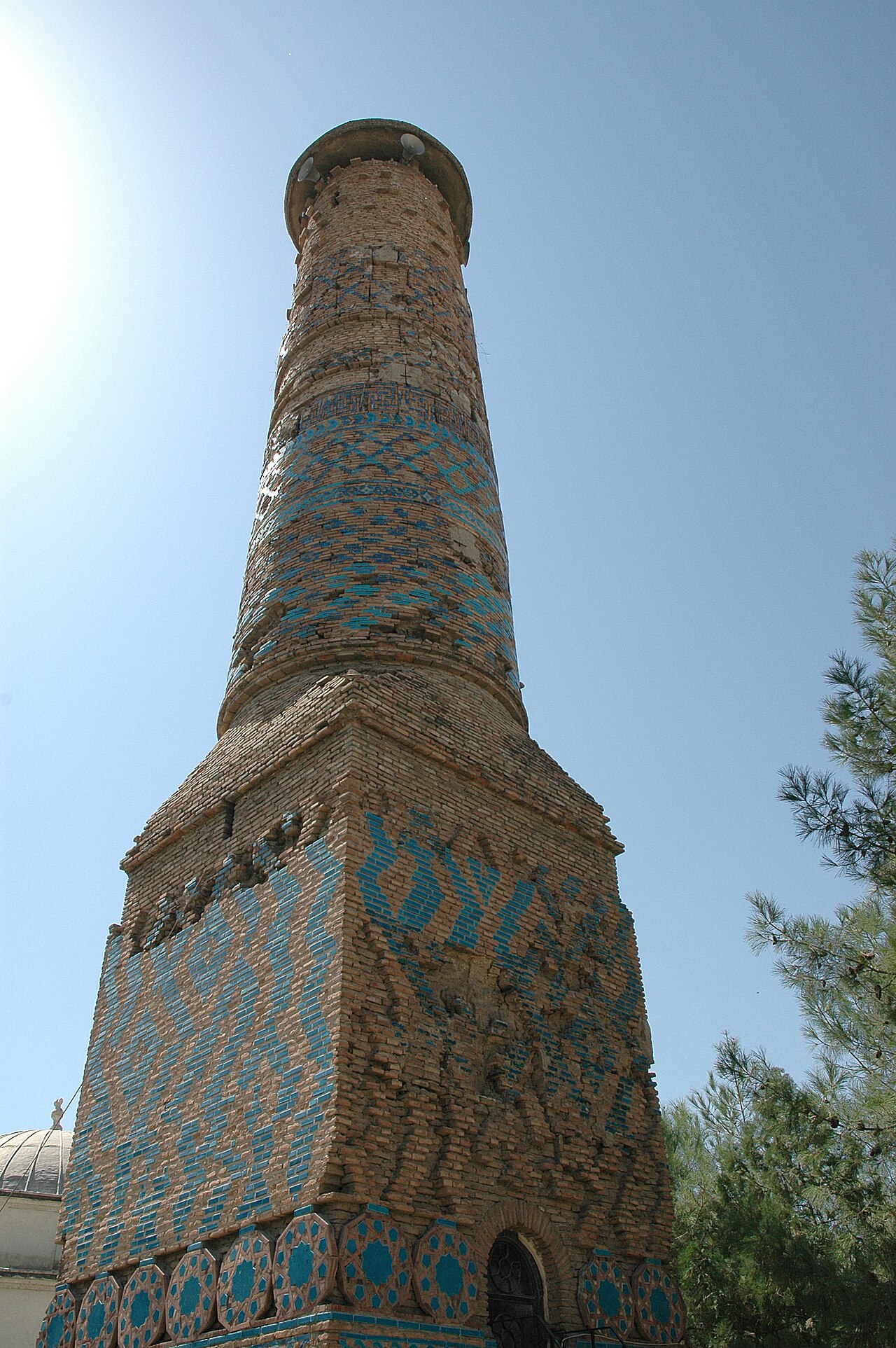
The Ulu Camii preserves several periods of construction. Abdüsselam Uluçam treats its original date as uncertain and identifies repairs and enlargement under Mugisüddin Mahmud in 1129 and Mücahid İshak in 1260. Later changes included the removal of medrese cells and a clock tower built in 1905. The leaning minaret was dismantled and rebuilt in 1974–1975. [2] Its surviving form therefore reflects repeated intervention. The photograph’s turquoise patterns and brick surfaces give a close view of the craft through which the monument is recognised.
Kurdish manuscripts and Arabic oral culture
Mela Xelîlê Sêrtî, originally from Hizan, became associated with Siirt after settling there. Abdurrahman Adak’s manuscript study identifies his Kurdish verse works Nehcu’l-Enam and Rîsaleya Tecwîdê, alongside Arabic and Kurmanji poems written under the name Şewqî. Four Kurdish poems survive in the two manuscript collections examined. [3] Another strand is Siirt Arabic. Emin Cengiz’s research documents the role of spoken stories, sayings and other oral forms in transmitting the dialect. One example contrasts an Arabic word for shepherd preserved in a rain chant with the Kurdish loanword şivân used in everyday speech in the Rıstak area. [4] Such evidence gives the city’s multilingual past a concrete form in manuscripts, remembered words and performance.
Addai Scher and the Christian scholarly record
Addai Scher became Chaldean bishop of Siirt in 1902. His editions included the Chronicle of Siirt, published in instalments of Patrologia Orientalis, as well as other Syriac texts and manuscript catalogues. Sebastian Brock and George Kiraz’s biographical entry records his initial escape with Kurdish help during the First World War, the killing of Christians and his eventual capture by Ottoman soldiers. He was tortured and killed on 15 June 1915. [5] His published work preserves part of the scholarly world that the wartime violence shattered. The city’s Christian history includes these named people, texts and institutions.
Tillo and the Veysel Karani shrine
Tillo’s Ismail Fakirullah tomb is associated with his student İbrahim Hakkı’s eighteenth-century design directing equinox sunlight onto the cenotaph. Türkiye’s 2015 UNESCO Tentative List submission describes a hilltop wall opening, a tower reflector and the tomb as parts of the mechanism. It also records disruption during 1963 restoration and restored operation in 2011. This is a Tentative List entry. [6] The Veysel Karani shrine belongs to Baykan district, approximately 40 km from Siirt, and forms a complex with a mosque and shared courtyard. Its original building date is unknown. [7]
The weaving behind the city’s name
Siirt blankets are woven from the hair of a locally distinctive mohair goat. Tuncel’s 2009 account records a rise from about 135 handlooms in the 1940s to around 200 towards the 1970s, followed by decline. [1] This dated trajectory places the craft within changes in work and urban life, alongside the city’s more visible monuments.
Sources and further reading
- Metin Tuncel, Siirt, TDV İslâm Ansiklopedisi, 2009: setting, history and weaving.
- Abdüsselam Uluçam, Siirt Ulucamii, TDV İslâm Ansiklopedisi, 2012, section 41: construction and restoration.
- Abdurrahman Adak, Mela Xelîlê Sêrtî: Helbestvanê bi Mexlesa Şewqî û Helbestên Wî Yên Kurdî (Kurmancî), Mukaddime 1(1), 2010, pp. 143–168.
- Emin Cengiz, Siirt Arapçasının Korunmasında Sözlü Kültürün Rolü, Artuklu Akademi 6(1), 2019, pp. 67–88, especially p. 74. DOI: 10.34247/artukluakademi.558047.
- Sebastian P. Brock and George A. Kiraz, Scher, Addai, Gorgias Encyclopedic Dictionary of the Syriac Heritage, electronic edition.
- UNESCO World Heritage Centre, Ismail Fakirullah Tomb and its Light Refraction Mechanism, Türkiye’s Tentative List submission, 13 April 2015.
- Türkiye Culture Portal, Veysel Karani Türbesi – Siirt: Baykan location, architecture and historical information.