Alqosh’s history can be traced through its mountain monasteries, named scribes and a shrine shared in regional memory. Manuscripts and conservation records make those connections concrete.
Town and landscape
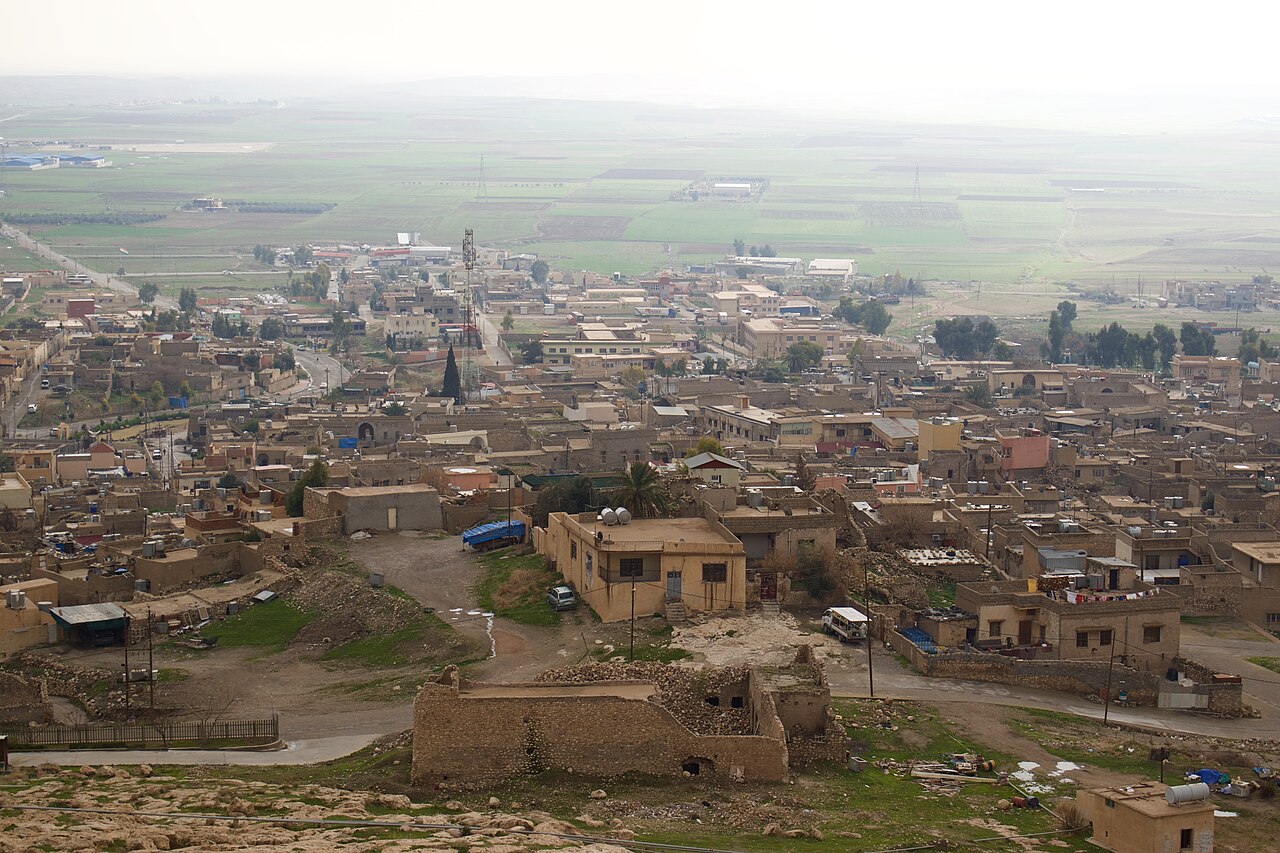
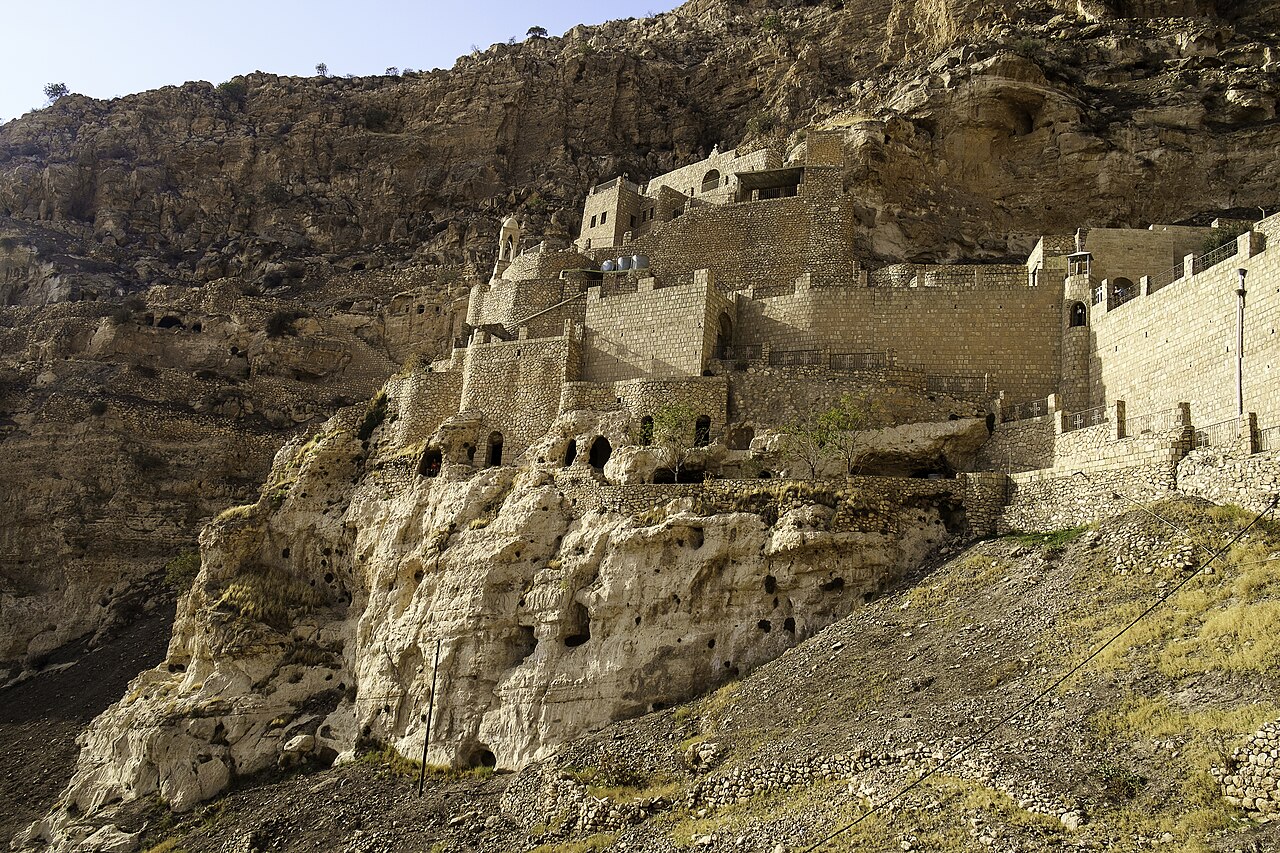
Alqosh lies at the foot of a mountain range in northern Iraq, in Nineveh province, roughly 45 kilometres north of Mosul. The conservation company GEMA ART identifies it as an Assyrian town. [1] Its Chaldean monastic institutions and Syriac book culture form major parts of its documented history. [2] The modern photographs show a built settlement and the monastery’s rocky setting; they cannot establish a continuous history extending to a particular year in antiquity. [5] [6]
Rabban Hormizd and Our Lady of the Seeds
The monastery of Rabban Hormizd stands in the mountains above Alqosh. Grigory Kessel’s manuscript research traces a particular revival to Gabriel Danbo, who gained control of the abandoned monastery in 1808 to establish a new community. Education of clergy was a central aim, with philosophy and logic among the subjects taught. [2] The nearby monastery of Our Lady of the Seeds, built in 1858, later offered the community a more secure setting. [2] These are distinct institutions and building histories; the nineteenth-century revival is not the foundation date of the older mountain monastery.
A scribal centre with named witnesses
A CNRS manuscript catalogue records a Syriac codex copied in 1672 by the priest Abdisho, son of the priest Hormizd and grandson of the priest Israel of Alqosh. Its production moved between the church of Mar Mikha in the town and Rabban Hormizd monastery, at Mar Eliya’s request. [3] Such records link people, places and books more precisely than a general claim that the town preserved learning. Kessel shows how nineteenth-century monastic teaching likewise depended on existing books, local professional scribes and new copies. [2]
Nahum: a devotional tradition and a historical question
The shrine associated with the biblical prophet Nahum is a separate landmark. In her study of Syriac Christian history, Heleen Murre-van den Berg discusses a 1729 Alqosh manuscript colophon that calls the settlement Nahum’s village and names the nearby monastery. She interprets this language as connecting the local community with biblical history. [4] It documents a meaningful local tradition. The identification of the prophet’s biblical home, and the claim that his remains lie at this shrine, should not be treated as established archaeological facts.
What conservation involved
GEMA ART’s own project account dates its Nahum shrine work to 2018–21, beginning with surveys in January 2018. It describes photogrammetric recording, a three-dimensional model, emergency support, rubble clearance and documentation of significant fragments. Later work included foundations, cracked masonry, columns, vaults, roofing and drainage, alongside inscriptions, timber and metalwork. [1] These details explain what preserving a monument requires: recording vulnerable fabric, stabilizing it and protecting it from further damage. Restoration of the building safeguards a historical place without resolving the attribution of a biblical burial.
Sources and further reading
- GEMA ART International, Prophet Nahum Shrine, Iraq: conservator’s project account, 2018–2021; location, surveys and structural conservation.
- Grigory Kessel, Field Notes on Syriac Manuscripts IV, Hugoye 26.1 (2023): Rabban Hormizd revival, education and manuscript production.
- CNRS IRHT, Erbil-Ankawa O.A.O.C. syr. 194: direct-observation catalogue, copying history, Alqosh and Rabban Hormizd, 1672.
- Heleen Murre-van den Berg, A History of Syriac Christianity, Part II, Cairo Journal of Theology 6 (2019), pp. 29–31: scribes, colophons and the Nahum tradition.
- Levi Clancy, Sunset over a stormy alQosh 17, 24 February 2018, photograph, CC0.
- Hardscarf, Rabban Hormizd Monastery—view from below, 18 October 2016, photograph, CC BY-SA 4.0.