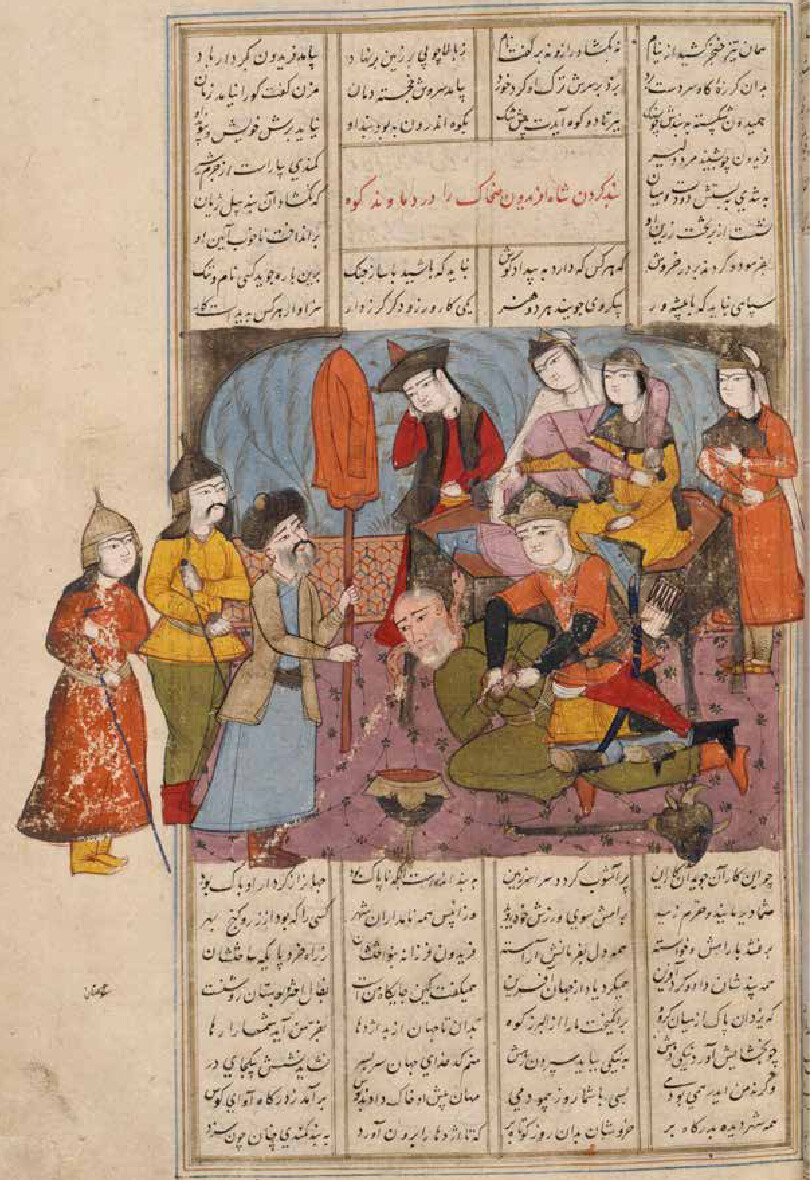
The Derafsh-e Kaveyani: The Banner of Kawa
- Sherko Sabir

- 1 hour ago
- 11 min read

Introduction
Few symbols in the Iranian world carry so deep a meaning as the Derafsh-e Kaveyani, the legendary Banner of Kawa. Born, in the tale, from the humble leather apron of Kawa the blacksmith, raised upon a spear as the rallying-sign of his revolt against the serpent-tyrant Zahhak, it became in time the jewelled royal standard of ancient Iran, an emblem at once of resistance to tyranny and of legitimate sovereignty.
The story of the banner is inseparable from the most beloved of all the rebellion-tales of the Shahnameh: the rising of the common smith against the monstrous king, and the raising up of the rightful sovereign Faridun in his place. From the toil-stained apron of a workman to a banner ablaze with gold and gems, the Derafsh-e Kaveyani embodies the passage from oppression to freedom, and the triumph of the people and their rightful king over the tyrant.
Belonging to the shared heritage of the Iranian peoples, a tradition the Kurds hold in common with the Persians and others of the Iranic world, the Banner of Kawa carries a special resonance for the Kurds, among whom the figure of the rebel blacksmith is most especially cherished. To know the Derafsh-e Kaveyani is to know one of the great symbols of the Iranian past, a standard that joined the humble and the royal, the workman's apron and the king's jewels, into a single emblem of justice, freedom and sovereignty.
Contents
What Was the Derafsh-e Kaveyani?
The Derafsh-e Kaveyani, meaning the Standard of Kawa or of the Kayan kings, was the legendary royal banner of ancient Iran, identified in tradition with the leather apron of Kawa the blacksmith. According to the Shahnameh, Kawa raised his blacksmith's apron upon a spear as the standard of his revolt against the tyrant Zahhak, and when the rightful king Faridun came to the throne he adorned the apron with gold, brocade and precious gems, making it the imperial standard. As the Derafsh-e Kaveyani it served, in legend and in history, as the royal flag of pre-Islamic Iran, above all in the Sasanian age, until it was lost at the time of the Arab conquest.
The Apron of the Blacksmith
The origin of the banner lies in the most famous act of Kawa the blacksmith, the hero of the great rebellion against the serpent-tyrant Zahhak. In the tale, Zahhak, with two serpents growing from his shoulders that had to be fed with the brains of the young, had devoured the children of his people, among them the sons of Kawa. When the tyrant's servants came at last for Kawa's youngest son, the smith's grief turned to fury, and he rose in open revolt.
As the sign of his rebellion, Kawa took the simple leather apron that he wore at his forge, the humble badge of his trade and his toil, and raised it high upon the point of a spear. This rough workman's apron, lifted as a banner, became the rallying-sign of the uprising. The image spoke directly to the oppressed, for it was the emblem of the common man and of his labour, and beneath it the people flocked to Kawa's side. So the most ordinary of objects, a blacksmith's apron, became through that act of defiance the seed of the most glorious banner of the Iranian world, the symbol around which a people rose to throw off their tyrant.
Key Takeaways
The Derafsh-e Kaveyani was the legendary royal banner of ancient Iran.
It began as the leather apron of Kawa the blacksmith, raised in revolt.
Kawa raised it against the serpent-tyrant Zahhak.
Faridun adorned it with gold, brocade and jewels as the royal standard.
It served as the imperial flag of pre-Islamic Iran, notably the Sasanians.
It was lost to the Arab conquest in the seventh century.
Quick Facts
Name: Derafsh-e Kaveyani (the Standard of Kawa / of the Kayan)
Origin: The leather apron of Kawa the blacksmith
Raised against: The tyrant Zahhak
Adorned by: Faridun, who added gold, brocade and gems
Colours: Tassels of red, yellow (or blue), and violet
Role: The royal standard of pre-Islamic Iran
Chief era: The Parthian and especially Sasanian empires
Source: The Shahnameh; also Tabari, Bal'ami, Biruni
Meaning: Resistance to tyranny; justice; legitimate sovereignty
Fate: Captured and destroyed at the Arab conquest (7th c.)
From Apron to Royal Standard
The transformation of the humble apron into a royal banner is the heart of the legend. When the revolt of Kawa had triumphed and the rightful prince Faridun had been raised to the throne in place of the fallen Zahhak, the new king recognised the immense symbolic power of the banner under which the people had rallied. Rather than discard the rough apron, he honoured it, transforming it into a standard worthy of a king.
Faridun had the apron adorned with gold, with rich brocade, and with precious gems, and hung from it tassels of red, yellow or blue, and violet. He named it the Derafsh-e Kaveyani, the Standard of Kawa, in honour of the smith whose defiance it commemorated. Thereafter, the tradition tells, each succeeding king added his own jewels to the banner, until it blazed with such splendour that even in the darkness of night it shone like the sun. So the workman's apron became the most magnificent of royal standards, yet it never lost the memory of its origin, remaining always the Banner of Kawa, a king's treasure that had begun as a blacksmith's badge of toil. In this union of the humble and the royal lay much of its enduring power as a symbol.
The Banner of the Kings
As the Derafsh-e Kaveyani, the banner became the supreme royal standard of Iran, passed down through the legendary dynasties of the Shahnameh from the time of Faridun onward. It is associated in the tradition not only with Kawa and Faridun but with the glory of the ancient kings reaching back to Jamshid, and it stood as the emblem of legitimate Iranian kingship, the standard borne before the rightful sovereign and his armies.
The banner thus came to embody the very idea of legitimate rule. To march beneath the Derafsh-e Kaveyani was to fight in the cause of the rightful king and of the order and justice that his kingship upheld; the standard was the visible sign of the divine glory and legitimacy of the throne. In the long wars of the epic, the great heroes and champions of Iran rallied to this banner, and its presence on the field marked the army of the true king. As the emblem of legitimate sovereignty, descended from the rebellion that had overthrown a tyrant and raised up a just king, the Derafsh-e Kaveyani carried in itself the whole story of the triumph of right over oppression.
The Historical Standard
Beyond the world of legend, the Derafsh-e Kaveyani was also a real historical banner, the royal standard of the pre-Islamic Iranian empires. It is associated above all with the Sasanian Empire, which ruled Iran from the third to the seventh century and which bore the Derafsh-e Kaviani as its imperial flag, and traditions connect it with the earlier Parthian age as well. The legendary origin in Kawa's apron and the historical royal standard were understood as one and the same banner, the myth giving the historical flag its meaning and its prestige.
The historical sources describe the banner as large and square, richly decorated and radiant with gold and jewels. In time of peace it was kept safe in the royal treasury, and in war it was brought forth and carried before the army, entrusted to the commander-in-chief of the Iranian forces, and borne at the very forefront when the king himself marched to battle. Its presence was a focus of the army's courage and a sign of the king's authority. Beyond the Shahnameh, early historians and scholars of the Islamic period, such as Tabari, Bal'ami and Biruni, recorded the story and the splendour of the banner, a sign of how deeply it was woven into the memory of the Iranian past.
The Loss of the Banner
The long history of the Derafsh-e Kaveyani came to an end with the fall of the Sasanian Empire before the Arab conquest in the seventh century. In the great battles in which the Sasanian armies were defeated, the imperial banner was captured by the conquerors. The tradition records that the magnificent standard, with its gold and its priceless jewels, was taken as spoil, stripped of its treasures, and destroyed, its jewels divided among the victors.
The loss of the Derafsh-e Kaveyani became, in later memory, a poignant symbol of the fall of the old Iranian world and the passing of its ancient glory. The banner that had flown since the days of Faridun, that had embodied the sovereignty and the legitimate kingship of Iran for so many centuries, was gone, and with it an age of the world. Yet the memory of the banner endured, preserved in the Shahnameh and in the histories, so that the Derafsh-e Kaveyani lived on as a symbol even after the physical banner had perished, a lasting emblem of the Iranian past and of the ideals it had represented.
Symbolism and Meaning
The Derafsh-e Kaveyani is one of the richest of symbols, uniting several great meanings in a single emblem. Born from the revolt of Kawa against Zahhak, it is above all a symbol of resistance to tyranny and of the triumph of justice and freedom over oppression. As the apron of a common workman raised in defiance, it is an emblem of the people and of their power, when roused, to overthrow even the mightiest tyrant. And as the standard of the rightful king, it is the sign of legitimate sovereignty and just rule.
Its deepest power lies perhaps in the union of these meanings, in the image of the humble apron transformed into the king's jewelled banner. For the Derafsh-e Kaveyani joins the common man and the rightful king in a single symbol, suggesting that true and legitimate kingship rests upon the people and upon justice, and that the throne is bound to the cause of the oppressed against the tyrant. To contemplate the Banner of Kawa is to contemplate a whole vision of just rule and righteous resistance, an emblem in which the toil of the workman and the glory of the king are joined, and which carries forever the memory of a people who rose against tyranny and won their freedom.
The Banner and the Kurds
The Derafsh-e Kaveyani belongs to the shared heritage of the Iranian peoples, the tradition of the Shahnameh and of the ancient Iranian world that the Kurds hold in common with the Persians and others. As the royal standard of pre-Islamic Iran, it is, in its historical character, a symbol of Iranian sovereignty broadly rather than of any one of the Iranian peoples alone. Yet it carries a special resonance for the Kurds, because it springs from the legend of Kawa the blacksmith, the rebel hero whom the Kurds especially cherish and whose revolt is linked in Kurdish tradition to the festival of Newroz.
For the Kurds, the figure of Kawa rising against the tyrant is among the most beloved of all the tales of the heroic past, a story of resistance and freedom that resonates deeply with the Kurdish experience. The banner born of Kawa's apron thus holds a natural place of honour in the Kurdish imagination as the standard of that beloved rebellion, even as it belongs, historically, to the wider Iranian heritage. It is honest to recognise both truths: that the Derafsh-e Kaveyani was the royal flag of the ancient Iranian empires as a whole, and that, as the Banner of Kawa, it carries for the Kurds a particular and cherished meaning, bound up with the figure of the rebel smith and the ideals of justice and freedom that his story embodies.
Debates and Misconceptions
Was the Derafsh-e Kaveyani a specifically Kurdish flag? No; it is most accurate to understand it as the royal standard of the ancient Iranian empires as a whole, a symbol of pre-Islamic Iranian sovereignty shared across the Iranian peoples, rather than as a flag of any one of them. Its special meaning for the Kurds comes through its origin in the legend of Kawa, a hero the Kurds especially cherish, rather than through the banner itself being uniquely Kurdish. The honest framing honours both the shared Iranian character of the historical standard and the particular Kurdish love of the Kawa legend from which it springs.
Was the banner really just a leather apron? In the legend, yes: its origin was the humble leather apron of the blacksmith, and this humble origin is central to its meaning. But the banner that became the royal standard was, of course, far more, transformed by Faridun and successive kings into a magnificent jewelled flag. The power of the symbol lies precisely in the contrast and the continuity between the two: the king's glorious standard never ceased to be, in memory, the workman's apron, and that is the heart of its meaning.
Is the story of the banner history or legend? It is both, intertwined. The Derafsh-e Kaveyani was a real historical standard of the pre-Islamic Iranian empires, attested in the histories and lost at the Arab conquest. But its origin in the apron of Kawa belongs to the legendary world of the Shahnameh. The tradition wove the historical royal banner together with the beloved legend of the rebel smith, so that the myth gave the real flag its meaning. It is best appreciated as a symbol in which history and legend are joined, rather than as a simple record of fact.
Related Topics
Kawa the Blacksmith: the rebel smith whose apron became the banner
Zahhak: the serpent-tyrant against whom the banner was raised
Faridun: the king who made the apron into the royal standard
Jamshid: the ancient king with whose glory the banner is linked
Newroz: the festival linked to Kawa's revolt in Kurdish tradition
Qaren: the warrior son of Kawa, of the line honoured with the banner
The Shahnameh: the epic in which the banner's legend is told
Frequently Asked Questions
What was the Derafsh-e Kaveyani?
The Derafsh-e Kaveyani, meaning the Standard of Kawa, was the legendary royal banner of ancient Iran. According to the Shahnameh, it began as the leather apron of Kawa the blacksmith, raised on a spear as the sign of his revolt against the tyrant Zahhak. The king Faridun later adorned it with gold and jewels, and it became the imperial standard of pre-Islamic Iran, borne especially by the Sasanian Empire until the Arab conquest.
How did the banner originate?
In the legend, when the tyrant Zahhak's servants came for the last of his sons, Kawa the blacksmith rose in revolt and raised his leather work-apron upon a spear as the banner of his uprising. The humble apron, the badge of the common workman, became the rallying-sign under which the people gathered to overthrow Zahhak. When the rightful king Faridun came to the throne, he honoured the apron by transforming it into a jewelled royal standard.
Why was it called the Standard of Kawa?
It was named the Derafsh-e Kaveyani, the Standard of Kawa, in honour of Kawa the blacksmith, whose leather apron had been the original banner of the revolt against Zahhak. Even after Faridun adorned it with gold and gems and it became the magnificent royal standard of Iran, it kept the memory of its origin in the smith's apron, remaining always the Banner of Kawa. The name also carries the sense of the standard of the Kayan, the kings.
What happened to the Derafsh-e Kaveyani?
The banner was lost at the fall of the Sasanian Empire before the Arab conquest in the seventh century. When the Sasanian armies were defeated, the imperial standard was captured as spoil, stripped of its gold and priceless jewels, and destroyed, its treasures divided among the victors. Its loss became a poignant symbol of the fall of the ancient Iranian world, though the memory of the banner endured in the Shahnameh and the histories.
Is the Derafsh-e Kaveyani a Kurdish symbol?
It is most accurately understood as the royal standard of the ancient Iranian empires as a whole, a symbol of pre-Islamic Iranian sovereignty shared across the Iranian peoples. It carries a special resonance for the Kurds, however, because it springs from the legend of Kawa the blacksmith, a hero the Kurds especially cherish and whose revolt is linked in Kurdish tradition to Newroz. Both truths are honest: a shared Iranian standard, with a particular Kurdish meaning through Kawa.
Was the banner real or legendary?
Both, intertwined. The Derafsh-e Kaveyani was a real historical standard of the pre-Islamic Iranian empires, attested in early histories and lost at the Arab conquest. But its origin in the apron of Kawa belongs to the legendary world of the Shahnameh. The tradition wove the historical royal banner together with the beloved legend of the rebel smith, so that the myth gave the real flag its meaning and prestige.
References and Further Reading
Comments