Modern Elazığ developed on the plain below historic Harput in the nineteenth century. Reading the two settlements together reveals changing administration, Armenian education and genocide, Syriac and Islamic monuments, Kurdish political history and a landscape shaped by geology.
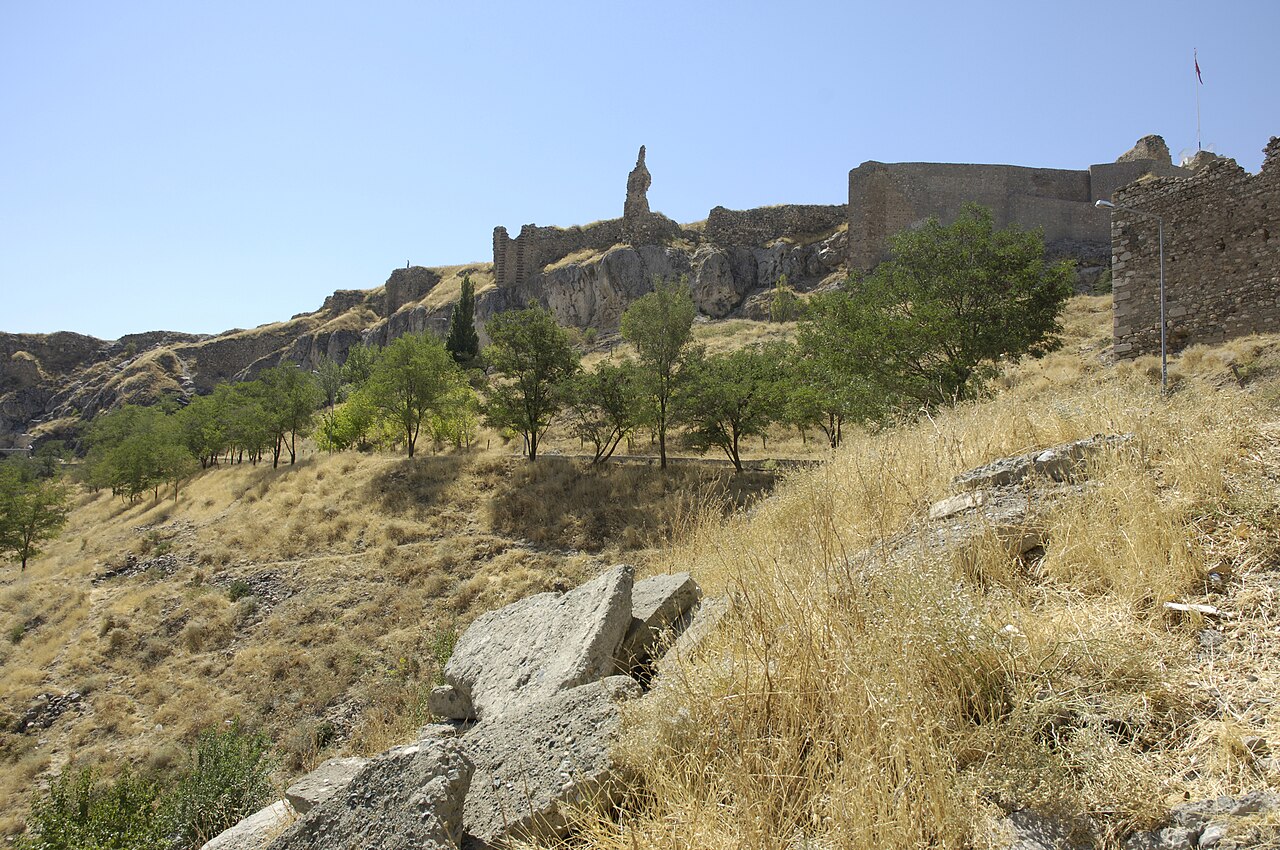

Harput above, Elazığ below
Elazığ is the modern provincial capital on the plain below Harput, the older fortified settlement in the Upper Euphrates region of eastern Turkey. They are connected places with different urban histories. A 2026 geological study places Harput roughly four kilometres northeast of the modern centre and explains the conspicuous height difference through the Elazığ Fault and resistant rock formations. “Harput,” Armenian “Kharpert,” the modern city and the wider province must be distinguished when interpreting a school photograph, a population figure or an account of political unrest. [1] [4]
How administration moved onto the plain
Murat Çelikdemir’s archival study dates the move towards Mezra, or Agavat Mezrası, to Governor Mehmet Reşit Pasha’s administration in 1834. Officials governed from the lower settlement; administrative buildings came first, followed by other construction and migration from Harput. This was a process, not the sudden replacement of every resident on a single day. The new centre received the name Mamuretülaziz in 1867 in reference to Sultan Abdülaziz. Metin Tuncel records the railway branch reaching Elazığ on 8 August 1934 and the adoption of the spelling Elazığ in December 1937. [2] [3]
Stone, worship and preservation
Harput’s castle occupies an erosion-resistant limestone prominence surrounded by valleys that provided natural defence. Kayğılı, Özkul and Aksoy identify sandstone and calcarenite from the local Kırkgeçit Formation as extensively used building materials; the monuments contain different stones and construction phases. Their survey includes Ulu Mosque, Sarahatun Mosque, baths, houses and the Syriac Meryem Ana church. A monument’s religious association should not make every surviving wall the same age. Türkiye submitted Historic City of Harput to UNESCO’s Tentative List on 2 May 2018. Tentative-list submission is a preliminary step, not inscription as a World Heritage property. [1] [7]
Armenian education was part of everyday life
Harput’s Armenian history includes substantial educational institutions, rather than only an account of their destruction. Houshamadyan’s research combines school catalogues, photographs and Armenian memorial books. It dates Euphrates College’s foundation to 1878 and records pupils arriving from the surrounding plain and other towns. Donabed Lulejian studied at Yale and Cornell before teaching natural sciences and biology. Ashur Yussef, an Assyrian teacher, taught calligraphy and classical Armenian. These named careers reveal overlapping languages and communities, international educational connections and work carried out locally. [4]
1915: deportation and genocide
The Armenian genocide destroyed much of this social world. Contemporary diplomatic evidence makes that rupture explicit. On 10 July 1915, Ambassador Henry Morgenthau cabled Washington about organized persecution, quoting Consul Leslie Davis’s reports of torture and deportation at Harput. The Near East Relief Historical Society presents this National Archives document with its provenance. Clark University’s Guerguerian Archive also indexes Davis’s reports and eyewitness testimony from the Harput area. These records concern coercion and killing; describing the change simply as voluntary migration would conceal what the evidence documents. [5] [6]
Palu, Kurdish history and the 1925 uprising
The wider province connects this urban story to Kurdish political history through Palu and Sheikh Said. Zekeriya Kurşun describes Said’s Zaza background, Naqshbandi-Khalidi religious family and educational work in Palu and Hınıs. His account dates the capture of Elazığ by rebels to 24 February 1925. Religious authority, tribal relations and opposition to the new republic intersected in the uprising; those networks should not be reduced to a present-day ethnic percentage for the city. Harput’s monuments and Elazığ’s growth can be understood alongside this conflict without making one episode stand for every community’s history. [8]
Sources and further reading
- Sibel Kayğılı, Mehmet Özkul and Ercan Aksoy, “Geological and Cultural Heritages of Harput Old City (Elazığ, Eastern Türkiye),” Geoheritage 18, article 24 (17 January 2026), DOI 10.1007/s12371-025-01244-9: topography, geology, building stones and monument survey.
- Murat Çelikdemir, “Harput’un Elazığ’a Nakli,” Fırat Üniversitesi Sosyal Bilimler Dergisi 29/2 (2019), pp. 425–430, DOI 10.18069/firatsbed.548613: archival study of the 1834 relocation process and 1867 naming.
- Metin Tuncel, “Elazığ: Bugünkü Elazığ,” TDV İslâm Ansiklopedisi 10 (1994): railway arrival and 1937 name changes. This citation concerns that modern geographical section.
- Houshamadyan, Harput, Schools (Part I): original reconstruction using Euphrates College catalogues, photographs and Armenian memorial books; foundation, students and named teachers.
- Henry Morgenthau, telegram 841 to Secretary of State Robert Lansing, 10 July 1915, U.S. National Archives RG 59, presented by Near East Relief Historical Society: contemporary reporting including Consul Davis’s Harput evidence.
- Clark University, Krikor Guerguerian Archive, “01 Appendix A–Q” (2018), institutional sponsor Taner Akçam: catalogue and digitized collection of consular reports and eyewitness testimony.
- UNESCO World Heritage Centre, Historic City of Harput, Tentative List reference 6349, submitted by Türkiye on 2 May 2018. Used for submission status, not as independent validation of all historical claims in the nomination.
- Zekeriya Kurşun, “Şeyh Said,” TDV İslâm Ansiklopedisi (2019): Palu, Zaza family background, religious networks and the 24 February 1925 capture of Elazığ.
- Dosseman, Harput general view in 2006 1104, 9 September 2006, CC BY-SA 4.0 photograph, Wikimedia Commons.