Haft Tan, also written Haftan, names a group of seven holy beings in Yarsani and Kaka‘i traditions. Their identities are understood through sacred narratives and recurring manifestations. Accounts vary, so the Seven Companions should be distinguished from other groups of seven and from a universally fixed list.
What the name refers to
Haft Tan is commonly rendered Seven Persons or Seven Companions. Karol Kaczorowski’s overview distinguishes them from the Haftawana, the Seven Sons, and the Haft Khalifa, the Seven Vicars. These terms concern different sacred and social relationships, despite sharing a number. [1] Heinz Halm likewise describes divine manifestations accompanied by sacred figures, rather than one straightforward biography of seven ordinary disciples. [2] A summary needs to identify the particular community or scholarly account it follows.
Named figures and differences between accounts
Kaczorowski gives a commonly cited list: Benyamin, Dawud, Pir Musi, Mustafa Daudani, Baba Yadgar, Ramzbar and Shah Ebrahim. Ramzbar is identified as a female spirit. He also notes that some accounts count Sultan Sahak among the Seven. [1] Martin van Bruinessen’s Guran fieldwork records disagreement over Shah Ebrahim’s status, including whether he belongs to the Haft Tan and how he relates to Baba Yadgar. [3] This variation cannot be resolved by declaring Sultan plus six companions the only correct membership.
Creation and recurrence
Philip Kreyenbroek describes a creation narrative in which God forms a pearl containing the world in embryonic form, then creates Seven Beings. A first sacred assembly, or jam, and sacrifice precede the pearl’s opening. In later sacred periods, divine essences appear in human forms. The term dowre refers to such a period, while dunaduni expresses movement from form to form. [4] These are accounts of religious belief, rather than archaeological descriptions of the beginning of the world.
The Haft Tan and spiritual lineages
Jean During distinguishes the Haftan from the Haftawana in discussing how spiritual authority and hereditary religious families are explained. His survey notes traditions in which the companions have no descendants and authority passes through the second hierarchy. [5] Van Bruinessen records both complementary and oppositional interpretations of the two groups among people he met in Guran. [3] The difference therefore cannot be reduced to a universal chart of good and evil. It also concerns how communities understand sacred authority and their own lineages.
How the narratives are transmitted
Kreyenbroek shows how sacred poetry, oral explanation, manuscripts and printed collections work together. Knowledge of earlier periods and the identities of recurring beings helps listeners understand the allusions in kalams. Literary Gurani is especially important, alongside texts in other languages. He also documents differences between published collections in ordering and selection. [4] The Saranjam is consequently better approached as a transmitted textual heritage than as a single unchanged book containing an identical list for every community.
Comparison without making religions identical
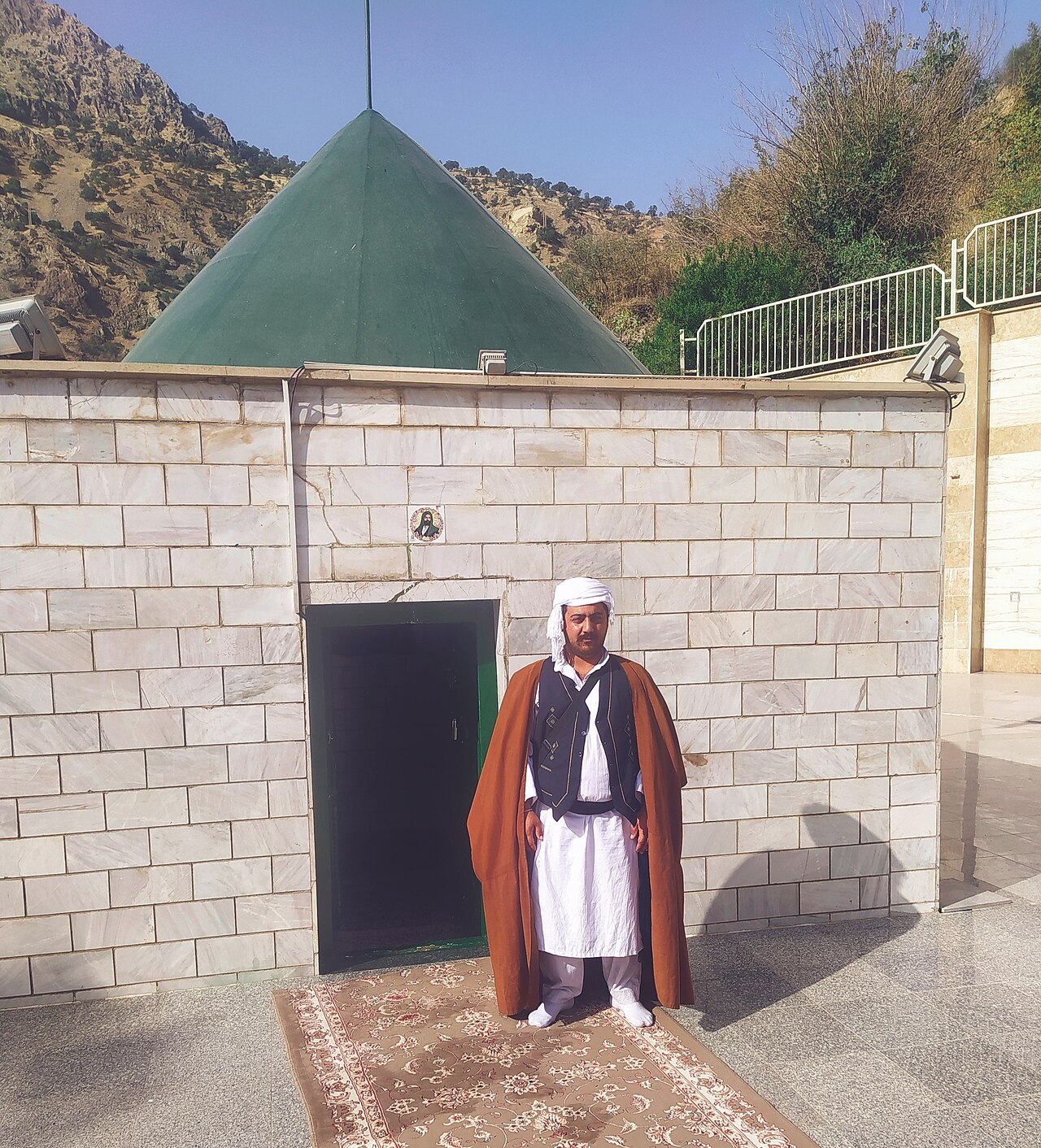
Halm discusses Islamic and Shi‘i motifs as well as locally rooted Gurani narratives. [2] During’s critical survey stresses the difficulties of generalising from particular texts and communities, and reports how followers explain their own tradition. [5] Comparisons with Yazidi or Zoroastrian groups of holy beings can raise useful questions, but a shared number does not by itself establish identical names, rituals or a proven line of descent. The photograph here is likewise specific: it shows a modern shrine visit, while the identity of the sacred Seven is explained through the sources.
Sources and further reading
- Karol Kaczorowski, Ahl-e Haqq (Yarsanism), Alevi Encyclopedia, 5 October 2025; groups of seven, names and regional variation.
- Heinz Halm, Ahl-e Ḥaqq, Encyclopaedia Iranica I/6 (1984), pp. 635–637; sacred manifestations and religious narratives.
- Martin van Bruinessen, Veneration of Satan among the Ahl-e Haqq of the Gûrân Region, Fritillaria Kurdica 3–4 (2014), pp. 6–41, especially 21–22; differences recorded in Guran fieldwork.
- Philip G. Kreyenbroek, The Religious Textual Heritage of the Yārsān (Ahl-e Haqq), Oral Tradition 35/2 (2022), pp. 331–340; creation, recurrence and transmission.
- Jean During, A Critical Survey on Ahl-e Haqq Studies in Europe and Iran, in Alevi Identity (1998), pp. 105–126; manuscripts, perspectives and spiritual hierarchies.
- Molla Qasem (ملا قاسم), visitor at Sultan Sahak’s shrine, 24 June 2022; original photograph, CC BY-SA 4.0, Wikimedia Commons.