top of page

Hojir: Castellan of the White Fortress

Illustrated banner of Kurdish and Iranic heritage evoking Hojir, hero of the House of Gudarz and castellan of the White Fortress in the Shahnameh, alongside the Newroz fire, the Simurgh and the tanbur


Introduction


Hojir is a hero of the House of Gudarz in the Shahnameh, the Persian Book of Kings, remembered above all for his fateful role in the greatest of the epic's tragedies, the tale of Rostam and Sohrab. A son of the patriarch Gudarz and a brother of the mighty Giv, Hojir was the castellan of the White Fortress upon the border of Iran and Turan, a loyal champion whose silence, at a crucial moment, helped to seal a father's tragic doom.


When the young hero Sohrab, in truth the son of Rostam, invaded Iran and came to the White Fortress, it was Hojir who rode out to meet him, only to be defeated and taken captive. And it was Hojir who, when the captive was asked by Sohrab to point out Rostam among the Iranian leaders, refused to reveal which of them was the great hero, fearing that Sohrab meant to kill his father. This refusal, born of loyalty, became one of the fatal turns of the tragedy, for it kept father and son from knowing one another until it was too late.


Like all the heroes of the Book of Kings, Hojir belongs to the shared epic heritage of the Iranian peoples, a tradition the Kurds hold in common with the Persians, the Lurs, and others of the Iranic world. To know Hojir is to know one of the worthy champions of the House of Gudarz, and to encounter the fateful part that even a loyal and well-meaning hero can play in the unfolding of a great tragedy. His silence before Sohrab is among the most consequential moments of the epic's most sorrowful tale.


Contents


Who Is Hojir?


Hojir, also spelled Hujir, is an Iranian hero of the Shahnameh, a member of the great House of Gudarz. He is the son of Gudarz and the brother of the famed heroes Giv, Bahram, and Rohham. Hojir first appears in the tragic story of Rostam and Sohrab, where he serves as the castellan of the White Fortress, Dezh-e Sepid, upon the border of Iran and Turan. When the young hero Sohrab attacks the fortress, Hojir rides out to fight him but is defeated and taken prisoner. Most memorably, when Sohrab, seeking to recognize his father Rostam, asks the captive Hojir to identify the Iranian leaders, Hojir refuses to point out Rostam, fearing that Sohrab intends to kill him, a fateful silence that helps to seal the tragedy. He appears also in the Battle of the Twelve Rooks, where he slays a Turanian foe. He is remembered as a loyal champion of the House of Gudarz whose role in the tale of Sohrab is among the most consequential in the epic.


Hero of the House of Gudarz


Hojir belongs to the House of Gudarz, one of the most prominent and celebrated warrior-families of the Shahnameh, famed for its loyalty and its many champions in the service of Iran. He is a son of the patriarch Gudarz son of Kashvad, and so a brother of some of the greatest heroes of the epic: the mighty Giv, the loyal Bahram, and the valiant Rohham, among the many sons and descendants of the house.


As a member of this great family, Hojir shares in its character of loyalty and devotion to Iran, and takes his place among the band of brothers and kinsmen who served the Iranian cause across the wars of the heroic age. Though he is not among the very foremost heroes of the epic, and is sometimes portrayed as more cautious or short-sighted than his mighty brothers, he is nonetheless a worthy champion of the House of Gudarz, a loyal warrior who plays his part in the great tales of the Iranian wars. His membership in this illustrious house places him within the dense web of heroic kinship that fills the Shahnameh, the sons of Gudarz fighting together in the service of their kings and their land. Hojir's identity is bound up with his place in this family of heroes, and it is as a son of Gudarz and a brother of Giv that he appears in the epic, taking part in its great tales, and above all in the fateful tragedy of Rostam and Sohrab.


Key Takeaways


  • Hojir is an Iranian hero of the House of Gudarz in the Shahnameh.

  • He is the son of Gudarz and brother of Giv, Bahram, and Rohham.

  • He was castellan of the White Fortress (Dezh-e Sepid) on the Iran-Turan border.

  • He was defeated and captured by the young hero Sohrab.

  • He refused to point out Rostam to Sohrab, helping to seal the tragedy.

  • He also fought in the Battle of the Twelve Rooks, slaying a Turanian foe.


Quick Facts


  • Name: Hojir (also Hujir)

  • Role: Hero of the House of Gudarz; castellan of the White Fortress

  • Father: Gudarz, patriarch of the house

  • Brothers: Giv, Bahram, and Rohham

  • Fortress: Dezh-e Sepid, the White Fortress, on the border

  • Captured by: Sohrab, son of Rostam

  • Famous for: Refusing to point out Rostam to Sohrab

  • Significance: His silence helped seal the tragedy of Sohrab

  • Later deed: Slew the Turanian Sepahram in the Twelve Rooks

  • Heritage: Shared Iranic epic tradition


Castellan of the White Fortress


Hojir first appears in the epic as the castellan, or commander, of the White Fortress, known in Persian as Dezh-e Sepid, a stronghold of Iran upon the frontier with Turan. This fortress was a vital bulwark of Iran's eastern border, a key defensive position guarding against incursions from Turan, and its command was entrusted to Hojir, a champion of the House of Gudarz, together with the veteran commander Gazhdaham and his household.


It was to this frontier fortress that the young hero Sohrab, the son of Rostam by the princess Tahmineh, came at the head of an invading army, seeking, in part, to find his father and to overturn the order of Iran and Turan. The White Fortress, as the first great obstacle on Sohrab's path, became the setting for the opening of the tragedy, the place where the young hero's invasion first met the defence of Iran. As its castellan, Hojir stood as the first champion of Iran to face the mighty young invader, and it was here, at the White Fortress, that the chain of events leading to the great tragedy of Rostam and Sohrab began to unfold. The fortress is also the setting for the famous episode of the warrior-woman Gordafarid, the daughter of Gazhdaham, who took up arms after Hojir's defeat. Hojir's role as castellan of this border stronghold places him at the very beginning of one of the epic's central and most sorrowful tales.


Defeat and Capture by Sohrab


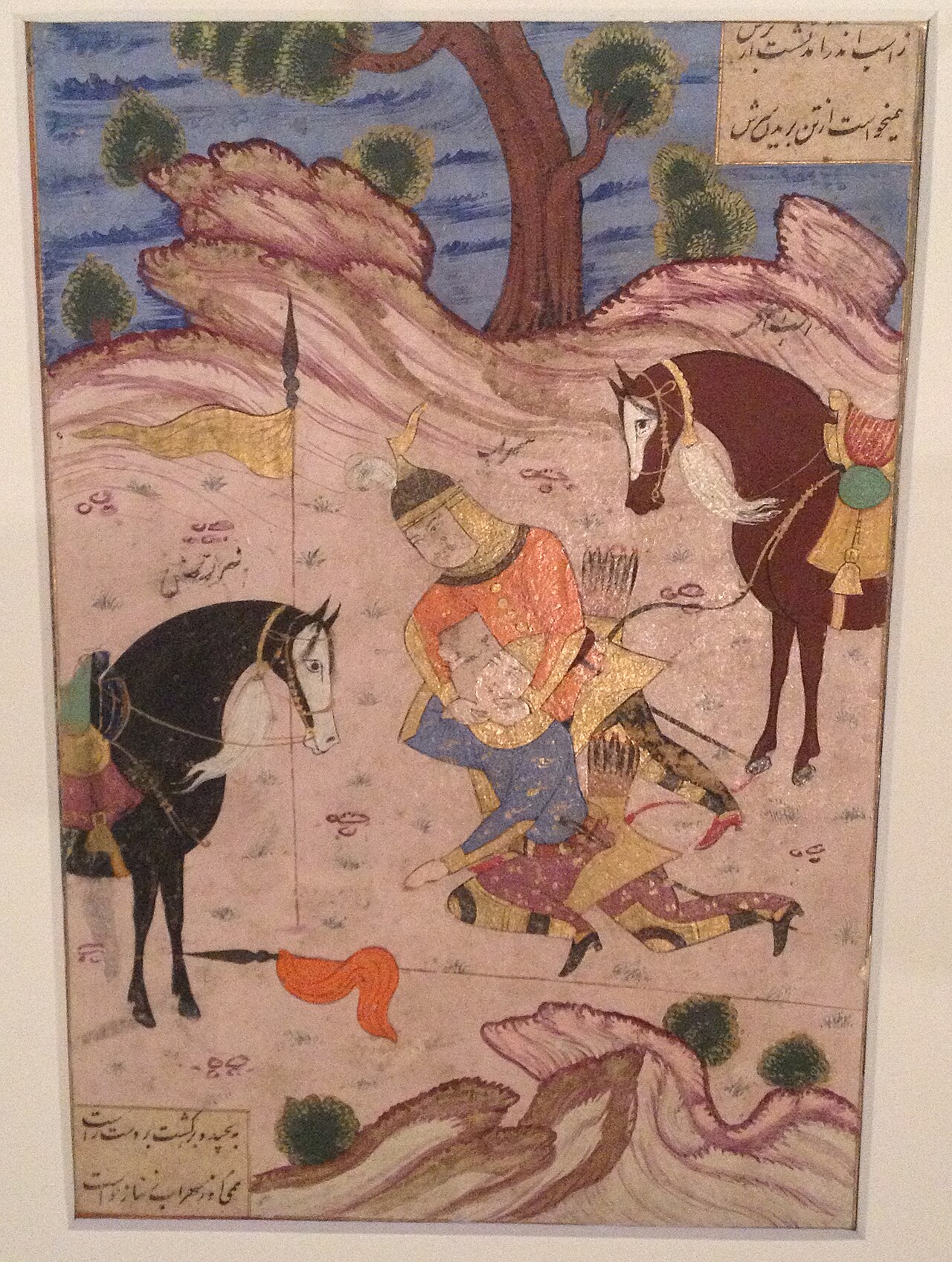
When the young Sohrab and his army arrived before the White Fortress, it was Hojir who rode out to meet the invader in single combat, as the castellan and champion of the stronghold. But Sohrab, though young, was a hero of tremendous strength, the son of the mighty Rostam, and in the combat he overcame Hojir, defeating the Iranian champion. Yet Sohrab did not kill his captive; instead, he took Hojir prisoner.


The defeat and capture of Hojir is the opening blow of the tale, demonstrating at once the formidable power of the young Sohrab and setting the stage for the events that follow. With the castellan defeated and taken, the White Fortress was left in peril, and it was then that the warrior-woman Gordafarid, daughter of Gazhdaham, donned armour and rode out to challenge Sohrab, buying time for the fortress in one of the epic's most celebrated episodes. Hojir, meanwhile, remained Sohrab's captive, and it is in this condition, as the prisoner of the young hero, that he would play his most fateful role. The capture of Hojir, the first Iranian champion to fall before Sohrab, marks the beginning of the young hero's invasion and the unfolding of the tragedy, and it places Hojir in the position from which his most consequential act, his refusal to identify Rostam, would follow. Though defeated, Hojir's part in the tale was far from over, for his captivity set the stage for the fateful silence to come.


The Fateful Silence


Hojir's most memorable and most consequential act in the epic is his refusal, as Sohrab's captive, to point out Rostam among the leaders of the Iranian army. The young Sohrab, who had been told by his mother Tahmineh that his father was the great Rostam, and who longed to find and recognize him, sought to use his captive Hojir to identify the Iranian champions, and above all to point out Rostam. He brought Hojir to a vantage point and asked him to name the leaders of the Iranian host.


But Hojir, when asked to identify Rostam, refused to reveal which of the Iranian leaders was the great hero. Fearing that the mighty young invader meant to seek out and kill Rostam, Hojir, out of loyalty and a desire to protect the champion of Iran, withheld the truth, misleading Sohrab and concealing his father's identity. This refusal, born of loyal intentions, became one of the fatal turns of the tragedy. For Sohrab, kept from recognizing his father, went on to meet Rostam in combat without either knowing the other, and so the terrible duel between father and son unfolded, ending in the death of Sohrab at his own father's hand, the recognition coming only too late. Hojir's silence was thus one of the crucial links in the tragic chain: had he pointed out Rostam, the father and son might have known one another and the tragedy been averted. In this, Hojir embodies the way that even loyalty and good intentions can, through the workings of fate, contribute to disaster. His fateful silence before Sohrab is among the most consequential moments in all the Shahnameh, a small act of loyal concealment that helped to seal one of the epic's greatest sorrows.


In the Battle of the Twelve Rooks


Beyond his role in the tragedy of Sohrab, Hojir appears later in the epic as a champion in the wars between Iran and Turan, and above all in the great Battle of the Twelve Rooks, the Davazdah Rokh. In this celebrated set-piece combat, in which the issue of the war was decided by single combats between chosen champions of the two sides, Hojir took his place among the Iranian heroes.


In his combat in the Twelve Rooks, Hojir met and slew a Turanian hero named Sepahram, winning his duel for Iran. This victory places Hojir among the victorious Iranian champions of one of the epic's most famous battles, alongside his brothers and kinsmen of the House of Gudarz and the other heroes of Iran. His role in the Twelve Rooks shows that Hojir, for all the fateful and somewhat passive part he played in the tragedy of Sohrab, was nonetheless a capable warrior who could prevail in single combat against a Turanian champion, and a worthy member of the great warrior-family to which he belonged. (The epic tradition notes that the castellan of the White Fortress should not be confused with another figure of the same name, Hojir the messenger; it is the son of Gudarz who is the hero of these tales.) Hojir's victory in the Twelve Rooks adds to his portrait as a loyal champion of the House of Gudarz, one who, despite the sorrowful consequences of his silence before Sohrab, played his part in the wars of Iran and won his own measure of martial renown.


Symbolism and Meaning


Hojir embodies, above all, the way that loyalty and good intentions can, through the workings of fate, contribute to tragedy. His refusal to point out Rostam to Sohrab was an act of loyalty, born of the desire to protect the great hero of Iran from a mighty and unknown enemy. Yet this very loyalty, by keeping father and son from recognizing one another, became one of the fatal links in the chain of the tragedy. In this, Hojir embodies the epic's profound sense of the workings of fate, the way that even well-meant actions can serve the unfolding of doom, and the tragic irony that loyalty itself can contribute to disaster.


Hojir embodies, too, the role of the lesser hero within the great tales of the epic, and the place of the House of Gudarz in the wars of Iran. Not every figure can be a Rostam or a Sohrab; Hojir stands for the many worthy but not pre-eminent champions whose actions, nonetheless, can prove crucial to the great events of the epic. His somewhat cautious and fateful part in the tragedy of Sohrab, contrasted with the martial valour he shows in the Twelve Rooks, gives him a particular and human complexity, neither a great hero nor a villain, but a loyal champion whose well-meant silence had terrible consequences. In all this, Hojir is a meaningful figure, embodying the epic's vision of fate and tragic irony, the consequential role of the lesser hero, and the loyalty of the House of Gudarz, even as that loyalty, in his case, helped to bring about one of the greatest sorrows of the Book of Kings.


Hojir and the Kurds


Hojir, like all the figures of the Shahnameh, belongs to the shared epic and mythological heritage of the Iranian peoples, a tradition that the Kurds hold in common with the Persians, the Lurs, and others of the Iranic world. The great epic of Ferdowsi, with its heroes and its tragedies, is the common inheritance of these peoples, who share in the ancient Iranian mythological tradition from which it springs. It is honest and accurate to understand Hojir and the House of Gudarz as part of this shared heritage, rather than as uniquely Kurdish figures.


For the Kurds, as an Iranian people, the heroes of the Shahnameh are part of the wider cultural and mythological world to which they belong, and the epic and its champions hold a place in the broad Iranic heritage that the Kurds share. The names and tales of the heroes, the loyal Hojir and his fateful silence among them, are part of the common store of Iranian epic tradition, known and valued across the Iranic lands. In presenting Hojir, then, we present not a specifically Kurdish hero but one of the worthy champions of the shared Iranian epic, a son of the House of Gudarz whose role in the tragedy of Sohrab belongs to the heritage that the Kurds hold in common with the other peoples of the Iranic world. This honest framing places Hojir accurately within the broad and rich tradition of Iranian epic to which the Kurds, as an Iranic people, are heirs alongside their neighbours.


Debates and Misconceptions


Is Hojir a specifically Kurdish hero? No; it is important to be clear and honest on this point. Hojir is a hero of the Persian Shahnameh and belongs to the shared epic heritage of the Iranian peoples, a tradition the Kurds hold in common with the Persians, the Lurs, and others of the Iranic world, rather than a uniquely Kurdish figure. As an Iranian people, the Kurds share in this broad Iranic heritage, and the heroes of the epic, including the champions of the House of Gudarz, are part of the common Iranian tradition. It would be inaccurate to claim Hojir as specifically Kurdish; he is, rather, one of the worthy heroes of the shared Iranian epic to which the Kurds, alongside their neighbours, are heirs.


Was Hojir right to conceal Rostam's identity? This is one of the intriguing questions of the tale. Hojir acted out of loyalty, fearing that the mighty young Sohrab meant to seek out and kill Rostam, and so he refused to point his captor toward the great hero, even at risk to himself. By his own lights, his silence was an act of devotion to Iran and its champion. Yet the tragic irony is that this very loyalty helped to keep father and son from recognizing one another, contributing to the fatal duel and the death of Sohrab. The epic does not present Hojir as a villain, but his fateful silence is one of the links in the tragic chain. It is best understood not as wickedness but as an instance of the epic's vision of fate, in which even loyal and well-meant actions can serve the unfolding of doom.


Is there more than one Hojir in the Shahnameh? Yes; the epic tradition notes that the castellan of the White Fortress, the son of Gudarz who features in the tale of Sohrab and the Twelve Rooks, should not be confused with another figure also called Hojir, sometimes distinguished as Hojir the messenger. Such overlaps of names are not uncommon in the vast cast of the Shahnameh. It is the son of Gudarz who is the hero of the tales described here, the castellan of the White Fortress and the captive of Sohrab. The distinction is worth noting to avoid confusion, but the famous and consequential Hojir, the one whose fateful silence helped seal the tragedy of Sohrab, is the champion of the House of Gudarz.


  • Sohrab: the young hero who captured Hojir and sought his father

  • Rostam: the great hero whose identity Hojir concealed

  • Gordafarid: the warrior-woman of the White Fortress

  • Gudarz: the patriarch of the House of Gudarz, Hojir's father

  • Giv: the mighty hero, Hojir's brother

  • Rohham: a hero of the House of Gudarz, Hojir's brother

  • Tahmineh: the mother of Sohrab

  • The Shahnameh: the Persian Book of Kings, the great epic of Iran


Frequently Asked Questions


Who is Hojir in the Shahnameh?


Hojir, also spelled Hujir, is an Iranian hero of the Shahnameh, a member of the House of Gudarz. He is the son of Gudarz and the brother of Giv, Bahram, and Rohham. He serves as castellan of the White Fortress (Dezh-e Sepid) on the Iran-Turan border, where he is defeated and captured by the young hero Sohrab. Most memorably, when Sohrab asks him to point out Rostam among the Iranian leaders, Hojir refuses, fearing for Rostam's life, a fateful silence that helps seal the tragedy of Rostam and Sohrab.


Why did Hojir refuse to point out Rostam?


Hojir, as Sohrab's captive, was asked to identify Rostam among the Iranian leaders. He refused because he feared that the mighty young invader meant to seek out and kill Rostam, and so, out of loyalty and a desire to protect the great hero of Iran, he withheld the truth and concealed Rostam's identity. By his own lights it was an act of devotion, but the tragic irony is that this very loyalty kept father and son from recognizing one another, contributing to the fatal duel and the death of Sohrab.


What was the White Fortress?


The White Fortress, Dezh-e Sepid in Persian, was a stronghold of Iran upon the frontier with Turan, a vital bulwark guarding Iran's border against incursions. Its command was entrusted to Hojir, together with the veteran Gazhdaham and his household. It was the first great obstacle on the young Sohrab's invading path, and so became the setting for the opening of the tragedy of Rostam and Sohrab, as well as for the famous episode of the warrior-woman Gordafarid, daughter of Gazhdaham.


Who captured Hojir?


Hojir was captured by Sohrab, the young son of Rostam by the princess Tahmineh. When Sohrab and his army arrived before the White Fortress, Hojir rode out to meet him in single combat as the castellan and champion of the stronghold. But Sohrab, though young, possessed tremendous strength, and he overcame Hojir, taking him prisoner rather than killing him. It was as Sohrab's captive that Hojir would play his most fateful role, refusing to point out Rostam.


What did Hojir do in the Battle of the Twelve Rooks?


Beyond his role in the tragedy of Sohrab, Hojir appears in the Battle of the Twelve Rooks (Davazdah Rokh), a celebrated combat in which the war was decided by single duels between chosen champions. In his duel, Hojir met and slew a Turanian hero named Sepahram, winning his combat for Iran. This victory shows that Hojir, despite his fateful and somewhat passive role in the Sohrab tragedy, was a capable warrior and a worthy member of the House of Gudarz.


Is Hojir a Kurdish hero?


Hojir is a hero of the Persian Shahnameh and belongs to the shared epic heritage of the Iranian peoples, a tradition the Kurds hold in common with the Persians, the Lurs, and others of the Iranic world, rather than a uniquely Kurdish figure. As an Iranian people, the Kurds share in this broad Iranic heritage, and the heroes of the epic, including the champions of the House of Gudarz, are part of the common Iranian tradition to which the Kurds are heirs alongside their neighbours.


References and Further Reading


Comments


bottom of page