How the jam brings together ritual service, shared food, sacred songs and community knowledge, with distinctions drawn from published fieldwork.

An assembly within a living religious tradition
The jam is a central ritual assembly of the Yarsan, also called Ahl-e Haqq and, in Iraq, Kaka’i. Philip G. Kreyenbroek describes communities in western Iran and northern Iraq, with a religious heritage transmitted substantially through performance and memory. [2] M. Reza Fariborz Hamzeh’ee explains jam as a gathering, and jam-khāna as its place of assembly. His comparative account also discusses Alevi ceremonies; shared terminology does not make the communities or all their practices identical. [1]
The circle and those who serve it
Hamzeh’ee’s fieldwork distinguishes the sayyed, who directs the assembly, a representative or khalifa, a sacred reciter and a khādem responsible for service. Participants sit in a circle, with prescribed places for ritual officers. His discussion relates different participant counts to the inclusion of officers and to initiation rites. Different ritual roles coexist with an ideal of equal treatment; the numbers are not one universal attendance rule. [1]
Food, water and the place of music
Offerings are blessed and shared. Hamzeh’ee describes cooked sacrificial portions distributed on bread, including shares for people outside the ritual circle, and water passed from person to person. He also records that an assembly may proceed without music when a performer or reciter is unavailable. [1] Kreyenbroek describes a musical sequence in which a kalāmkhwān leads, solo singing alternates with communal voices, and the tanbur accompanies sacred songs. Rhythm and clapping can intensify before slowing as the gathering ends. These accounts describe a structured religious act, not simply a concert followed by a meal. [2]
What is sung, and in which language?
Kreyenbroek distinguishes shorter compositions sung during a jam from longer poetic texts, while noting that kalām can refer to different kinds of text. Literary Gurani has a major place in the tradition; sacred material also exists in other languages. [2] Rahman Veisi Hasar’s 2024 study examines the diversity of Yarsani sacred texts and the processes by which they gain authority. He argues that continuing composition, diverse communities and oral traditions complicate the idea of one final, uniform canon. A short ritual song should therefore not automatically be described as a passage from a single universally fixed book. [4]
Learning through people, instruments and practice
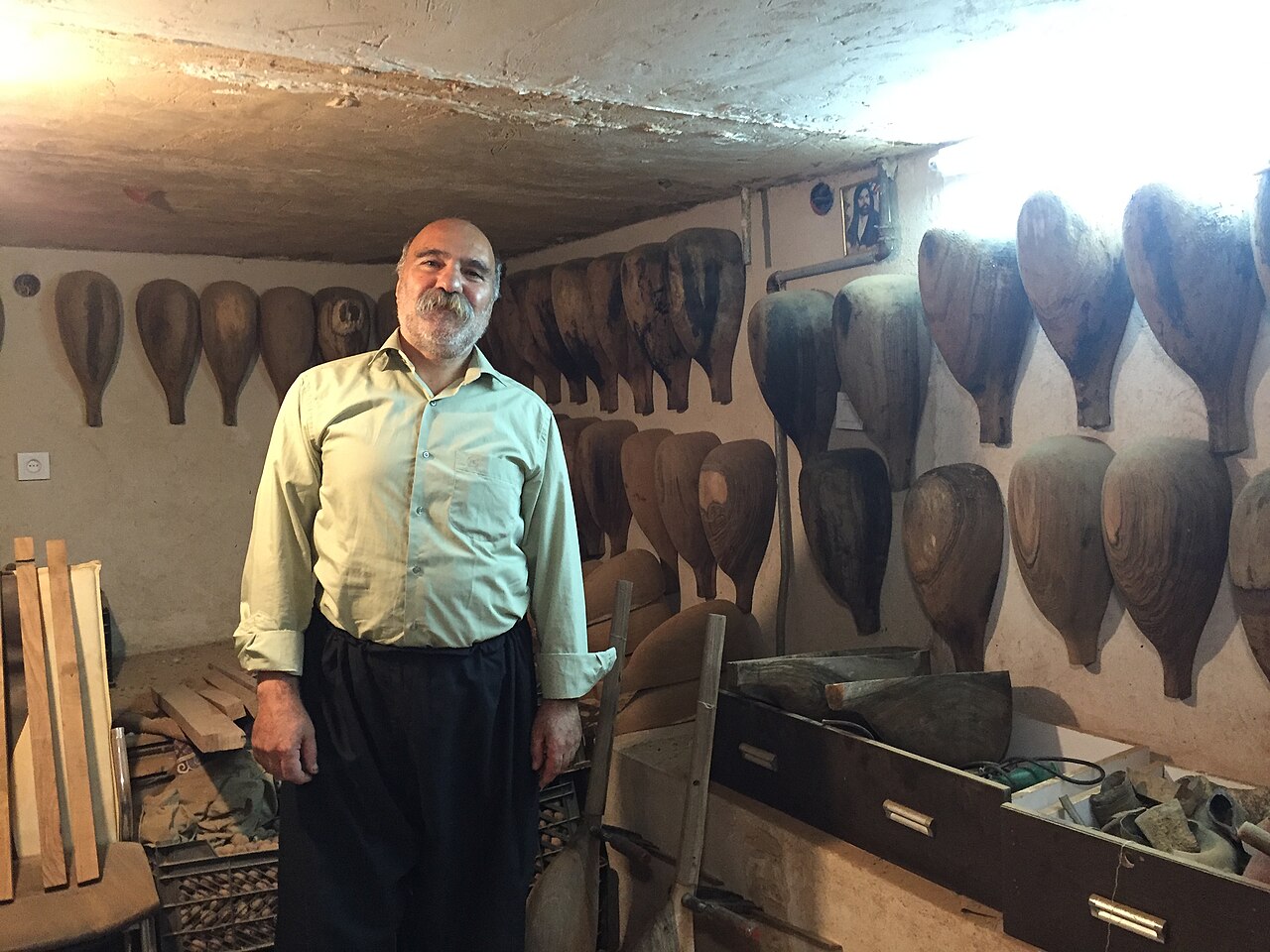
Partow Hooshmandrad’s research draws on nineteen years with the Ahl-e Haqq of the Guran region. She describes musical knowledge as embodied: melodies, words, rhythm, clapping, etiquette, religious narratives and relations with teachers are learned together. Her discussion of sina wa sina, literally chest to chest, links transmission with memory, understanding and personal contact. A nazm is consequently more than a tune detached from its setting. [3] This helps explain why the instrument-maker, reciter, teacher and listener all belong within the history of the tradition, even though they do not perform identical functions. A photograph of a workshop can illuminate that material setting without being presented as a view inside a sacred assembly.
Sacred history and the limits of comparison
Kreyenbroek recounts the creation narrative in which God and the Seven Beings, the Haft Tan, meet in a primordial jam. This is the community’s sacred cosmology, rather than a datable eyewitness report. [2] The relationship between story, song and ritual gives the assembly its religious significance. Published accounts should still be read with their regional scope in mind: a description of Guran, a comparison with Alevis, and an account of another Yarsani branch are related evidence, not interchangeable instructions for all worshippers. [1] [2] [3]
Sources and further reading
- M. Reza Fariborz Hamzeh’ee, Jam (Religious Ceremony), Encyclopaedia Iranica XIV/4 (2008), pp. 428–430, updated 2012; fieldwork on roles, offerings, participation and music.
- Philip G. Kreyenbroek, The Religious Textual Heritage of the Yārsān (Ahl-e Haqq), Oral Tradition 35/2 (2022), pp. 331–340; ritual, languages and textual categories.
- Partow Hooshmandrad, Religious Musical Knowledge and Modes of Transmission among the Kurdish Ahl-e Haqq of Gurān, Oral Tradition 35/2 (2022), pp. 341–362; fieldwork, embodied knowledge and sina wa sina.
- Rahman Veisi Hasar, Canonization and Sacred Text in the Yārsān Religion, Iranian Studies 57/1 (2024), pp. 47–72, DOI 10.1017/irn.2023.65; research abstract.
- DTH-BD-NVT, tanbur-maker’s workshop, Kerend-e Gharb, Kermanshah Province, 2020; own-work photograph, CC BY-SA 4.0, via Wikimedia Commons.