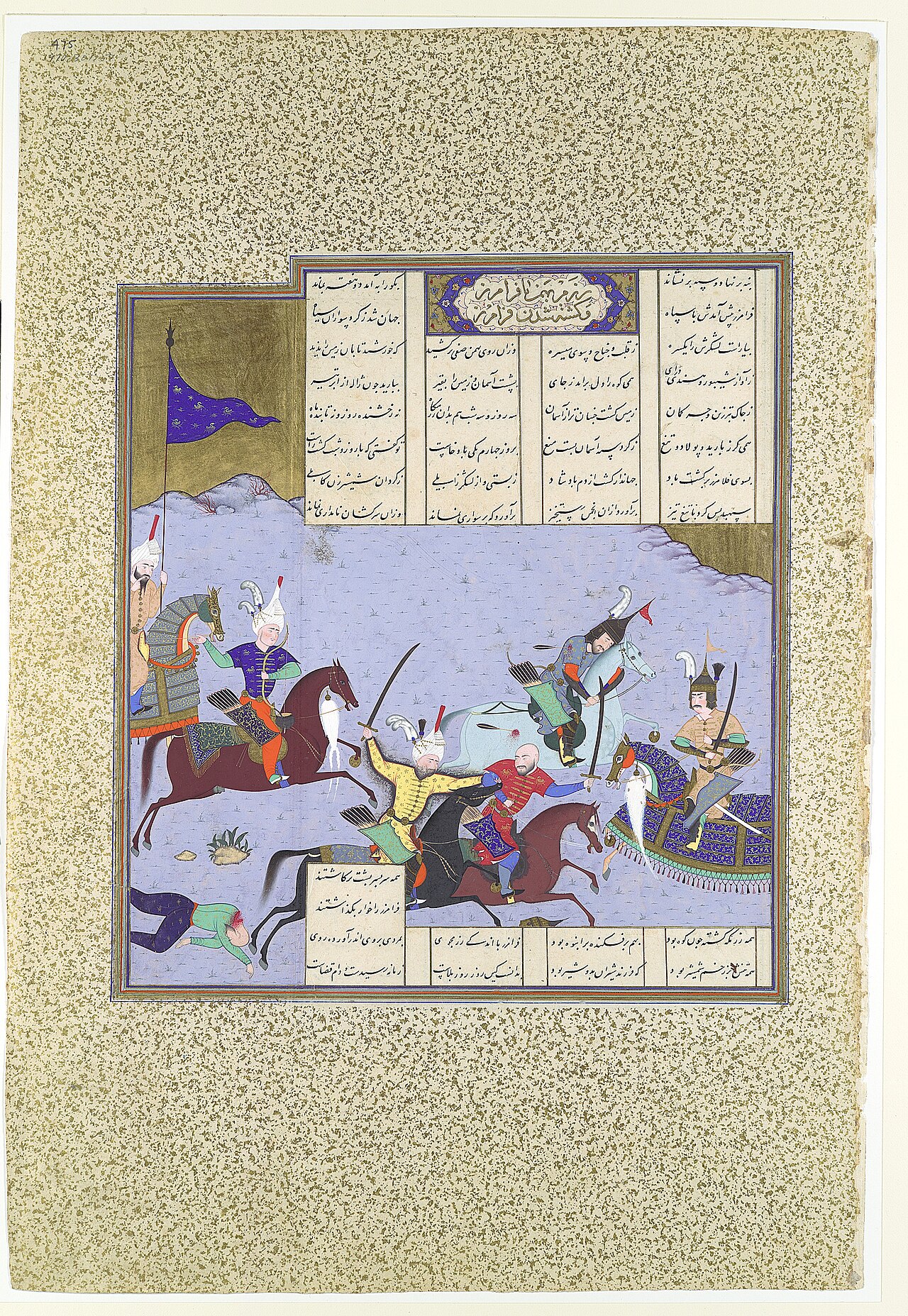
Faramarz: The Son of Rostam
- Dala Sarkis

- 38 minutes ago
- 11 min read

Introduction
Among the heroes of the younger generation in the Shahnameh, Faramarz shines as the worthy son of the greatest champion of all, Rostam. Bearing the blood and the valour of the mightiest of Iranian heroes, Faramarz was a great pahlavan in his own right, a conqueror, a ruler, and at the last the avenger of his father's treacherous death, the heir who upheld the glory of the House of Nariman into its final and tragic days.
The grandson of Zal and the descendant of the great Sam, Faramarz belonged to the most illustrious of all the warrior-lineages of Iran, the house that had given the realm its supreme champion. He fought in the great wars against Turan, conquered India, and avenged his father with a terrible vengeance, before meeting his own tragic end in the long cycle of blood that marked the close of the heroic age. He is the last great bearer of the glory of Rostam's line.
Belonging to the shared epic heritage of the Iranian peoples, a tradition the Kurds hold in common with the Persians and others of the Iranic world, Faramarz is celebrated not only in the Shahnameh but in his own epic, the Faramarz-nama, devoted to his many adventures. To know him is to know the heir of the greatest of heroes, the son who carried his father's valour forward and who, in avenging Rostam, performed one of the great acts of devotion of the epic, even as his own fate completed the tragedy of his glorious house.
Contents
Who Was Faramarz?
Faramarz is a legendary Iranian hero, or pahlavan, of the Shahnameh, the son of the great champion Rostam and a member of the illustrious House of Nariman. A mighty warrior in his own right, he fought in the wars against Turan, was appointed ruler of Zabulistan, conquered India, and famously avenged the treacherous death of his father. He is often described as the last great heir of Rostam's heroic family, and his own adventures are the subject of a separate epic, the Faramarz-nama. In the end, he was himself executed by Bahman, the son of Esfandiyar, in the long cycle of vengeance that closed the heroic age.
The Son of Rostam
Faramarz's glory begins with his descent, for he was the son of Rostam, the greatest of all the heroes of the Shahnameh, the grandson of Zal, and a descendant of the mighty Sam. He belonged thus to the House of Nariman, the most illustrious of all the warrior-lineages of Iran, the family that had given the realm its supreme champion and that was bound to the throne by ties of service across the generations.
As the son of the peerless Rostam, Faramarz bore a heavy inheritance of valour and expectation, and he proved worthy of it. He was a brother, in the tradition, to the heroic Banu Goshasp, the warrior-daughter of Rostam, and a half-brother to the ill-fated Sohrab, the son Rostam slew unknowing. Among these children of the great champion, Faramarz was the heir who lived to carry the family's glory forward, the son who fought at his father's side and in his cause, and who would at the last avenge him. In him the heroic legacy of the House of Nariman, descended from Sam through Zal and Rostam, found its last great bearer, the worthy son of the mightiest of heroes.
Key Takeaways
Faramarz was the son of the great hero Rostam.
He belonged to the illustrious House of Nariman, descended from Sam and Zal.
He was a mighty warrior in the wars against Turan.
He was made ruler of Zabulistan and conquered India.
He avenged the treacherous death of his father Rostam.
He was himself executed by Bahman, son of Esfandiyar.
Quick Facts
Name: Faramarz
Source: The Shahnameh; the Faramarz-nama; the Bahman-nama
Father: Rostam, the greatest hero of Iran
Lineage: Grandson of Zal; House of Nariman, descended from Sam
Siblings: Banu Goshasp (sister); Sohrab (half-brother)
Role: Pahlavan; ruler of Zabulistan; conqueror of India
King served: Kay Khosrow and his successors
Famous deed: Avenging the death of his father Rostam
Own epic: The Faramarz-nama, devoted to his adventures
Fate: Executed by Bahman, son of Esfandiyar
Warrior of Iran
Faramarz was a great warrior of Iran, fighting in the major campaigns of his age, above all the long war of vengeance for the murdered Siyavash waged by the ideal king Kay Khosrow against Turan. In these wars Faramarz proved himself a champion worthy of his father's name, slaying Turanian rulers such as Varazad and capturing Surkheh, a son of the Turanian king Afrasiab, deeds that marked him as one of the leading heroes of the younger generation.
He was also caught up in one of the most tragic episodes of the epic, the fatal feud between his father Rostam and the prince Esfandiyar. In the course of that bitter confrontation, Faramarz killed Mehrnush, a son of Esfandiyar, an act that deepened the tragedy and the cycle of blood between the two great houses. Throughout, Faramarz fought as a loyal son and champion, upholding the cause of his father and his king, a mighty pahlavan whose valour placed him among the foremost warriors of Iran in the age after the great deeds of Rostam himself.
The Conqueror of India
Among the most celebrated of Faramarz's exploits were his campaigns and conquests in India, deeds so renowned that they became the subject of his own epic poem, the Faramarz-nama. Appointed by Kay Khosrow as ruler of Zabulistan, the domain of his family, Faramarz was later entrusted with the conquest and governance of India, following the victories of his father Rostam there.
The Faramarz-nama, a Persian epic composed in the centuries after the Shahnameh and devoted wholly to Faramarz, recounts his many adventures in India: his battles against kings and warriors, his encounters with demons and marvels, and the spiritual trials he underwent in that distant and wondrous land. These tales, in the tradition of the great heroic romances, present Faramarz as a champion of extraordinary prowess, venturing into far and perilous realms and overcoming every foe and marvel he met. The conquest of India and the adventures recorded in his own epic established Faramarz as one of the great heroes of the wider Shahnameh tradition, a worthy heir to his father's renown whose fame extended beyond the bounds of the main epic into a literature of his own.
The Avenging of Rostam
The most poignant and famous of all Faramarz's deeds was the avenging of his father. The great Rostam met his end not in open battle but through treachery, lured to his death in Kabul by the scheming of his own half-brother Shaghad, who had a pit dug and lined with spears into which Rostam and his horse fell. Though the dying Rostam contrived to slay the treacherous Shaghad with his last strength, the greatest of heroes was gone, betrayed and murdered, and word of the sorrow was carried to his aged father Zal in Zabulistan.
It fell to Faramarz to avenge his father. Gathering an army, he marched upon Kabul to exact retribution for the treachery that had destroyed Rostam. He fell upon the region, slew its king and its warriors who had been complicit in the plot, and, in the tradition, ritually burned the traitor Shaghad and the very tree to which the scheme had been bound. Having taken his vengeance, Faramarz recovered the bodies of his father and of Rostam's brother Zavareh, and laid them to rest with honour in a great tomb in Zabulistan. In this act of vengeance and of filial devotion, Faramarz fulfilled the deepest obligation of the heroic code, answering the murder of his father and honouring his memory, a deed that stands as one of the great expressions of devotion in the closing chapters of the epic.
The Tragic End
Faramarz's own end came in the long cycle of vengeance that marked the close of the heroic age, and it completed the tragedy of his glorious house. After the death of Rostam, the family of Esfandiyar, whom Rostam had slain in their fated duel, sought their own vengeance. Bahman, the son of Esfandiyar, who became king, marched against the house of Rostam to avenge his father.
In this reckoning, Faramarz, who had himself killed Esfandiyar's son Mehrnush, was a chief target of Bahman's wrath. In the tradition, Bahman defeated and captured Faramarz and put him to death, executing the last great hero of the House of Nariman and bringing down the family that had given Iran its supreme champion. The death of Faramarz thus closed the long and glorious story of Rostam's line, a line that had served Iran across the generations and produced its mightiest heroes, now brought to its end in the turning of the wheel of vengeance. In his tragic death, as in his father's, the epic shows the sorrow that shadows even the greatest of heroic houses, and the remorseless cycle of blood that, in the end, consumed the age of heroes.
Symbolism and Meaning
Faramarz embodies the ideal of the worthy heir, the son who upholds and carries forward the glory of a great father. As the son of Rostam, he bore the heaviest of inheritances, the legacy of the greatest hero of all, and he proved equal to it, a mighty champion, conqueror and ruler in his own right. In him the epic celebrates the continuity of heroism across the generations, the valour of the father living on in the son, and the devotion that binds a son to avenge and honour his father.
Yet his story also carries the epic's deep awareness of the tragedy that shadows the heroic life. Faramarz's avenging of Rostam, for all its devotion, was part of a remorseless cycle of vengeance, and his own death at the hands of Bahman completed the destruction of his glorious house. In this, Faramarz embodies the bittersweet truth that runs through the close of the Shahnameh's heroic age: that the greatest of houses, for all their valour and glory, are not spared the workings of fate and the cycle of blood, and that the age of heroes itself must pass. To contemplate Faramarz is to contemplate both the glory of the heroic inheritance and the sorrow of its ending, in the last great bearer of the line of Rostam.
Faramarz and the Kurds
Faramarz belongs to the shared epic heritage of the Iranian peoples, the tradition of the Shahnameh that the Kurds hold in common with the Persians and other Iranic peoples. As an Iranic people deeply rooted in this cultural world, the Kurds are heirs to its great cycle of heroes, including the House of Nariman, the line of Rostam to which Faramarz belongs, the most celebrated of all the heroic families of the epic.
It is honest to say that Faramarz, like the other heroes of the Shahnameh, is part of this wider Iranic tradition rather than a specifically Kurdish figure; he is a champion of the shared legendary past of the Iranian peoples as a whole. Yet the values embodied in his story, the upholding of a great inheritance, the devotion of a son to his father, and the bittersweet awareness of the passing of the age of heroes, are universal, and they have resonated across the whole Iranian cultural world, including among the Kurds who have long treasured the great epic. In the figure of Faramarz, the shared heritage offers a moving portrait of the worthy heir and the tragic end of a glorious house, a portrait that belongs to all the peoples who have cherished the Book of Kings.
Debates and Misconceptions
Was Faramarz as great a hero as his father Rostam? No hero of the Shahnameh equals Rostam, the supreme champion of the epic, and Faramarz, for all his prowess, belongs to the generation of mighty heroes who came after rather than to the singular eminence of his father. He is best understood as a worthy and valiant heir who upheld his father's legacy, a great pahlavan in his own right, rather than as Rostam's equal. His distinctive glory lies in his devotion as a son and in his own adventures, above all in India.
How much of Faramarz's story is in the Shahnameh itself? Faramarz appears in the Shahnameh as a hero of the wars against Turan, the feud with Esfandiyar, and the avenging of Rostam. But much of the fuller account of his adventures, especially the Indian campaign, comes from the Faramarz-nama, a separate epic composed in the centuries after the Shahnameh and devoted wholly to him, as well as other related epics. The body of tradition about Faramarz is thus larger than the Shahnameh alone, drawing on a wider literature of heroic romance built around the House of Rostam.
Is the story of Faramarz history? No; Faramarz belongs to the legendary cycles of the Shahnameh and the wider Iranian heroic tradition, not to documented history. He is a figure of the epic's mythical heroic age, his tale rich in meaning but belonging to the realm of legend rather than fact. His story, including the adventures recorded in his own epic, is to be appreciated as heroic legend, a celebration of valour, devotion and the glory and tragedy of a great house, rather than as a record of real events.
Related Topics
Rostam: the greatest hero of Iran, the father of Faramarz
Zal: the grandfather of Faramarz, raised by the Simurgh
Sam: the great ancestor of the House of Nariman
Sohrab: the half-brother of Faramarz, slain by Rostam
Esfandiyar: the prince whose feud with Rostam drew in Faramarz
Kay Khosrow: the king who made Faramarz ruler of Zabulistan
Siyavash: the murdered prince in whose vengeance Faramarz fought
The Shahnameh: the epic Book of Kings in which Faramarz appears
Frequently Asked Questions
Who was Faramarz in the Shahnameh?
Faramarz was a legendary Iranian hero of the Shahnameh, the son of the great champion Rostam and a member of the illustrious House of Nariman. A mighty warrior in his own right, he fought in the wars against Turan, was made ruler of Zabulistan, conquered India, and famously avenged the treacherous death of his father. He is often described as the last great heir of Rostam's heroic family, and he has his own epic, the Faramarz-nama.
Who was Faramarz's father?
Faramarz was the son of Rostam, the greatest of all the heroes of the Shahnameh, and the grandson of Zal, descending from the mighty Sam and the House of Nariman, the most illustrious of the warrior-lineages of Iran. He was a brother of the warrior-woman Banu Goshasp and a half-brother of the ill-fated Sohrab. As Rostam's heir, he carried forward the glory of his father's heroic line.
How did Faramarz avenge his father?
When Rostam was killed by treachery, lured into a pit of spears through the scheming of his half-brother Shaghad in Kabul, Faramarz gathered an army and marched on Kabul to avenge him. He slew the king and warriors complicit in the plot and, in the tradition, ritually burned the traitor Shaghad. He then recovered the bodies of his father and his uncle Zavareh and laid them to rest with honour in a great tomb in Zabulistan.
What is the Faramarz-nama?
The Faramarz-nama is a Persian epic poem, composed in the centuries after the Shahnameh, devoted wholly to the adventures of Faramarz, especially his campaigns and conquests in India. It recounts his battles against kings and warriors, his encounters with demons and marvels, and his spiritual trials. It is one of several epics built around the House of Rostam, showing how the fame of Faramarz extended beyond the Shahnameh into a literature of its own.
How did Faramarz die?
Faramarz was executed by Bahman, the son of Esfandiyar, in the long cycle of vengeance that closed the heroic age. After Rostam had slain Esfandiyar in their fated duel, and Faramarz had killed Esfandiyar's son Mehrnush, Bahman, having become king, marched against the house of Rostam to avenge his father. He defeated and captured Faramarz and put him to death, ending the last great hero of the House of Nariman.
Was Faramarz a real historical figure?
No; Faramarz belongs to the legendary cycles of the Shahnameh and the wider Iranian heroic tradition, not to documented history. He is a figure of the epic's mythical heroic age, and his tale, including the adventures in his own epic the Faramarz-nama, is heroic legend rather than historical fact. His story is to be appreciated as a celebration of valour, filial devotion, and the glory and tragedy of a great heroic house.
References and Further Reading
Comments