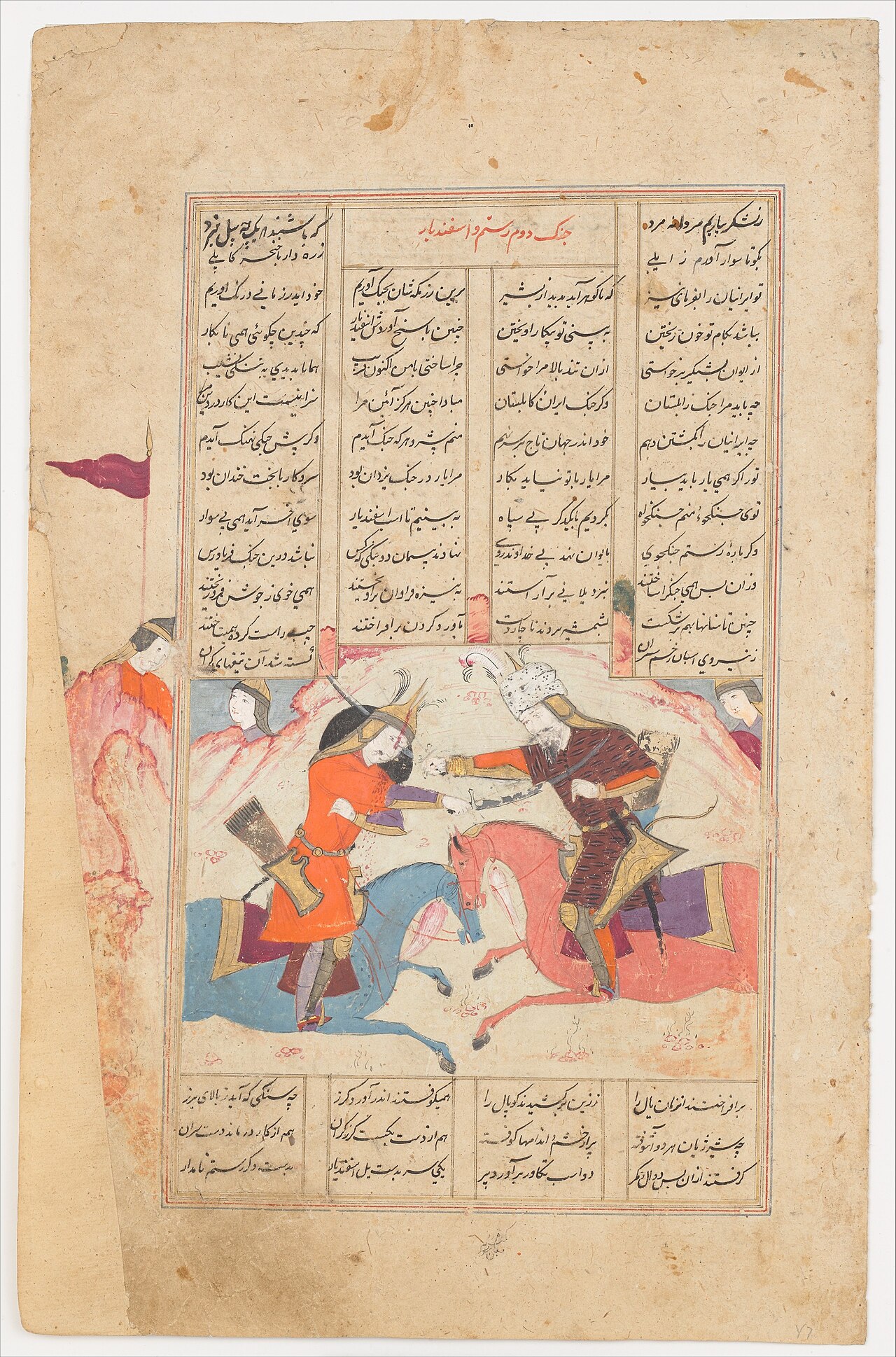
Esfandiyar: The Invulnerable Prince of the Shahnameh
- Sherko Sabir

- 23 hours ago
- 10 min read

Introduction
Esfandiyar is the invulnerable prince of the Shahnameh, the great Book of Kings of the Iranic world, and the hero of its second great tragedy of fathers and sons. The crown prince of Iran and the foremost champion of the new faith of Zoroaster, his body was made proof against every weapon, so that no sword or spear could harm him. Yet for all his invincibility he was doomed, brought to his death in a duel he never wished to fight, against the aged hero Rostam.
His story is a mirror of the epic's other great sorrow, the death of Sohrab. Where that tale turned on a father killing his unknown son, this one turns on an old hero forced to kill a young prince he admires, and on a king who sends his own son to his death to keep a crown he had promised to give. It is, as readers have said for a thousand years, a tragedy not of good against evil but of duty against conscience.
Across the Iranic world that the Kurds share, Esfandiyar has been remembered as the perfect knight of the faith, the brazen-bodied champion, the man invulnerable in body but caught in a snare of obedience and ambition that no armour could turn aside. His one weak point, his eyes, and the strange arrow that found them, have made his fall one of the most haunting in all the epic.
Contents
Who Is Esfandiyar?
Esfandiyar is a legendary Iranian prince of the Shahnameh, the son of King Goshtasp and the great champion of the religion of Zoroaster. Granted a body invulnerable to all weapons, he performs heroic deeds, including a famous series of Seven Labours, to free his captured sisters. But when his father repeatedly withholds the throne he has promised and finally orders him to bring the hero Rostam to court in chains, Esfandiyar is forced into a fatal duel, and is killed by an arrow to his one vulnerable spot, his eyes.
Key Takeaways
Esfandiyar is the invulnerable prince of the Shahnameh.
He was the son of King Goshtasp and the champion of Zoroaster's faith.
A blessing made his body proof against weapons, except his eyes.
He performed Seven Labours to rescue his captured sisters.
His father sent him to a fatal duel with Rostam to avoid giving up the crown.
Rostam killed him with a tamarisk arrow to the eyes, revealed by the Simurgh.
Quick Facts
Name: Esfandiyar (also Esfandiar, Isfandiyar); the ruyin-tan, 'the brazen-bodied'
Role: Crown prince of Iran, son of King Goshtasp; champion of the Zoroastrian faith
Father: Goshtasp, the royal patron of the prophet Zoroaster
Famed for: His invulnerable body and his Seven Labours (Haft Khan)
Invulnerability: A boon of Zoroaster; his body proof against weapons, save his eyes
Great deeds: Freeing his sisters from Arjasp; taking the Brazen Fortress
Downfall: A forced duel with the hero Rostam, ordered by his own father
Slain by: A double-headed tamarisk arrow shot into his eyes
Son: Bahman, entrusted to Rostam and later a king of Iran
Attestation: The Avesta and Pahlavi texts; fullest in Ferdowsi's Shahnameh
The Invulnerable Champion of the Faith
Esfandiyar was the son of King Goshtasp, the very ruler who, in the epic, became the royal patron of the prophet Zoroaster and made the new faith the religion of Iran. Esfandiyar was its sword: a holy and gallant warrior who defended the faith against its enemies and carried it to distant lands, the model of the Zoroastrian knight. In reward for his devotion, the tradition tells, the prophet granted him an extraordinary gift.
By the prophet's blessing his body was made ruyin-tan, brazen-bodied and invulnerable, so that no blade or point could pierce it. But one part was left unguarded, his eyes, the seat of vision and of truth. And there was a shadow on the gift: it was said that whoever shed Esfandiyar's blood would be cursed, hounded by misfortune and brought to an early and evil death. The prince was, in body, all but unkillable; but his story would prove that no armour protects against the snares of duty and ambition.
The Seven Labours
Goshtasp had promised his son the throne of Iran if he would defend the realm, and Esfandiyar did so gloriously, only to find the crown always withheld and a new task always set. The greatest of these was a mission of rescue: the Turanian king Arjasp had attacked Iran and carried off Esfandiyar's two sisters into captivity, and the prince set out to free them by the most dangerous road of all.
On that road he performed his Seven Labours, the Haft Khan, a sequence of trials that deliberately echo the Seven Labours of Rostam himself. He slew monstrous wolves and lions, killed a venomous dragon, resisted and destroyed a treacherous enchantress, overcame a great bird, survived a killing snowstorm, and crossed a deadly waste. At the end he stormed the Brazen Fortress, the stronghold called Ruyin Dezh, slew Arjasp, and brought his sisters home, proving himself the equal of any hero in the epic.
The Fatal Order
Yet still the throne was not given. Casting about for one more impossible task, or perhaps wishing his too-powerful son out of the way, Goshtasp gave the order that would destroy them both: Esfandiyar was to go to Zabol, the home of the great hero Rostam, and bring that aged champion of Iran to court bound in chains, humbled like a criminal. It was a command soaked in dishonour, for Rostam had served Iran faithfully for generations and deserved every honour, not disgrace.
Esfandiyar saw the trap clearly. He knew that to bind Rostam was a shameful and unjust thing, and that the old hero would never submit to it; he sensed that the errand might be his death. But he was caught between his conscience and two powerful chains of his own: his duty to obey his father and king, and his longing for the crown that obedience might finally win. Against the warnings of his own heart, he chose obedience, and rode toward his doom.
Two Heroes Who Should Not Fight
At Zabol, Rostam received the prince with all honour, laying out a feast and offering him friendship and respect. He begged Esfandiyar not to demand the one thing he could not give, for to be led in chains would stain a lifetime of faithful service beyond bearing. He offered everything else, his loyalty, his treasure, his service, anything but his honour. But Esfandiyar, bound by his father's command, could accept nothing less than the chains, and so two men who admired each other, and neither of whom wished to fight, were driven to combat.
Their duel is one of the saddest in the epic, for it pits the old heroic world against the new. When they fought, Esfandiyar's invulnerable body turned aside every blow, while his own diamond-tipped arrows tore through Rostam's guard and wounded the great hero and his horse Rakhsh grievously. By the day's end Rostam, bleeding and beaten as he had never been, withdrew from the field knowing that by ordinary strength he could not prevail, and that without some other answer he faced either death or the unbearable shame of the chains.
The Simurgh and the Tamarisk Arrow
That night Rostam turned in despair to his father Zal, who had been raised in the wilderness by the wise bird, the Simurgh, and who now summoned her by burning one of the feathers she had long ago given to their family. The Simurgh came, and with her healing arts she closed the wounds of Rostam and of Rakhsh, restoring them both. Then she told the hero the one hard truth that could save him.
Esfandiyar could be killed by no common weapon, she said, but in his eyes, his one unguarded place, he was mortal. There grew by the water a tamarisk tree, and from its branch Rostam must fashion a special double-headed arrow and aim it at the prince's eyes. But she warned him of the cost: the ancient curse meant that whoever killed Esfandiyar would himself be doomed to an early and sorrowful death. Rostam took the knowledge with a heavy heart, for he knew that to save himself he must destroy a noble prince and call down ruin on his own head.
The Death of Esfandiyar
In the morning Rostam returned to the field, but first he pleaded with Esfandiyar one last time, begging him to turn aside, to abandon the dishonourable errand, to choose friendship over his father's cruel command. He laid bare the sorrow of the whole affair: that this was a battle neither of them should fight. But Esfandiyar would not yield; he was bound to his father's word and to the crown he still hoped to win, and he demanded again the chains. There was no way left but the terrible one.
Rostam set the tamarisk arrow to his bow, said a prayer, and loosed it into the prince's eyes. Esfandiyar, the invulnerable, the brazen-bodied, fell at last. As he lay dying he did not curse the hero who had felled him; instead he forgave Rostam and named the true author of his death, his own father Goshtasp, whose pride and broken promises had sent him to this end. With his final breath he entrusted his young son Bahman to Rostam's care, asking the old hero to raise the boy well, and Rostam, weeping, swore to honour the wish.
The Curse Fulfilled
The doom on Esfandiyar's slayer did not sleep. Not long after, Rostam himself met a treacherous death, betrayed and killed through the scheming of a jealous half-brother, so that the curse spoken over the brazen-bodied prince was fulfilled upon the greatest hero of them all. And the wheel turned further still: Esfandiyar's son Bahman, raised in Iran, in time became its king, and in some tellings turned against the house of Rostam to avenge his father. The killing of Esfandiyar, like the killing of Sohrab, set loose a sorrow that ran on for generations.
Symbolism
Esfandiyar is the supreme image of strength undone by its single flaw. Invulnerable in body, he is destroyed through his eyes, the very organ of sight and insight, as though the epic were saying that the man who could not be wounded from without was blind to the trap closing around him from within. His invincible armour could not protect him from his own obedience, nor from a father's ambition, nor from the workings of fate.
Above all his story is a meditation on the clash of duty and conscience. Esfandiyar is not a villain; he is a good man who knows the order he has been given is wrong, and obeys it anyway, partly from loyalty and partly from desire for the crown. In him the Shahnameh asks one of its hardest questions, whether obedience can excuse an unjust act, and answers it in tragedy: the prince keeps faith with his father and loses his life, his honour caught forever between the command he followed and the conscience he silenced.
Esfandiyar and the Kurds
As one of the central heroes of the Shahnameh, Esfandiyar belongs to the shared mythic heritage of all the Iranic peoples, the Kurds among them. His tale is bound up with the deep Iranic and Zoroastrian past from which Kurdish tradition also springs: the same world of heroic quests and the Haft Khan, of sacred fire and prophetic blessing, that runs beneath so many of the legends the Kurds hold dear.
As always with the Shahnameh, it would be wrong to claim Esfandiyar as uniquely Kurdish. He is the common inheritance of a whole family of Iranic nations, Persians, Kurds and others alike, and the Kurds may rightly count this brazen-bodied prince and his tragedy among the legends of their wider world, without making him their own alone. His story is theirs as it belongs to everyone who looks back to that ancient Iranic dawn.
Debates and Misconceptions
Did Esfandiyar really kill the Simurgh? This is a famous puzzle. In his Seven Labours Esfandiyar slays a great bird called the Simurgh, yet it is also the Simurgh who heals Rostam and reveals how to kill Esfandiyar. The tradition seems to hold two different birds of the same name: a monstrous, predatory Simurgh that the prince destroyed, and the wise, benevolent Simurgh that raised Zal and protected the line of Rostam. They should not be confused; the divine bird of Rostam's family is not the beast that Esfandiyar slew.
Is Esfandiyar an Iranic Achilles? Scholars have long noted the resemblance: like Achilles, he is all but invulnerable save in one spot, is reluctant to fight, and is drawn into a fatal combat. Some have even matched Goshtasp to Agamemnon and Rostam to Hector. Whether these likenesses come from a shared ancient Indo-European inheritance or from later contact between cultures is debated, and the question is best left open; what is clear is that the theme of the invulnerable hero with one fatal weakness is very old and very widespread.
Is the tale Persian or Kurdish? Like the whole of the Shahnameh, the story of Esfandiyar is the shared heritage of the Iranic peoples, told by Persians, Kurds and their neighbours alike. The Kurds count its heroes and its themes among their own, and rightly, but the prince belongs to no single nation; he is best understood as a treasure held in common across the Iranic world.
Related Topics
Rostam: the great hero who reluctantly killed Esfandiyar
Sohrab: Rostam's son, the hero of the epic's other great tragedy
The Simurgh: the wise bird who healed Rostam and revealed the fatal arrow
Zal: Rostam's father, raised by the Simurgh, who summoned her aid
Zoroaster: the prophet whose blessing made Esfandiyar invulnerable
Kay Khosrow: the just king of the age before Esfandiyar's generation
Frequently Asked Questions
Who is Esfandiyar?
Esfandiyar is the invulnerable prince of the Shahnameh, son of King Goshtasp and champion of the faith of Zoroaster. His body was proof against all weapons except his eyes, and he died in a forced duel with the hero Rostam.
How did Esfandiyar become invulnerable?
By a blessing of the prophet Zoroaster, whose faith he defended, his body was made brazen and proof against every weapon. Only his eyes were left unguarded, and it was there that he could be harmed.
What were the Seven Labours of Esfandiyar?
They were a series of trials, echoing Rostam's own, that he faced while marching to free his captured sisters: slaying wolves, lions, a dragon and a great bird, defeating an enchantress, and surviving a snowstorm and a desert, before taking the Brazen Fortress.
Why did Esfandiyar fight Rostam?
His father Goshtasp, unwilling to give up the throne he had promised, ordered Esfandiyar to bring the hero Rostam to court in chains. Rostam would not accept such dishonour, and Esfandiyar, bound by his father's command, was forced into the duel.
How was the invulnerable Esfandiyar killed?
On the counsel of the Simurgh, Rostam made a double-headed arrow from a tamarisk branch and shot it into Esfandiyar's eyes, his one vulnerable spot. It was the only weapon that could harm him.
What happened to Rostam afterwards?
The ancient curse held that Esfandiyar's slayer would be doomed. Not long after, Rostam himself died through treachery, and Esfandiyar's son Bahman, whom Rostam had raised, later became king of Iran.
References and Further Reading
Comments