Sam: The Champion of the Shahnameh
- Sherko Sabir

- 5 hours ago
- 12 min read

Introduction
In the great epic of the Iranian world, the Shahnameh, the Book of Kings, there arises a line of mighty champions from the land of Sistan, heroes whose deeds fill some of the most beloved pages of the poem. At the head of this heroic house, in the age when the dynasty of Iran was being forged, stands Sam, the son of Nariman, the great champion of his time and the patriarch of a family that would produce the supreme hero of the whole epic.
Sam was Iran's foremost warrior under a succession of kings, a protector of the realm and a maker of kings. But he is remembered above all for a deeply human story: the tale of how he cast out his own newborn son, Zal, because the child was born with hair as white as snow, and how, after the wondrous bird the Simurgh had raised the boy in the mountains, a repentant Sam reclaimed him. From that reconciliation flowed the whole line of Sistan's heroes, culminating in his grandson Rostam.
The figure of Sam belongs to the shared heroic heritage of the Iranian peoples, the great epic tradition that the Kurds hold in common with the Persians and others of the Iranic world. In his story of pride and repentance, of a father's harshness and a father's love, and of the bird that nurtured an abandoned child, we find some of the most enduring and tender themes of the Shahnameh, gathered around the towering figure of Iran's champion.
Contents
Who Was Sam?
Sam, often called Sam son of Nariman, is a legendary hero of ancient Iran and one of the great characters of the Shahnameh, the epic Book of Kings. He was the champion and protector of Iran under several kings, the head of the heroic house of Nariman that ruled the land of Sistan, the father of the white-haired hero Zal, and the grandfather of Rostam, the supreme champion of the whole epic. He is remembered above all for the tale of abandoning and then reclaiming his son Zal, who was raised in the mountains by the wondrous bird the Simurgh.
The Champion of Iran
Sam was the mightiest warrior of his age, the pahlavan or champion of Iran who served as the realm's foremost general and protector across the reigns of several kings. The tradition names him as Iran's champion under Fereydun, the great hero-king who overthrew the tyrant Zahhak; under Manuchehr, in whose long reign the age of heroes dawned; and under Nowzar, Manuchehr's son. Through these reigns Sam was the strong right arm of the throne, the defender of Iran-zamin, the Land of Iran.
Like the great heroes who would descend from him, Sam was not himself a king but a champion and a king-maker, a mighty subject whose strength upheld the crown. The house of Nariman, ruling in Sistan, stood in close and loyal relation to the kings of Iran, lending its heroes to the defence of the realm generation after generation. Sam embodied this ideal of the loyal champion, the warrior whose might served the throne and the land, and in this he set the pattern that his son and grandson would follow after him.
Key Takeaways
Sam is a legendary hero and champion of Iran in the Shahnameh.
He was the son of Nariman and grandson of the dragon-slayer Garshasp.
He served as Iran's champion under the kings Fereydun, Manuchehr and Nowzar.
He abandoned his white-haired son Zal, who was raised by the Simurgh.
Moved by a dream, Sam repented and reclaimed his son.
He was the grandfather of Rostam, the greatest hero of the epic.
Quick Facts
Name: Sam (Persian: Sam, also Saam); often Sam-e Nariman, Sam son of Nariman
Source: The Shahnameh, the Persian Book of Kings
Type: A legendary hero and champion of ancient Iran
Father: Nariman; grandfather: Garshasp, the great dragon-slayer
Son: Zal, the white-haired hero raised by the Simurgh
Grandson: Rostam, the greatest champion of the Shahnameh
Role: Champion and protector of Iran, and king-maker
Kings served: Fereydun, Manuchehr, and Nowzar
Realm: The house of Nariman, rulers of Sistan (Zabulistan)
Famous for: Abandoning and then reclaiming his son Zal
The House of Nariman
Sam stands at the centre of one of the great heroic dynasties of the Shahnameh, the house of Nariman, which ruled the eastern land of Sistan, also called Zabulistan. The line reached back to the mighty Garshasp, the ancient dragon-slaying hero, and ran through Nariman, Sam's father, to Sam himself, and then onward to his son Zal and his grandson Rostam. This was a family of champions, who for generations served the kings of Iran as their greatest warriors and generals.
The deeds of this Sistan dynasty form one of the richest seams of the whole epic, and they are thought to preserve very ancient legends of the eastern Iranian world, once told in independent epics of their own before being woven into the Shahnameh. Sam is a central figure of this heroic cycle, the link between the ancient Garshasp and the supreme Rostam, and the patriarch in whose generation the family's greatest fame began to unfold. To know Sam is to know the root of the house that gave the epic its mightiest heroes.
The Birth of Zal
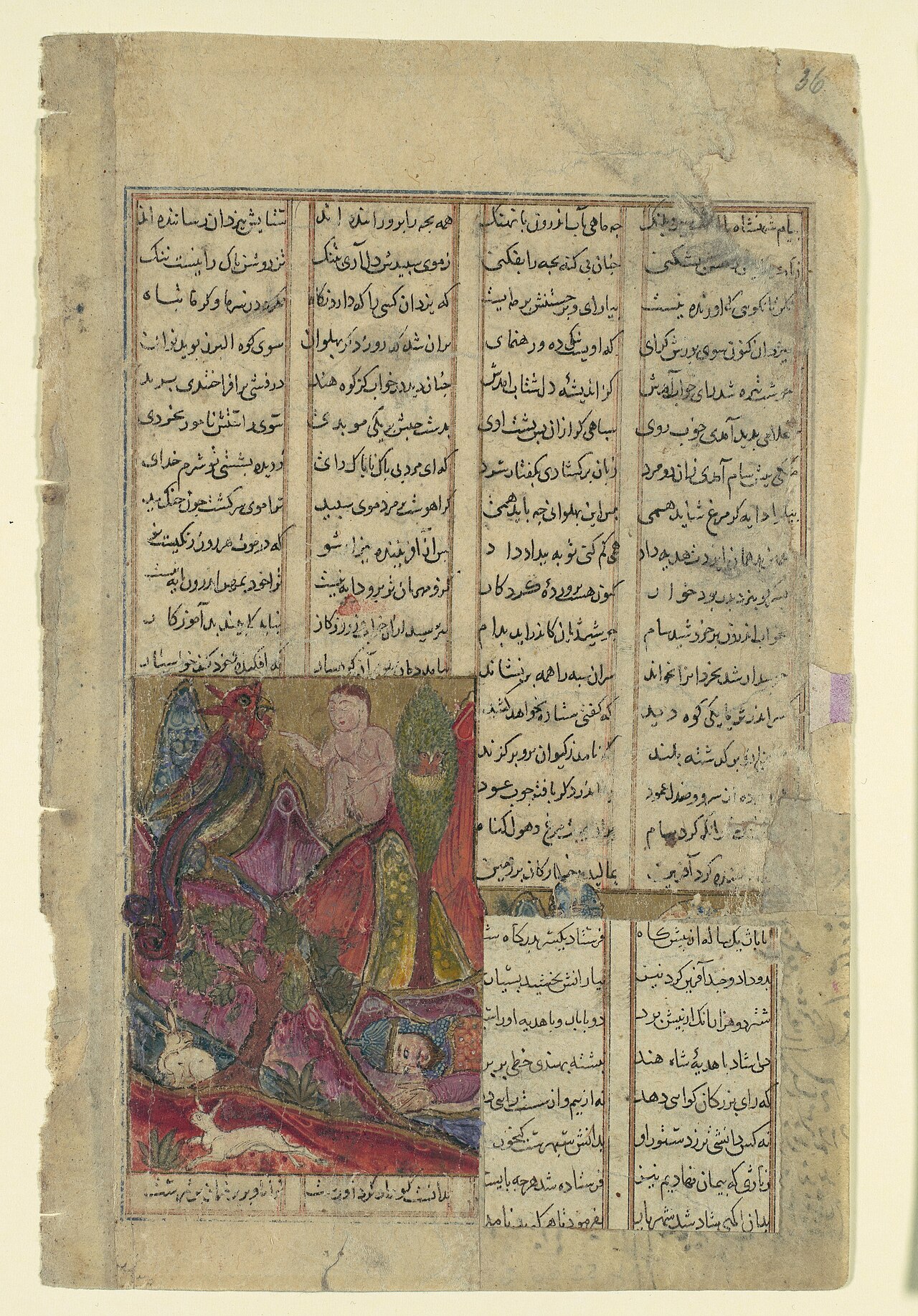
The most famous episode of Sam's life concerns the birth of his son. When Sam's child was born, he was found to have hair as white as snow, an extraordinary mark that filled his father with dismay. In the thinking of the age, such a child seemed an ill omen, and Sam, ashamed and fearful that the white hair betokened some demonic taint, made a harsh and fateful decision: he ordered that the infant be carried away and abandoned in the wilderness of the Alborz mountains, far from the eyes of men. This child was Zal, whose name came to mean one marked by such whiteness.
It was a cruel act, born of pride and superstition, and the epic does not hide its harshness. The helpless newborn was left exposed on the mountainside to die, cast out by the very father who should have protected him. Yet this dark beginning would become the seed of one of the most beautiful tales of rescue and reconciliation in the whole tradition, for the child abandoned on the mountain was not forsaken by all. High on the peaks of the Alborz dwelt a wondrous being who would become his salvation.
The Simurgh's Gift
The infant Zal was found by the Simurgh, the great and wise mythical bird that nested in the heights of the Alborz. Rather than harm the child, the Simurgh took him to her nest and raised him as her own, sheltering him beneath her wings and nourishing him alongside her young. Under the care of this marvellous creature, the abandoned baby grew into a strong and noble youth, wise beyond his years, learning the secrets that the ancient bird could teach.
Years passed, and Sam was visited by dreams that troubled his conscience and told him that his son still lived, grown into a worthy youth in the care of the Simurgh. Stricken with remorse for what he had done, Sam journeyed to the Alborz mountains to seek the child he had cast away. When the Simurgh saw that the father had come to reclaim his son, she prepared to return the youth, but she did not send him away unprotected: she gave Zal several of her feathers, telling him that if ever he was in need he should burn one, and she would come to his aid. With this gift, the bond between the bird and the house of Sam was sealed, and Zal was restored to his father.
A Father's Repentance
The reunion of Sam and Zal is a moving scene of repentance and joy. When Sam beheld the noble youth that his abandoned son had become, he was overcome with pride and remorse together, swelling with love for the child he had so wrongfully cast out. He acknowledged his fault, embraced his son, and resolved to make amends, taking Zal home to be raised as the heir of his house and the champion he was destined to become. The harsh father had become a repentant and loving one.
Sam then presented his son at the court of King Manuchehr, who received the youth with honour and recognised in him the makings of a great champion. So the boy once left to die on a mountainside took his place among the heroes of Iran. The tale carries a clear moral weight: it condemns the cruelty of judging a child by appearances and omens, and it celebrates the power of repentance and the restoration of a broken bond. In Sam's journey from shame to love, the epic offers one of its most humane and affecting lessons.
The Mace of Sam
Among the emblems of Sam's heroic might was his great mace, a mighty weapon worthy of Iran's champion. This mace became a treasured heirloom of the house of Nariman, a symbol of the family's strength passed down through the generations. Its most famous appearance comes in the boyhood of Sam's grandson Rostam, who, while still a child, slew a maddened, rampaging white elephant with a single blow of the mace that had belonged to his grandfather Sam.
In that single image, the mace of Sam links three generations of heroes, the weapon of the grandfather wielded by the grandson to perform his first great feat of strength. It is a fitting symbol of the heroic inheritance that Sam passed down: the might, the courage and the role of champion that descended from him through Zal to Rostam. The mace of Sam stands for the continuity of the heroic line, the strength of the house of Nariman handed on like a sacred trust from one mighty champion to the next.
Grandfather of Rostam
Sam lived to see the birth of his grandson Rostam, the son of Zal and the princess Rudaba of Kabul, who would become the greatest hero of the entire Shahnameh. The tradition tells that when Sam learned of the birth of his grandchild, a child of extraordinary size born with the help of the Simurgh, he rushed joyfully to see the infant, overjoyed at the new champion of his line. In Rostam, the house of Sam reached its glorious height.
As the grandfather of Rostam and the great-grandfather of the ill-fated Sohrab, Sam stands at the root of the most celebrated heroic family of the epic. The deeds of Rostam, which fill so many of the Shahnameh's most famous pages, all descend from the line that Sam headed, and the champion who reclaimed his son from the Simurgh became the ancestor of Iran's mightiest defender. Sam's importance in the epic is thus twofold: he is a great hero in his own right, and the patriarch from whom the supreme hero sprang.
The Hero of Legend
Beyond the tale of Zal, Sam is remembered as a warrior of tremendous prowess, a champion who defended Iran against its enemies and, in the manner of the Sistan heroes, contended with monsters and dragons. His ancestor Garshasp was the dragon-slayer par excellence of Iranian legend, and the heroes of this house inherited his monster-slaying valour. The independent epics of the Sistan cycle, partly absorbed into the Shahnameh, told many deeds of Garshasp and his descendants, Nariman, Sam, Zal and Rostam, as a continuous saga of heroism.
In these legends Sam appears as a figure of immense strength and courage, the worthy bearer of his family's heroic tradition. Though the tale of his son Zal has tended to overshadow his other exploits in popular memory, the epic and its related traditions present him as one of the great warriors of the age, a champion whose might was matched by his eventual wisdom and humility. He is the very type of the Iranian hero: powerful, loyal to the throne, and, for all his early harshness, capable of growth and repentance.
Symbolism and Meaning
The figure of Sam carries rich symbolic meaning, above all through the tale of Zal. The story of the father who casts out his child for being different, only to repent and reclaim him, speaks to enduring human themes: the cruelty of prejudice and superstition, the wrong of judging by appearances, and the redemptive power of repentance and love. The white-haired child rejected as an ill omen, yet raised to greatness by the Simurgh, becomes a parable of how the despised and abandoned may rise to honour.
Sam himself embodies the figure of the patriarch and the champion, the strong founder at the head of a heroic line. The motif of the abandoned child nurtured by a wondrous creature, found across the world's mythologies, takes in his story one of its most beautiful forms, with the wise Simurgh as the foster-parent. And the mace handed down from Sam to Rostam symbolises the continuity of heroism across the generations. In Sam, the epic gathers themes of pride and humility, harshness and love, and the passing of greatness from father to son.
Sam and the Kurds
Sam belongs to the shared epic heritage of the Iranian peoples, the great tradition of the Shahnameh that the Kurds hold in common with the Persians and other Iranic peoples. As an Iranic people with their own ancient roots, the Kurds are heirs to this world of heroic legend, in which champions such as Sam, Zal and Rostam embody ideals of courage, loyalty and honour cherished across the whole Iranian cultural sphere. These are not the heroes of one people alone but the common inheritance of many.
It is honest to say that Sam, like the other heroes of the Shahnameh, is set in the wider Iranian world, with his home in the eastern land of Sistan, rather than being a specifically Kurdish figure. Yet the themes of his story, the mountains and the marvellous bird, the bonds of family, the ideal of the loyal champion, resonate deeply in a Kurdish world that shares this Iranic heritage and these mountainous landscapes. In honouring Sam and the epic he belongs to, the Kurds celebrate their place within the great family of Iranic peoples and their share in one of the world's most magnificent traditions of heroic legend.
Debates and Misconceptions
Is Sam a Kurdish hero? He is best understood as a figure of the shared Iranic epic tradition rather than as specifically Kurdish. The Shahnameh is the common heritage of the Iranian peoples, and Sam, set in the eastern land of Sistan, belongs to that wider world. The Kurds, as an Iranic people, are among the heirs to this epic, and they share its heroes with Persians and others; it is most accurate to present Sam as part of this common Iranic inheritance rather than to claim him for any single people.
Is Sam a historical figure? Sam is a legendary and mythic hero, not a documented historical person. The heroes of the Sistan cycle may preserve faint memories of ancient eastern Iranian warriors and traditions, but their tales belong to the realm of epic and myth rather than history. The deeds attributed to Sam, his contests with monsters and his place among kings who themselves belong to legendary dynasties, mark him clearly as a figure of heroic legend, to be appreciated as such.
Why did Sam abandon Zal? In the logic of the tale, Sam cast out his son because the child's white hair was seen as a frightening omen, perhaps a sign of demonic descent, that brought shame upon the proud champion. The epic presents this as a grave fault, an act of cruelty and superstition that Sam later bitterly regretted. The point of the story is not to excuse the abandonment but to show its wrongness and the beauty of the repentance and reconciliation that followed, when Sam reclaimed the noble son he had so wrongly cast away.
Related Topics
Zal: the white-haired son of Sam, raised by the Simurgh
Rostam: the grandson of Sam and greatest hero of the Shahnameh
The Simurgh: the wondrous bird that raised Sam's abandoned son
Garshasp: the dragon-slaying ancestor of the house of Nariman
Manuchehr: the king of Iran whom Sam served as champion
The Shahnameh: the epic Book of Kings in which Sam appears
Frequently Asked Questions
Who was Sam in the Shahnameh?
Sam, often called Sam son of Nariman, is a legendary hero of ancient Iran and one of the great characters of the Shahnameh. He was the champion and protector of Iran under several kings, the head of the heroic house of Nariman that ruled Sistan, the father of the white-haired hero Zal, and the grandfather of Rostam, the greatest champion of the whole epic.
Why did Sam abandon his son Zal?
Sam abandoned his newborn son because the child was born with hair as white as snow, which the proud champion took as a frightening and shameful omen, fearing it signified some demonic taint. He ordered the infant left in the Alborz mountains. The epic presents this as a grave and cruel fault, which Sam later deeply regretted, reclaiming his son after the Simurgh had raised him.
How is Sam related to Rostam?
Sam is the grandfather of Rostam, the supreme hero of the Shahnameh. Sam was the father of Zal, and Zal was the father of Rostam by the princess Rudaba of Kabul. Sam thus stands at the head of the heroic house of Sistan that produced Iran's greatest champion, and the tradition tells that he rejoiced greatly at the birth of his mighty grandson.
Who were Sam's ancestors?
Sam was the son of Nariman and the grandson of Garshasp, the great dragon-slaying hero of Iranian legend. The house of Nariman, rulers of Sistan, was a dynasty of champions reaching back through these ancient heroes, and Sam carried on their tradition of valour, passing it down in turn to his son Zal and his grandson Rostam.
What is the mace of Sam?
The mace of Sam was the great weapon of Iran's champion, which became a treasured heirloom of his heroic house. Its most famous moment comes when Sam's grandson Rostam, still a child, slays a maddened white elephant with a single blow of his grandfather's mace. The weapon symbolises the heroic strength passed down through the generations of Sam's line.
Is Sam a Kurdish or Persian hero?
Sam belongs to the shared epic heritage of the Iranian peoples rather than to one alone. The Shahnameh is the common inheritance of the Iranic world, and the Kurds, as an Iranic people, share its heroes with Persians and others. Sam is set in the eastern land of Sistan and is best understood as a figure of this wider Iranic tradition, cherished across the whole Iranian cultural sphere.
References and Further Reading
Comments