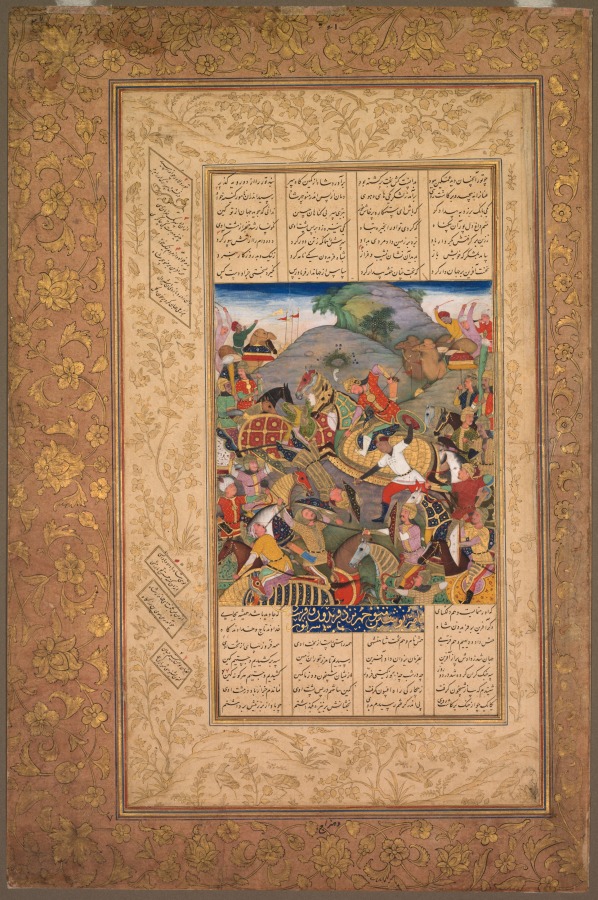
Manuchehr: The Avenger-King of the Pishdadians
- Dala Sarkis

- 8 hours ago
- 10 min read

Introduction
Manuchehr is the great avenger-king of Iranic legend, the righteous shah who set right one of the foundational crimes of the mythic age and ushered in the golden era of heroes. He is the heir of Faridun, the hero-king who had overthrown the tyrant Zahhak, and his story begins in tragedy: the murder of his grandfather Iraj by his own jealous brothers, a fratricide that lit the long and terrible war between Iran and Turan.
Reared by Faridun for the task, Manuchehr grew up to avenge that murder, hunting down and destroying the killers and reclaiming the throne of Iran. His was a reign of restoration and order, but it is remembered above all for what arose during it: the coming of the great Sistani heroes, Sam and his son Zal and Zal's son Rostam, the champions who would become the backbone of the Iranian epic. With Manuchehr's reign, the Shahnameh passes from the age of the world-kings into the age of heroes.
Manuchehr stands at one of the great hinges of the epic, the bridge between the cosmic founder-kings and the human heroes whose deeds fill the rest of the story. His tale is one of justice and vengeance, of a kingdom restored, and of a long shadow: for the war he began in righteousness would run on for generations, and not be ended until the reign of his far-off descendant Kay Khosrow.
Contents
Who Is Manuchehr?
Manuchehr is a legendary king of Iranic mythology, the eighth shah of the Pishdadian dynasty in the Shahnameh. He was the great-grandson of Faridun and the grandson of the murdered prince Iraj, and he is famous for avenging Iraj by destroying the killers, his uncles Salm and Tur, and for reclaiming the throne of Iran. His long reign is remembered as the dawn of the age of heroes, when the great champions Sam, Zal and Rostam arose to defend the land.
Key Takeaways
Manuchehr is the eighth king of the legendary Pishdadian dynasty.
He was the great-grandson of Faridun and grandson of Iraj.
He avenged Iraj's murder by slaying his uncles Salm and Tur.
His chief general was Qaran, son of Kaveh the blacksmith.
In his reign the great heroes Sam, Zal and Rostam arose.
The Iran-Turan war he began ran on until the reign of Kay Khosrow.
Quick Facts
Name: Manuchehr (Avestan Manuschihra, 'of the seed of Manush')
Type: Legendary king, the eighth shah of the Pishdadian dynasty
Lineage: Great-grandson of Faridun, grandson of Iraj
Famous for: Avenging Iraj by slaying his uncles Salm and Tur
Chief general: Qaran, son of Kaveh (Kawa) the blacksmith
Reign: 120 years in the epic; a time of restoration and order
His age: The dawn of the heroes: Sam, Zal and the birth of Rostam
The arrow: In tradition, Arash's border-shot fell in his reign
Succeeded by: His son Nowzar, whose weak reign brought disaster
Attestation: The Shahnameh of Ferdowsi; earlier Avestan tradition
The Heir of Faridun
Manuchehr belongs to the royal line of the Pishdadians, the first legendary dynasty of Iran. His name descends from an ancient form meaning something like one of the noble seed, and his blood is the most royal in the world: he is the great-grandson of Faridun, the hero who broke the thousand-year tyranny of the serpent-king Zahhak, and the grandson of Faridun's beloved son Iraj. After Iraj was murdered, it was Faridun himself who raised the child Manuchehr, grooming him in the ways of kingship for the great task that lay ahead.
In the long line of Pishdadian rulers, Manuchehr marks a turning point. The kings before him, Kayumars, Hushang, Tahmuras, Jamshid and Faridun, were towering cosmic figures, world-monarchs at the dawn of creation. With Manuchehr the scale shifts toward the human and the heroic, and the epic begins to fill with mortal champions, battles and the deeds of warriors. He is the last of the truly mythic founder-kings and the first of the age that follows.
The Division of the World and the Murder of Iraj
The tragedy that shapes Manuchehr's life begins a generation before him. Late in his reign, Faridun divided his vast empire among his three sons: to Salm he gave the lands of the west, to Tur the lands of the east, including Turan, and to his youngest and best-loved son Iraj he gave the central, most prized portion, the land of Iran itself. It was a fateful choice, for it sowed jealousy between the brothers.
Consumed by envy at Iraj's favoured inheritance, Salm and Tur plotted against him, and together they murdered their innocent brother, the first great fratricide of the epic. This crime ignited the long and bitter feud between Iran and Turan that would burn for centuries. But Iraj left a daughter, and from her in time was born a son, Manuchehr, the child in whom the hope of vengeance and the future of the royal line were joined.
The War of Vengeance
When Manuchehr had grown to manhood and mastered the arts of rule and war, Faridun equipped him with a great army to avenge Iraj. Sensing their danger, Salm and Tur sent offers of repentance, but Faridun, who had never forgiven the murder of his beloved son, refused them, and the two guilty brothers gathered their forces and marched on Iran. At Manuchehr's side rode the champions of the age, and chief among his commanders was Qaran, the son of Kaveh the blacksmith, the very hero whose rebellion had once raised Faridun to the throne.
In a series of hard-fought battles, Manuchehr prevailed. He slew Tur and then Salm, the murderers of his grandfather, and sent their heads back to the aged Faridun as proof that justice had at last been done. His task complete, the old king passed the rulership of Iran to his great-grandson and, his life's work finished, soon died. Manuchehr took the throne as the rightful heir, the royal glory of the Pishdadians secure once more in a worthy hand.
The Reign of Manuchehr
Manuchehr's reign, which the epic measures at a sweeping one hundred and twenty years, was an age of restoration and order. He reformed and strengthened the kingdom, uniting the Iranian realms under a firm and just rule, the very model of the legitimate monarch. Almost two-thirds of the Shahnameh is devoted to the long age of heroes that opens with his reign, and Manuchehr stands at its threshold as the king under whom that heroic world first takes shape.
The defining feature of his rule was his alliance with the warrior-house of Sistan, the line of paladins who would become the strong right arm of every Iranian king to come. Foremost among them was the mighty Sam, grandson of Garshasp, whom Manuchehr honoured and to whom he entrusted the rule of Zabulistan. Through Sam and his descendants, the throne of Iran gained the champions it would depend upon for generations, and the stage was set for the greatest stories of the epic.
The Dawn of the Heroes
It is in Manuchehr's reign that the most beloved hero-saga of the Shahnameh begins. Sam's son was born with hair as white as snow, and the dismayed father, fearing an evil omen, abandoned the infant on a mountainside, where he was found and raised by the wondrous bird, the Simurgh. This was Zal, who grew into a noble and wise hero and was joyfully reclaimed by his repentant father. Ruling in Zabol as a young man under Manuchehr's authority, Zal lost his heart to Rudabeh, the beautiful princess of Kabul.
Their love faced obstacles, for Rudabeh was descended from the line of the old tyrant Zahhak, and Manuchehr was at first wary of the match. But the counsel of Sam, the wisdom of the sages and the promise of a glorious offspring won the king's consent, and the marriage went ahead. From it was born the mightiest champion of all Iranic legend, Rostam. Thus the hero on whom the fate of Iran would so often rest came into the world during Manuchehr's reign, the crowning gift of his age.
Manuchehr and the Arrow of Arash
One of the most famous of all Iranic legends is also set in Manuchehr's reign, though it comes to us not from the Shahnameh but from the older Avestan tradition and the later histories. In those accounts, the Turanian commander Afrasiab, grandson of the slain Tur, besieged Manuchehr in the northern land of Tabaristan. To end the war, the two sides agreed that the border between Iran and Turan would be fixed by a single arrow-shot, and the hero Arash the Archer gave his life to send that arrow an impossible distance, securing as much of the homeland as he could for his king and people.
That this beloved tale is attached to Manuchehr's reign shows how central he was to the Iranic memory of the war with Turan. He is the king under whom the struggle for the very borders of Iran was fought, and the sovereign for whom Arash made his supreme sacrifice. The two legends, the avenger-king and the self-sacrificing archer, belong to the same heroic moment.
The Unending War
Yet for all his justice, Manuchehr's vengeance did not bring lasting peace. The killing of Tur did not end the feud but passed it on, and the descendants of Tur, above all the formidable Afrasiab, carried the war forward against the Iranian line for generation after generation. It would run on through the tragedy of Siyavash and the long struggles that followed, and would not be brought to its final reckoning until the reign of the just king Kay Khosrow, many lifetimes later.
Manuchehr himself, after his long and honoured reign, was succeeded by his son Nowzar. But Nowzar proved a weak and troubled ruler, and under him Iran suffered grave disasters at the hands of Afrasiab, a sharp fall from the order his father had maintained. The age of heroes that Manuchehr had opened would be one of glory, but also of long and tragic war.
Symbolism
Manuchehr embodies the Iranic ideal of the just avenger and the legitimate king. In him the royal glory, the divine farr that marks the rightful ruler, is reclaimed from the chaos of fratricide and restored to a worthy line. His war is not one of conquest but of justice, the righting of a monstrous wrong, and his reign of restoration shows the proper order of the world reasserting itself after the disorder of crime. He is, in many ways, the model of the good king.
But his story also carries a sober wisdom about the cost of vengeance. Manuchehr's slaying of the guilty brothers was just, yet it did not heal the wound; instead it deepened the feud and bequeathed to his descendants a war without end. The epic seems to reflect, through him, on how violence even in a righteous cause can sow seeds that others must reap, and how the longing for justice and the curse of endless conflict can spring from the very same act.
Manuchehr and the Kurds
As one of the great kings of the Iranic epic, Manuchehr belongs to the shared heritage of all the Iranic peoples, the Kurds among them. The connection is especially close at one point: his foremost general in the war of vengeance was Qaran, the son of Kaveh the blacksmith, the rebel hero whose uprising against Zahhak the Kurds cherish as a founding story of Newroz. The line of the blacksmith who freed the people serves on, sword in hand, in the army of the just king.
As always with this heritage, it would be wrong to claim Manuchehr as uniquely Kurdish. He is the common inheritance of a whole family of Iranic nations, Persians, Kurds and others alike, and his fullest form is in the Persian epic of Ferdowsi. But the Kurds may rightly count this avenger-king among the legends of their wider world, and find in his story, woven through with the sons of Kaveh, another thread linking their own beloved tales to the great Iranic tradition.
Debates and Misconceptions
Was Manuchehr a real king? No. He is a legendary and mythic figure, part of the Pishdadian dynasty that belongs to the realm of myth rather than recorded history. Some scholars suggest that the dim outlines of such kings may preserve faint folk-memories of very ancient peoples and rulers, but Manuchehr as the Shahnameh presents him is a figure of legend, not a historical monarch whose reign can be dated.
Did he really reign for a hundred and twenty years? The immense reigns given to the early kings, often measured in many decades or centuries, are a feature of epic and mythic storytelling, not literal chronology. They signal the grandeur and the half-divine quality of the founding age, when kings were larger than life and time itself moved on a different scale. They are best read as poetry, not as history.
Is Manuchehr Persian or Kurdish? Like the rest of this heritage, he belongs to all the Iranic peoples in common. His tale is preserved chiefly in the Persian Shahnameh, yet it is the shared inheritance of Persians, Kurds and their neighbours alike. He is best understood not as the property of one nation but as part of a treasure held by a whole family of peoples.
Related Topics
Faridun: the hero-king and great-grandfather who reared and crowned Manuchehr
Kawa the Blacksmith: whose son Qaran was Manuchehr's chief general
Zal: the hero raised by the Simurgh, who flourished in Manuchehr's reign
Rostam: the greatest champion of Iran, born during Manuchehr's reign
Arash the Archer: who shot the border-fixing arrow in Manuchehr's reign
Kay Khosrow: the king who finally ended the war Manuchehr began
Frequently Asked Questions
Who is Manuchehr?
Manuchehr is a legendary king of the Iranic epic, the eighth shah of the Pishdadian dynasty. The great-grandson of Faridun and grandson of Iraj, he avenged Iraj's murder by slaying his uncles Salm and Tur, and reigned as the great heroes Sam, Zal and Rostam arose.
Why did Manuchehr go to war with Salm and Tur?
To avenge his grandfather Iraj, whom Salm and Tur had murdered out of jealousy after Faridun divided the world among his three sons. Reared by Faridun for the task, Manuchehr defeated and killed both uncles, settling the blood-debt for Iraj's death.
What happened during Manuchehr's reign?
It was a long reign of restoration and order, and above all the dawn of the age of heroes. The Sistani champions Sam, his son Zal (raised by the Simurgh) and Zal's son Rostam arose during it, and the great hero-saga of the Shahnameh begins.
How is Manuchehr connected to Kaveh the blacksmith?
Manuchehr's chief general in the war of vengeance was Qaran, the son of Kaveh the blacksmith, the hero whose rebellion had overthrown the tyrant Zahhak and raised Faridun to the throne. The blacksmith's line served on as warriors for the just kings.
Is the Arash story connected to Manuchehr?
Yes. In the Avestan and later traditions, the archer Arash shot his world-deciding arrow to fix the Iran-Turan border during Manuchehr's reign, when Afrasiab had besieged the king. The tale is not in the Shahnameh itself but belongs to the same legendary age.
Was Manuchehr a historical king?
No, he is a legendary and mythic figure of the Pishdadian dynasty, not a historical monarch. The vast reign attributed to him and his place among the founder-kings mark him as a figure of epic and myth rather than recorded history.
References and Further Reading
Comments