Kamuran Alî Bedirxan (1895–1978) connected Kurdish publishing in Beirut with language teaching in Paris. His work can be traced through journals, teaching materials and recollections, while the Kurdish Institute founded after his death belongs to the later history of preserving his legacy.
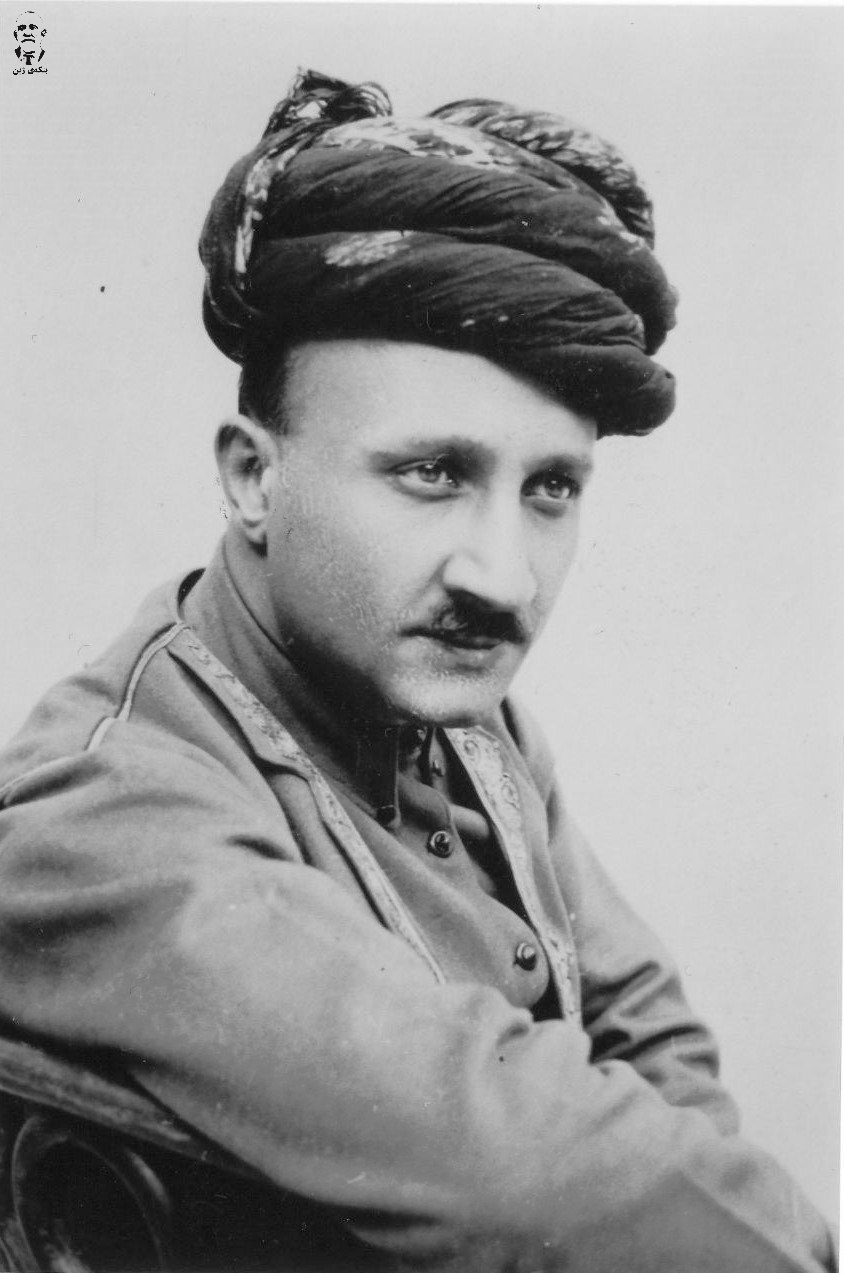

Family background and an uncertain birthplace
Mehmed Uzun identifies Kamuran, Celadet and Süreyya as sons of Emin Ali Bedir Khan and members of the family descended from the ruler of Botan. Süreyya was Kamuran’s brother, not his cousin. [2] The birthplace needs more care than a simple fact box allows. Barbara Henning discusses Kamuran’s own claim to Maqtala in Syria but considers Istanbul probable; Joyce Blau’s introduction to his memoirs gives Damascus. [1] [3] The sources agree on 1895 but do not justify silently making these different locations interchangeable. His life should also be distinguished from those of his brothers: family membership does not transfer one person’s publications or achievements to another.
From legal training to Beirut’s publishing world
Henning traces his legal studies in Germany, a Leipzig doctorate in 1926 and legal practice in Beirut by 1927. [1] Blau’s memoir introduction places his contributions in the Hawar circle, where Kurdish writing and French scholarly contacts met. [3] For his own periodical, the INHA’s AGORHA catalogue identifies Kamuran as founder, publication director and editor of Roja Nû, or Le Jour nouveau, published in Beirut in 1943–1946 in Kurdish and French. It associates the journal with the Khoyboun political milieu. [4] The bilingual publication is a concrete example of cultural work also directed towards readers outside Kurdish-speaking communities. Its dates place it in the Second World War period, rather than the First.
How his Paris teaching position developed
Blau’s account distinguishes successive appointments: a Kurdish cours libre in November 1947, renewed for 1948–49; regularisation in 1953; and a paid teaching appointment in 1960. She dates his final retirement to September 1970. [5] The institution was then the École Nationale des Langues Orientales Vivantes, a predecessor of today’s INALCO. This sequence is more informative than a single claim that he immediately founded a fully established professorial chair on arrival. It shows the gradual work of securing Kurdish teaching within a French educational institution.
Teaching materials with identifiable titles
Blau lists Langue Kurde in two volumes in 1953, followed by revised editions; Xwendina kurdî in 1956; and later reading and grammar materials. She also describes his production and distribution of duplicated teaching texts. [5] These details give practical substance to the phrase language preservation: students needed lessons, reading passages and explanations that could circulate. The dates and titles identify works to investigate; they do not claim that their complete contents or every edition have been examined here.
The memoirs: a document with a transmission history
Blau introduced a published memoir text from Thomas Bois’s archive in Études kurdes in 2000. Her introduction describes an unfinished recollection dictated to Bois in Beirut from 7 to 10 December 1946 and preserved as a typed document. The opening recalls Kamuran’s grandfather and schooling at Galatasaray, including a childhood encounter with Celadet. [3] Such recollections reveal how family history was narrated as well as what was remembered. They should not be treated as an independent contemporary record of every nineteenth-century event they describe. The source consulted here is the edited publication and its introduction, not a claimed inspection of Bois’s original typescript.
Death, archives and the institution founded in 1983
Kamuran died in Paris in December 1978. Henning places his papers at the Kurdish Institute of Paris and distinguishes its later foundation from his earlier Centre d’études kurdes. [1] The institute’s own history dates its creation to February 1983. [6] He therefore could not personally co-found it at that time. A legacy inherited by a later organisation is a meaningful connection without changing the chronology. His contribution is clearer when attached to publications, teaching and documents than to unsupported claims that he created every subsequent diaspora institution. The portrait reproduced here has an identified archive source and licence, but no invented event or photographic date. [7]
Sources and further reading
- Barbara Henning, Narratives of the History of the Ottoman-Kurdish Bedirhani Family in Imperial and Post-Imperial Contexts, especially section 5.3.3, pp. 369–375; selected biographical passages.
- Mehmed Uzun, Bedir Khan, Encyclopaedia Iranica IV/1 (1989), p. 74; family relationships.
- Joyce Blau, introduction and edited Mémoires de l’émir Kamuran Bedir-Khan, Études kurdes 1 (February 2000), especially pp. 71–72 and 76; selected passages.
- Institut national d’histoire de l’art, AGORHA, Roja Nû record; publisher, Beirut, Kurdish and French languages, 1943–1946.
- Joyce Blau, Le gardien de la flamme, online 1 March 2023; recollection of teaching appointments and publications.
- Kurdish Institute of Paris, Qui sommes-nous?; institutional history dating its foundation to February 1983.
- Zheen Archive Center, Kamuran Emin Ali Bedirxan portrait, supplied through the Kurdish Wikimedians cooperation project; date unknown, CC BY-SA 4.0.