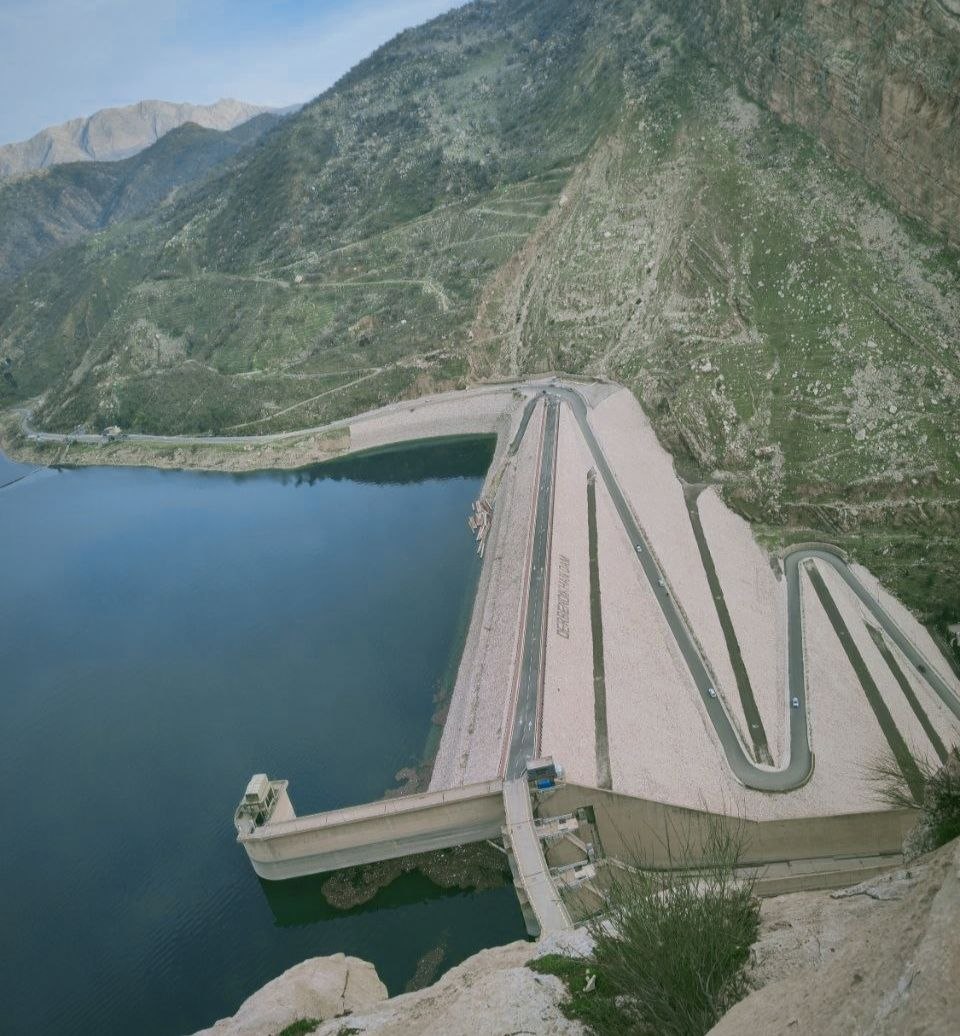
Lake Darbandikhan is a reservoir in Sulaymaniyah Governorate whose history links water storage, irrigation, power generation and the changing condition of its catchment. Archival material, official figures and local research provide a more precise account of the dam and lake.

A reservoir within a cross-border catchment
The lake lies in Sulaymaniyah Governorate in the Kurdistan Region of Iraq. The 2016 Transboundary Waters Assessment Programme profile places its catchment in the Tigris–Euphrates system and identifies Iran and Iraq as the basin’s countries. The profile describes irrigation, flood control, hydropower and recreation among the reservoir’s functions, alongside fisheries and bird life. [1] The reservoir is therefore part of a wider connected landscape. Its water and environmental conditions reflect a catchment extending beyond the visible shoreline.
Construction and the 1961 public record
The TWAP profile dates construction to 1956–1961. [1] A contemporary Arabic booklet, Darbandikhan Dam, survives in the University of Exeter’s Digital Archive of the Middle East. The archive identifies its publisher as Iraq’s Directorate of Popular Arts and Culture under the Ministry of Guidance and dates it to 1961. Its catalogue describes photographs of spillways, intake towers and tunnels, together with technical information and a dedication to Prime Minister Abd al-Karim Qasim. [2] This archival object records how the new infrastructure was presented to the public at the time.
Capacity and a dated comparison of stored water
A KRG water-infrastructure report published on 5 May 2026 lists Darbandikhan’s completion year as 1961, dam height as 128 metres and storage capacity as three billion cubic metres. Its comparison table gives stored water of 2.5 billion cubic metres for 2026 and 1.7 billion for 2025. [3] Capacity and the amount actually held are different measures. The dated comparison illustrates why a fixed storage capacity should not be described as a permanent volume of water in the lake. These published figures belong to the report’s reporting period.
Repair and rehabilitation are part of the history
The World Bank’s October 2008 brief on the Dokan and Derbandikhan hydropower project describes both facilities as parts of multipurpose electricity and irrigation schemes connected to Iraq’s national grid. It attributes deterioration to wars, sanctions, underinvestment and lack of maintenance. [4] A later repair episode followed the 2017 earthquake. In January 2024, Rahman Khani told 964media that a two-year renovation had been completed, covering safety and electrical components, at a reported cost of 2.28 billion dinars. The work involved Czech and local firms and KRG funding. [5] These are separate dated accounts of infrastructure maintenance.
What local environmental research measures
A study published in October 2025 by researchers affiliated with the universities of Sulaimani and Kurdistan and the dam directorate analysed monthly upstream reservoir samples collected in 2013–2018. It examined physicochemical indicators and trace metals and reported several parameters approaching or exceeding the limits used in the study. [6] Its collection dates matter: publication in 2025 does not make those samples a measurement of the lake today. The work documents a need to consider water quality alongside storage and electricity. Such research adds an environmental history to the dam’s construction and repair record.
Sources and further reading
- ILEC, UNEP-DHI, UNESCO-IHP, UNESCO-IOC and UNEP, Water System Information Sheets: Southern and Southeastern Asia (2016), Transboundary Waters: A Global Compendium, volume 6, annex I, pp.30–31; Darbandikhan basin and reservoir functions.
- University of Exeter, Digital Archive of the Middle East, catalogue record for Darbandikhan Dam; Arabic booklet issued by Iraq’s Ministry of Guidance, 1961.
- KRG Department of Media and Information, Comprehensive Data on the Provision, Expansion and Development of Water Infrastructure, 5 May 2026, tables 1–2, pp.5 and 7; dam characteristics and dated stored-water figures.
- World Bank, Rehabilitating Water Infrastructure in Conflict Areas: Iraq’s Dokan and Derbandikhan Emergency Hydropower Project, October 2008, report 46231; published project summary.
- 964media, Darbandikhan Dam Restoration Project Concludes, 8 January 2024; direct account from Rahman Khani on the two-year renovation and funding.
- Rezan Omer Rasheed, Mohammad Khezri, Hussein Salih Ali and Goran Mohamed Mahmood, Temporal Analysis of Physicochemical Parameters and Heavy Metal Contamination in the Water of Derbendikhan Reservoir: A Six-Year Study, 20 October 2025, pp.837–851, DOI 10.17656/11786; abstract, sampling period 2013–2018.