The basalt walls of Diyarbakır surround a historic city above the Tigris. Their gates, changing masonry and medieval reliefs reveal successive building campaigns, while the adjoining Hevsel landscape explains the wider World Heritage designation.
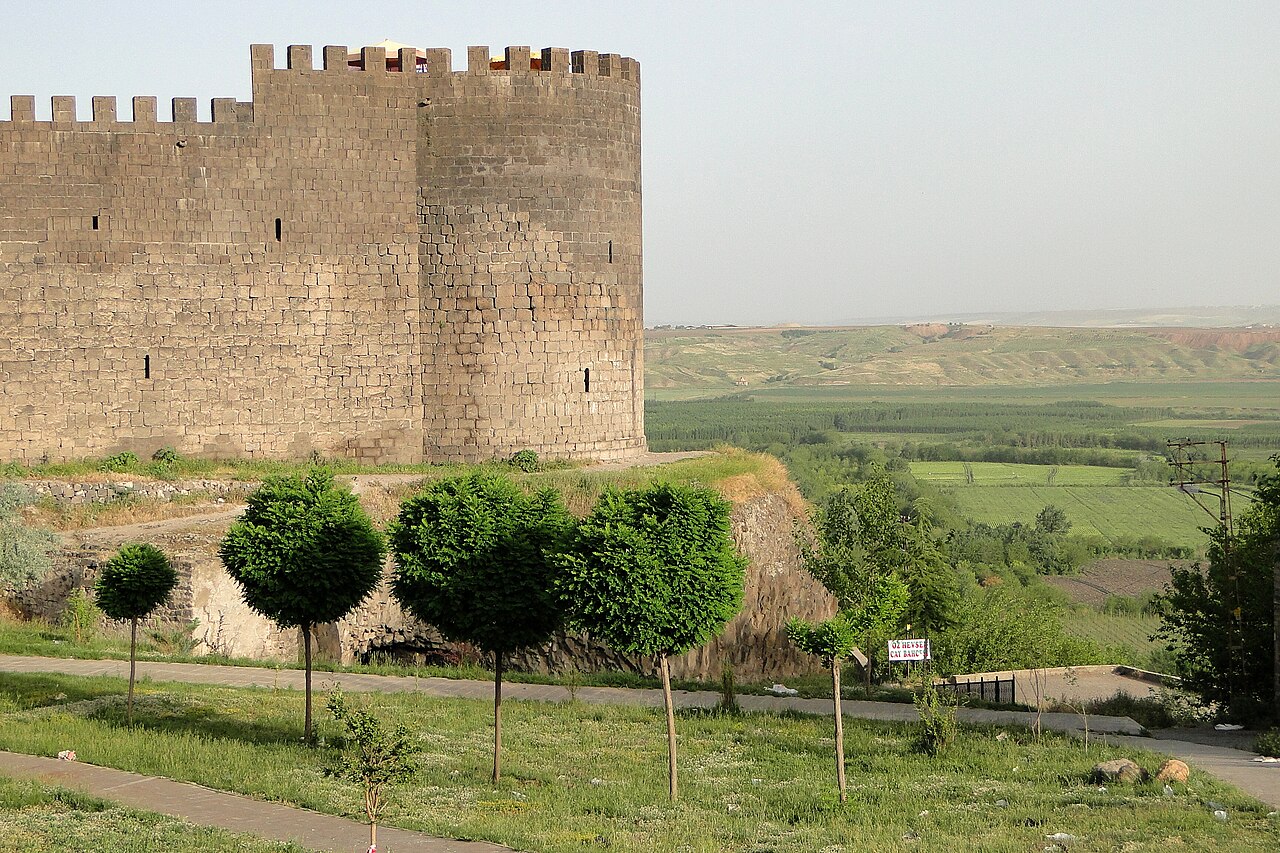
A fortress and a working landscape
UNESCO inscribed the Diyarbakır Fortress and Hevsel Gardens Cultural Landscape in 2015 under criterion (iv). The property connects the Inner Castle, or İçkale, and city walls with gardens, water resources and the Ten-Eyed Bridge. UNESCO records 63 inscriptions from different periods. The Hevsel Gardens historically supplied food and water to the city above the Tigris. [1] Their inclusion explains why the designation concerns the relationship between fortifications, settlement and productive land, rather than an isolated ring of stone.
Why the length figures differ
The provincial Culture and Tourism Directorate distinguishes approximately 5,200 metres around the city from another 599 metres of the Inner Castle wall inside Suriçi, giving roughly 5,800 metres in total. It also distinguishes the historic inventory of 82 outer-wall towers from 19 at İçkale and notes lost towers. [2] These distinctions matter when comparing descriptions: an inventory total should not be presented as a count of fully standing, intact towers. The directorate places the principal Roman building phase in the middle of the fourth century.
Four principal gates
The outer circuit’s main gates are Dağ Kapı toward the north, Urfa Kapı toward the west, Mardin Kapı toward the south and Yeni Kapı toward the east. The Inner Castle has a separate set of gates linking it both to the walled city and the exterior. [2] This is a useful way to orient an architectural reading of the site. It does not mean every gate, tower or wall-top section is currently open to visitors.
How to read the masonry and reliefs
The Culture Ministry inventory describes dressed basalt facing, less worked stone on inner surfaces, and rubble cores bonded with lime mortar; brick appears in tower vaults and domes, while some inscriptions use limestone. It identifies Ben-u-Sen and Yedi Kardeş as Artuqid towers, with inscriptions, double-headed eagles and winged lions. It records a Marwanid inscription at Keçi Burcu and a Seljuk-period Nur tower with carved animals and Kufic writing. [3] These named features make the walls evidence for successive interventions. A photograph of one stretch cannot stand for every tower’s date, material or condition.
Conservation: a dated assessment
In its 2025 decision, the World Heritage Committee acknowledged restoration following the 2023 earthquake but expressed continuing concern about development affecting the property and its buffer zone. It requested measures concerning the Hevsel Gardens, the Ten-Eyed Bridge setting, road projects and Suriçi’s historic fabric, along with a further monitoring mission. It set 1 December 2026 for an updated report and raised possible future inclusion on the List of World Heritage in Danger. [4] That was a warning and request for action, not a statement that such inscription had already occurred.
Sources and further reading
- UNESCO World Heritage Centre, Diyarbakır Fortress and Hevsel Gardens Cultural Landscape, property 1488; 2015 inscription and Statement of Outstanding Universal Value.
- Diyarbakır Provincial Culture and Tourism Directorate, Surlar; dimensions, tower inventories, gates and fourth-century construction phase; citing Nabikoğlu and Dalkılıç, 2013.
- Türkiye Ministry of Culture and Tourism, Diyarbakır Surları, Culture Inventory, updated 9 May 2016; masonry, named towers, inscriptions and reliefs.
- World Heritage Committee, Decision 47 COM 7B.129 (2025), paragraphs 3–10; restoration, landscape and urban-development concerns, monitoring and reporting requests.
- Adam Jones, City Wall and Battlements — Diyarbakir — Turkey, photograph, 30 May 2011; Wikimedia Commons, CC BY-SA 2.0.