Hasankeyf’s cylindrical Aq Qoyunlu mausoleum combines glazed brick, inscriptions and an octagonal interior. Its 2017 relocation preserved a building while changing its relationship to the historic town and surrounding complex.
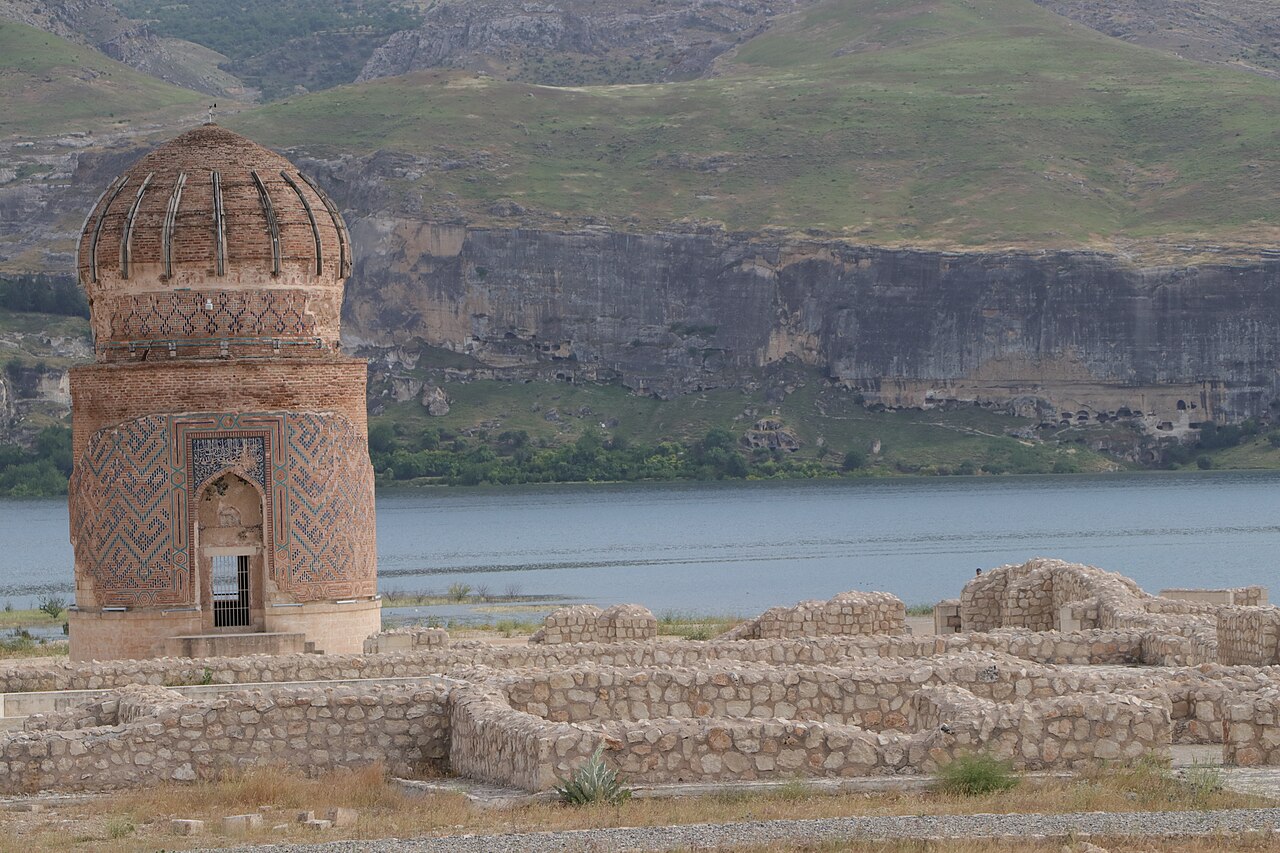

Its location changed in 2017
The Zeynel Bey mausoleum belongs to Hasankeyf in Batman Province, on the upper Tigris in southeastern Turkey. It originally stood on the river’s north bank. It was moved on 12 May 2017 in advance of inundation associated with the Ilısu dam reservoir. [1] [4] Turkey’s Culture Portal identifies its new location as the Hasankeyf Cultural Park, approximately two kilometres from the former position. [7] Descriptions that place it permanently on the old riverbank are therefore misleading. The structure, the original site and the reconstructed visitor setting are related but different things.
Who was commemorated, and how is the date established?
The usual identification is Zeynel Bey, a son of the Aq Qoyunlu ruler Uzun Hasan, associated with the battle of Otlukbeli in 1473. Abdüsselam Uluçam’s architectural entry connects the monument to its inscription and dates construction to around that period rather than citing a surviving exact foundation date. [1] There is a scholarly challenge: Faruk Sümer argued in 1990 that the identification and the inscription’s titles required scrutiny, noting the absence of an account establishing recovery and burial of the prince’s body. [2] His objection should be attributed, not silently turned into proof that the monument is a modern fake. A commemorative inscription and the presence of a verified burial are different questions.
A cylinder outside, an octagon within
The external silhouette is a brick cylinder above a stone base, crowned by a dome. Inside, the principal space is octagonal, with niches, a northern entrance and a southern window. [1] [4] The district’s architectural account describes turquoise and dark-blue glazed brick, mosaic tile, geometric and vegetal decoration and Arabic lettering. [3] Colour is therefore only part of the design: the arrangement of brick and script is built into the surface. The monument is associated with Aq Qoyunlu Turkmen patronage within a region with many communities; calling it part of Kurdish regional history need not change its dynastic attribution.
Craftsmanship and wider connections
Uluçam and the conservation project report give the craftsman’s name as Pir Hüseyin, son of Abdurrahman. [1] [4] Other public descriptions use Pir Hasan, so the spelling should not be treated as settled by repetition alone. [7] The Hasankeyf district account compares the tomb’s design with the tomb-tower tradition of Azerbaijan and Turkistan. [3] Such comparisons help explain why its glazed brick and cylindrical form stand out in the local landscape. They do not by themselves prove that the whole monument was imported, or establish the birthplace of every worker.
How the building was moved
The project report by architect Serap Sevgi and engineer Murat Çetin describes a supported whole-building move using hydraulic lifting and self-propelled modular transporters, rather than dismantling the tomb into individual bricks. It records the transport on 12 May 2017 and discusses preparation of the route, monitoring and the new foundation’s seismic isolation. [4] KURAM, the university conservation centre involved, separately reports testing stone, brick and mortar and using ground-penetrating radar to identify internal weaknesses. [5] Those investigations explain the engineering work behind the move more clearly than calling it simply a “remarkable rescue.”
The surrounding complex did not travel in the same way
The conservation report distinguishes the relocated tomb from the adjacent excavated complex. It describes protective measures and filling over the original remains intended to stay in place under water, alongside reconstruction of a representation of the complex at the new location. [4] This matters when reading photographs: a wall beside the tomb in a later cultural-park view is not automatically an original wall moved intact with it. Preservation of the mausoleum’s masonry and preservation of its archaeological relationships were different tasks, with different outcomes.
Why relocation remained contested
KURAM’s own account stresses that historic buildings gain meaning through their original surroundings and that relocation requires weighing losses as well as benefits. [5] The controversy also produced a complaint concerning the Dutch contractor Bresser. OECD Watch’s case account reports that the Dutch National Contact Point’s final statement of 20 August 2018 found that the company had not fully met due-diligence criteria under the OECD Guidelines. [6] This article cites that network’s account, not a court judgement or a directly consulted final-statement text. The debate concerned consultation and cultural rights as well as whether the building could physically survive transport.
Reading the monument after the move
The tomb remains evidence of late-medieval craftsmanship and dynastic commemoration, while the relocation is now part of its history. Its inscriptions, surviving material and restoration record should be read together. The 2020 photograph illustrates a later setting; the older 2013 architectural description predates the move and should not be used as a current location guide. A precise account can recognise the achievement of moving vulnerable masonry and the loss of original context without treating either observation as a complete history of Hasankeyf.
Sources and further reading
- Abdüsselam Uluçam, Zeynel Bey Türbesi, TDV İslâm Ansiklopedisi (2013); inscription, dating and architecture.
- Faruk Sümer, Remarks on Some Mongol and Turkmen Buildings in Eastern Anatolia, Belleten 54/210 (1990), pp. 641–648, section 10; critical identification argument.
- Hasankeyf District Governorate, Zeynel Bey Türbesi, 20 June 2019; interior plan, glazed decoration and regional comparisons.
- Serap Sevgi and Murat Çetin, The Conservation and Recovery Project of Zeynel Bey Tomb in Hasankeyf, project report, pp. 5, 16–21; architecture, 2017 transport and treatment of the complex.
- Fatih Sultan Mehmet Vakıf University, KURAM, Zeynel Bey Türbesi KURAM’ın Katkılarıyla Taşındı, 24 July 2018; material testing, radar survey and conservation principles.
- OECD Watch, Fivas et al. vs Bresser, case account; allegations distinguished from its summary of the Dutch NCP’s 20 August 2018 outcome.
- Türkiye Culture Portal / Batman Provincial Culture and Tourism Directorate, Zeynel Bey Kümbeti; relocation to the cultural park in 2017.
- VOA Kurdish, Bajarê Heskîfê 2, image record dated 28 May 2020, Wikimedia Commons; public-domain VOA record.
- VOA Kurdish, Hasankeyf before and after inundation, gallery published 30 May 2020; photographs credited to Xecîcan Farqîn.