Behram Pasha Mosque combines a single-domed prayer hall with Diyarbakır’s two-colour stonework. Its inscription, Sinan attribution and conservation surveys reveal different parts of its history.

An Ottoman foundation within the old city
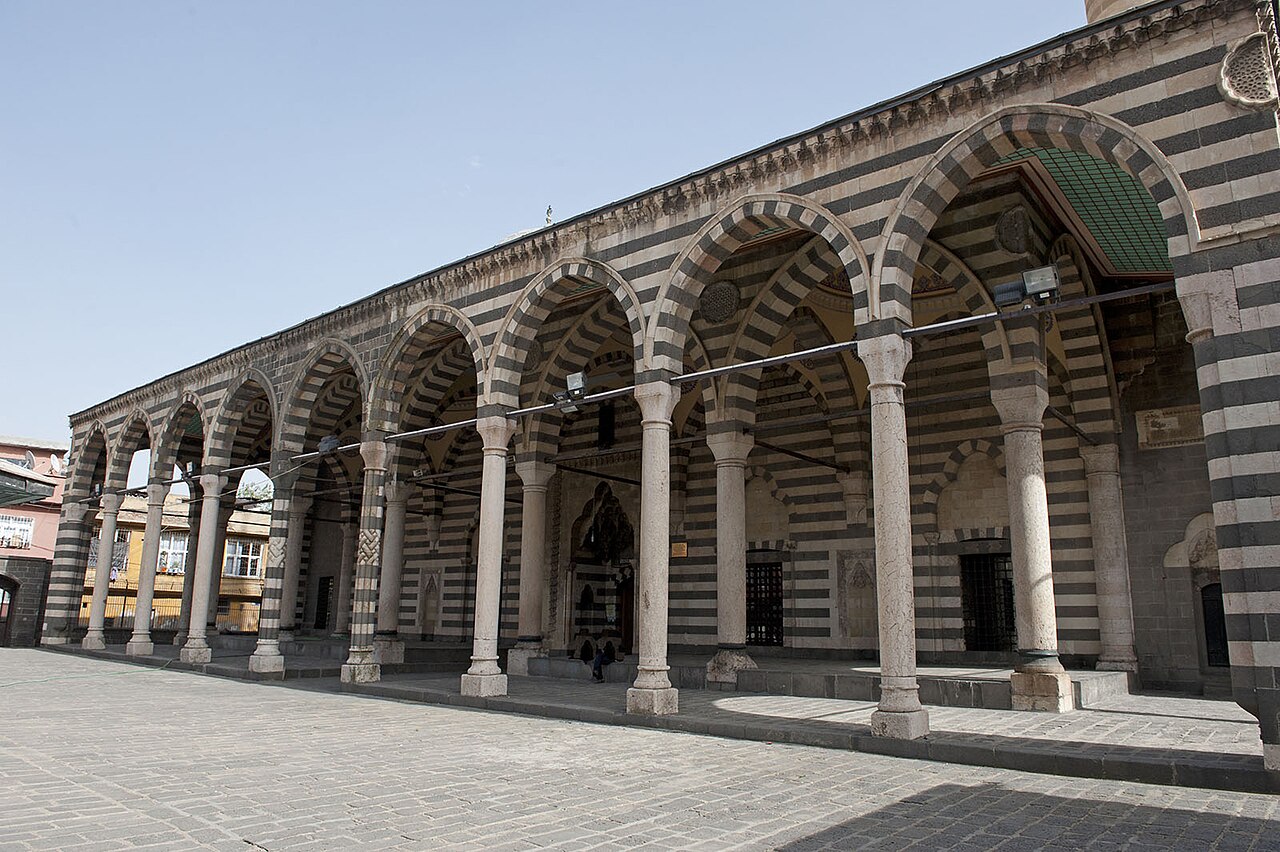
Behram Pasha Mosque stands in the southwestern part of Diyarbakır’s walled city, in the Sur area also known in Kurdish as Amed. The provincial governorate identifies its patron as the Ottoman governor Behram Pasha and describes the square prayer hall, single principal dome and alternating dark and pale masonry. Its position within the old city places it among buildings of different periods and religious communities. The mosque is one particular sixteenth-century foundation within that longer urban landscape. [1] [3]
The inscription and the attribution to Sinan
Ara Altun’s architectural study reads the entrance inscription as dating construction from 972 to 980 AH, conventionally given as 1564–1572; the latter Islamic year extends into 1573. Altun also points out that the mosque appears in only one of the lists of Sinan’s buildings, Tuhfetü’l-mi‘marin. Attribution to Sinan is therefore worth explaining through the documentary record. It does not, by itself, identify who supervised every stage on site or demonstrate that Sinan personally visited Diyarbakır. Patron, design attribution and the craftspeople who executed the building are related questions with different evidence. [2]
How the prayer hall and portico work
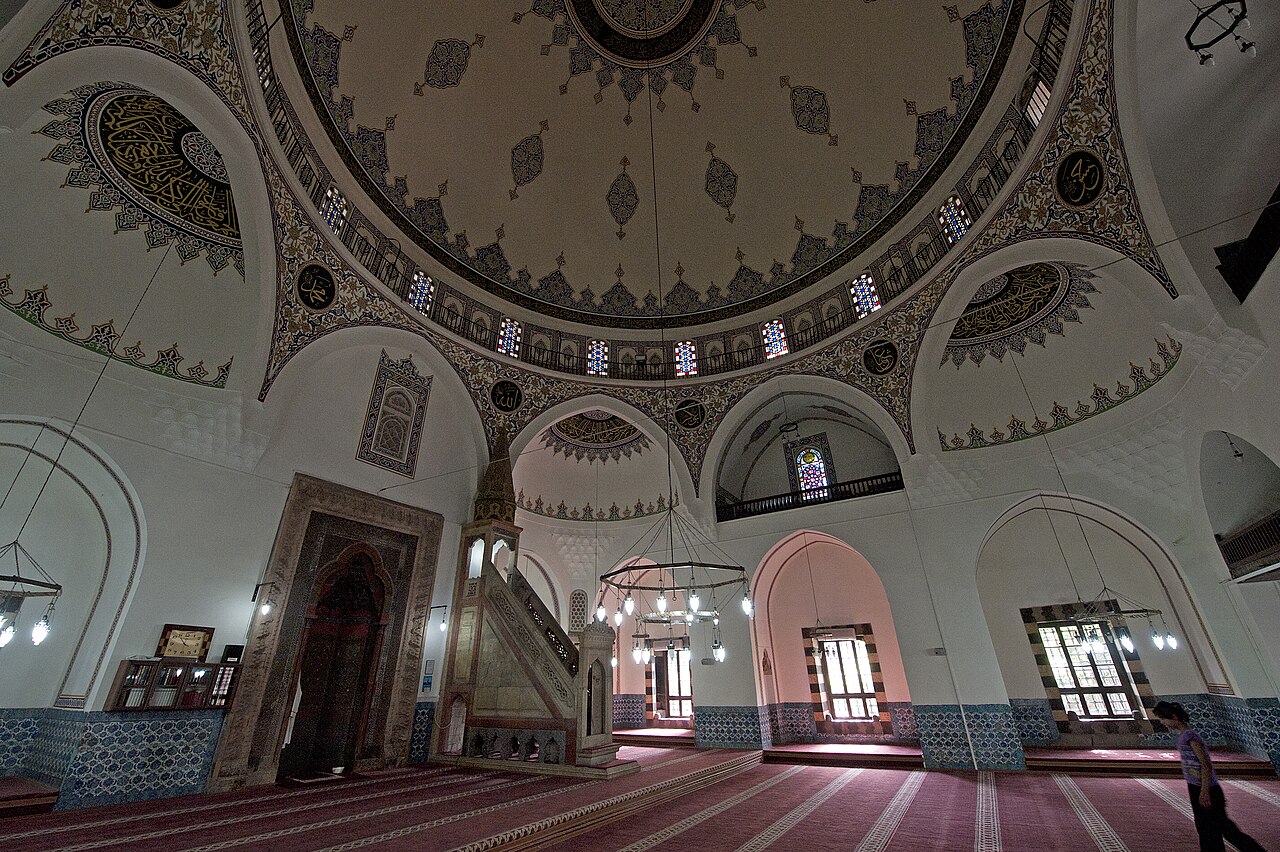
A single large dome covers the main prayer space. Squinches, the structures spanning its upper corners, mediate between the square room and the dome’s octagonal support. Recessed side spaces and upper galleries create a more varied interior than the simple exterior outline might suggest. On the north side, the five-domed inner portico is fronted by another colonnaded shelter with a timber ceiling. Altun relates this generous covered threshold to the regional practice of summer prayer outdoors. The two rows should not be confused with two minarets: the mosque has a cylindrical minaret at its northwestern corner. [2] [3]

Stone, tiles and the photographed interior
The entrance and arcades display alternating courses and arch stones in contrasting colours. Muqarnas, the tiered sculptural cells around the entrance and supports, add depth to the stonework. Inside, tilework covers the lower walls, while the mihrab marks the prayer direction and the adjacent minbar provides the stepped pulpit. Altun identifies sixteenth-century İznik tiles among the interior decoration. The 2010 interior photograph helps readers locate these elements, but its visible painted surfaces should not all be assumed to survive unchanged from the original building campaign. [1] [2] [5] [6]
What a conservation survey found
Nursen Işık’s 2021 research combined observation with ground-penetrating radar to investigate the floors, courtyard and walls. The study mapped cracks, material loss and moisture-related anomalies; some surveyed areas showed no deformation. Its purpose was to identify locations needing attention and inform future restoration. This provides a dated, building-specific account in place of a general claim that the mosque has simply been repaired over the years. Radar results are interpretations of particular survey profiles, and should not be presented as proof that the entire building was collapsing. [3]
Keeping the earthquake evidence dated
The Directorate General of Foundations’ post-earthquake inventory lists the mosque and fountain as slightly damaged in the 6 February 2023 earthquake. That classification comes from the authority’s published inventory, while Işık’s survey predates the earthquake. Neither source establishes every detail of later repairs or current visitor access. Keeping their dates visible allows readers to distinguish long-term conservation problems, an earthquake assessment and the earlier photographs reproduced here. [4]
Sources and further reading
- Diyarbakır Governorate, Behram Paşa Cami ve Külliyesi (7 February 2025): patron, location, stonework and plan.
- Ara Altun, “Behram Paşa Camii,” TDV İslâm Ansiklopedisi 5 (1992), pp. 356–357: inscription, attribution, architectural analysis and tiles.
- Nursen Işık, “Investigation of structural problems … by the georadar (GPR) method,” Dicle University Journal of Engineering 12/4 (2021), pp. 689–698, DOI 10.24012/dumf.1002241: original field observations and survey.
- Directorate General of Foundations, post-earthquake inventory, p. 76: Behram Pasha Mosque and Fountain classified as slightly damaged on 6 February 2023.
- Dosseman, Behram Pasha Mosque portico, 13 June 2010, Wikimedia Commons, CC BY-SA 4.0.
- Dosseman, Behram Pasha Mosque interior, 13 June 2010, Wikimedia Commons, CC BY-SA 4.0.