The detached minaret of Şeyh Mutahhar Mosque is both a distinctive structure and a place of public remembrance. Its inscription, architectural survey and earthquake research give a more precise history than claims of unexplained uniqueness.
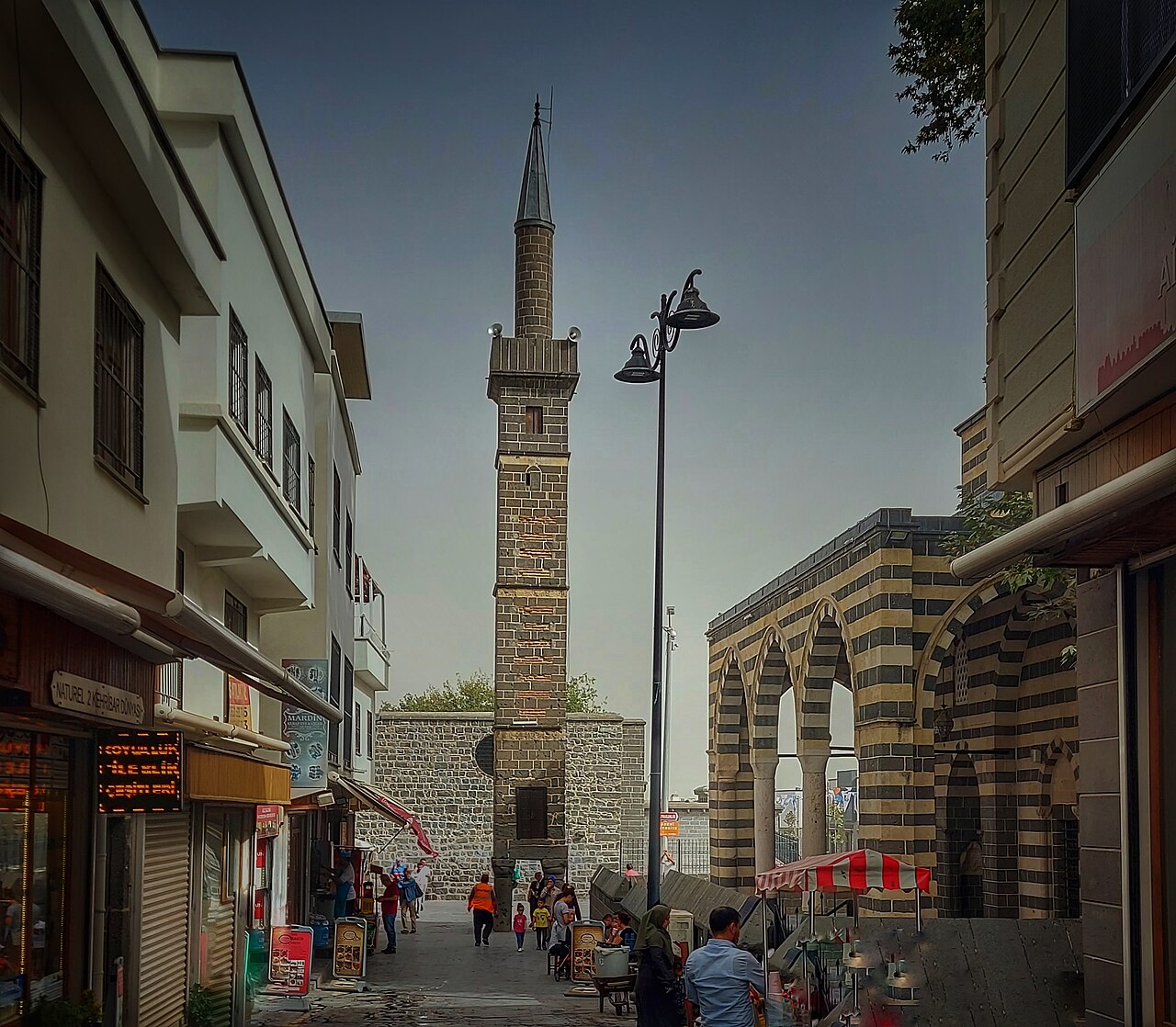

A mosque and a detached street landmark
Known as Dört Ayaklı Minare in Turkish, the tower stands beside Şeyh Mutahhar Mosque in Diyarbakır (Amed)’s walled Sur district. The mosque is also called Şeyh Matar or Kasım Padişah. The Culture Ministry inventory places it on Yenikapı Street and describes a square, single-domed prayer hall and a minaret independent of the mosque. The open base is central to its street presence: the tower is supported by columns rather than a continuous masonry pedestal. [1]
What the inscription actually names
Mehmet Top and Erkan Koç’s architectural survey transcribes the Arabic building inscription. It dates the minaret to AH 906, conventionally given as 1500, during the reign of the Aq Qoyunlu ruler Sultan Kasım, and names Hacı Hüseyin, son of Hacı Ömer, in connection with the work. Naming the ruler and naming the person responsible are therefore different pieces of information. The authors locate the construction text on the north and east sides of the lower inscription band; other bands contain Qur’anic verses. [2]
Reading the tower from the ground upward
Top and Koç describe four substantial columns, a square shaft divided by cornices, a square balcony, and a cylindrical upper section ending in a cap. Their survey gives an overall height of 23.70 metres. The materials include basalt, white limestone and brick; the tower is not simply one uniformly striped stone block. The capitals vary to accommodate differences among the supporting columns. These details make the design intelligible without describing the structure as an architectural impossibility. [2]
Earthquakes, cracks and careful repair
H. Polat Gülkan, İlker Kazaz and Emriye Kazaz’s 2026 study combines inspection with structural modelling and nearby earthquake records. It reports only slight effects from the February 2023 earthquakes and describes earlier carbon-fibre strengthening of cracked lintels. Their analysis explains a load path through the stone courses toward the supporting corners, rather than assuming the entire weight simply bends the middle of each lintel. The authors stress that interventions require careful study: survival does not mean immunity from future damage. Their introduction also records the interpretation linking the four supports to four Islamic legal schools; this is an interpretation, not an inscription establishing the builder’s intention. [3]
Tahir Elçi and the monument’s modern memory
The minaret is also inseparable from the memory of lawyer and Diyarbakır Bar Association president Tahir Elçi. In its statement of 4 December 2015, the association recorded that he was killed on 28 November after speaking about damage to the minaret and other cultural heritage in Sur. The statement is a contemporary institutional source for that connection, as well as the association’s demand for an effective investigation. It should not be turned into an unattributed finding about who fired the fatal shot. [4]
A place people continue to gather
The Bar Association’s own account of 28 November 2024 describes a march from the courthouse to the minaret and a commemorative gathering with Elçi’s family, lawyers and civic representatives. It documents how a historic building became a place for expressing grief, defending heritage and demanding justice. [5] The 2022 photograph shows another aspect of the site: pedestrians, shops and the mosque’s patterned arches around the tower. Keeping its date visible helps readers distinguish a streetscape photograph from evidence of later structural condition. The minaret’s history includes construction, maintenance and public memory, each supported by a different kind of source. [6]
Sources and further reading
- Republic of Türkiye Culture and Tourism Ministry, Şeyh Mutahhar Camisi (Dört Ayaklı Minare), cultural inventory, updated 2016: address, mosque plan and detached minaret.
- Mehmet Top and Erkan Koç, “Diyarbakır’ın Osmanlı Dönemi Öncesi Cami ve Mescitleri,” in Medeniyetler Mirası Diyarbakır Mimarisi (2011), pp. 247–248: inscription and architectural survey.
- H. Polat Gülkan, İlker Kazaz and Emriye Kazaz, Turkish Journal of Civil Engineering 37/3 (2026), pp. 29–46, DOI 10.18400/tjce.1732086: post-earthquake assessment, strengthening and structural behaviour.
- Diyarbakır Bar Association, statement concerning the killing of its president, 4 December 2015: heritage statement, death and demands for investigation.
- Diyarbakır Bar Association, own account of the march and Tahir Elçi commemoration at the minaret, 28 November 2024.
- H.H.ALMAS, Dört Ayaklı Minare, 4 October 2022, Wikimedia Commons, CC BY-SA 4.0: dated streetscape photograph.