top of page

Kay Kavus: The Flawed King of the Kayanians

Illustrated banner of Kurdish and Iranic mythology evoking Kay Kavus, the proud Kayanian king of the Shahnameh on his eagle-borne flying throne, alongside Kawa the Blacksmith, the Newroz fire, the Simurgh and the tanbur


Introduction


Kay Kavus is the great flawed king of the Iranic epic, a brave but reckless monarch whose pride, vanity and poor judgement bring one disaster after another upon himself and his people. The second king of the legendary Kayanian dynasty, he holds the divine glory of kingship in his hands and yet seems forever to misuse it, blundering into catastrophe and being rescued, again and again, by the mighty champion Rostam. He is one of the most vivid and human characters in the whole tradition: not a villain, but a cautionary tale.


His follies are famous. He leads a vainglorious invasion of the demon-land of Mazandaran and is blinded and captured; he builds a throne borne aloft by eagles in a mad attempt to fly to heaven, and crashes to earth; he is led astray by a treacherous wife whose schemes destroy his own noble son. That son was the pure prince Siyavash, and the tragedy of his death, set in motion by his father's weakness, would shape the rest of the epic and pass, in time, to Kavus's far worthier grandson, Kay Khosrow.


Kay Kavus is, in the end, the epic's profound study of bad kingship. He shows that bravery and even greatness are not enough in a ruler, and that a king's private failings of character can bring public ruin. To understand him is to understand the Iranic ideal of the just king all the more clearly, by seeing its opposite, and to feel the deep truth that the divine glory of kingship is a moral trust, not merely a possession.


Contents


Who Is Kay Kavus?


Kay Kavus (in the Avestan language Kavi Usan) is a legendary king of Iranic mythology, the second ruler of the Kayanian dynasty in the Shahnameh. The son of the dynasty's founder Kay Qobad, and the father of Siyavash and grandfather of Kay Khosrow, he is famous as a brave but deeply flawed monarch whose pride and folly lead to repeated disasters: the failed invasion of Mazandaran, the absurd flight to heaven on an eagle-borne throne, and the trust in his wicked wife Sudabeh that destroys his own son. He is rescued time and again by the hero Rostam.


Key Takeaways


  • Kay Kavus is the second king of the legendary Kayanian dynasty.

  • He is the father of Siyavash and grandfather of Kay Khosrow.

  • Brave but proud and rash, he brings repeated disasters upon Iran.

  • His follies include the Mazandaran invasion and a flight to heaven.

  • He is rescued again and again by the champion Rostam.

  • His weakness drives his noble son Siyavash to exile and death.


Quick Facts


  • Name: Kay Kavus (Avestan Kavi Usan; Pahlavi Kay Us)

  • Type: Legendary king, the second of the Kayanian dynasty

  • Lineage: Son of Kay Qobad, father of Siyavash, grandfather of Kay Khosrow

  • Character: Brave but proud, rash and easily misled

  • Reign: 150 years in the tradition

  • Great follies: The Mazandaran invasion, the flight to heaven, the trust in Sudabeh

  • Repeatedly saved by: Rostam, the champion of Iran

  • His tragedy: His weakness drives his son Siyavash to exile and death

  • Holds: The farr, the divine royal glory of the Kayanians

  • Attestation: The Avesta (as Kavi Usan) and the Shahnameh of Ferdowsi


The Kayanian King


Kay Kavus belongs to the Kayanian dynasty, the second great line of legendary Iranian kings, who succeeded the ancient Pishdadians. The title Kay comes from an old word that first meant something like a poet-priest or seer and came to mean king, and the Kayanian rulers were believed to hold the kavaem kharenah, the divine royal glory or farr that marks the rightful sovereign. Kavus was the son of the dynasty's founder, Kay Qobad, and he inherited both the throne and the sacred glory of his house.


By the measure of the epic he reigned for a vast span of a hundred and fifty years, and he was no weakling in battle; he was a brave and capable warrior who held his enemies at bay and extended the power of Iran. But his character was fatally flawed. He was vain, impulsive, credulous and easily flattered, quick to grand ambitions and slow to wise counsel, and these failings, not any lack of courage, are the thread that runs through his whole troubled reign. He held the glory of kingship, but he was forever proving himself unworthy of it, and it would in time pass to his grandson Kay Khosrow.


The Disaster in Mazandaran


The first of his great follies set the pattern. Tempted by a demon disguised as a wandering minstrel, who sang to him of the wonders and riches of Mazandaran, and ignoring the urgent warnings of the wise old hero Zal, Kavus led the army of Iran into that demon-haunted land to make himself its master. It was a reckless, prideful campaign, and it ended in catastrophe: the dreaded White Div and the Divs of Mazandaran fell upon the Iranians with sorcery, struck them blind, and took the king and his whole host captive.


It fell to others to undo the king's mistake. Zal sent his son, the young Rostam, who braved the perilous road and its terrors, the celebrated Seven Labours, slew the demon-commanders and at last the White Div himself, and with the blood of the demon's heart restored the sight of the blinded king and his men. Kavus was freed and led home, his disastrous adventure redeemed entirely by the courage of the hero. It would not be the last time.


The Flight to Heaven


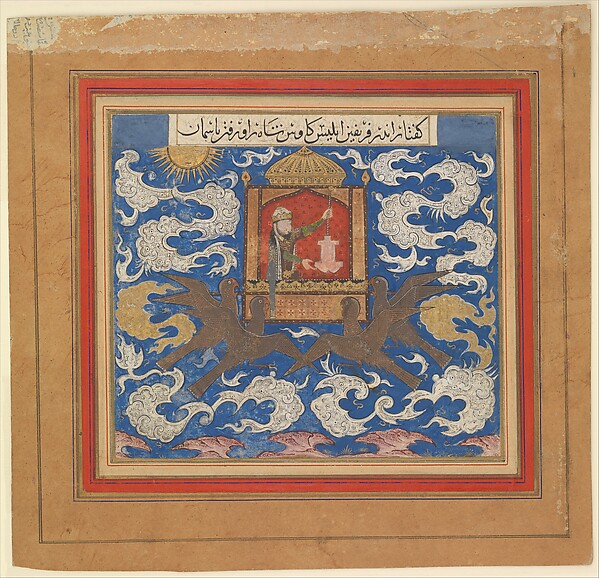
If Mazandaran showed his earthly ambition, Kavus's next great folly reached for the sky itself. Filled with pride and longing to rule not only the earth but the heavens, he conceived an astonishing scheme. He had a throne built and fixed to it four tall poles, and to the foot of each he chained a powerful eagle, with a piece of meat set just out of reach at the top. When the hungry eagles strained upward toward the meat, they lifted the throne, and the king, into the air.


Up and up the strange craft rose, bearing Kavus far across the world toward the heavens he meant to conquer. But the eagles tired at last, and the throne plunged to earth, leaving the would-be lord of the sky stranded and humiliated in the wilderness. Once again it was Rostam who came to find and rescue him. The image of the king borne aloft by eagles, grasping at heaven only to fall, became one of the most famous emblems in all the tradition of overreaching pride, an Iranic cousin to the Greek tale of Icarus.


Hamavaran and Sudabeh


Another of Kavus's adventures brought him a wife who would prove his undoing. In a campaign against the land of Hamavaran, he defeated its king and demanded the hand of his beautiful daughter, Sudabeh. The marriage was made, but the king of Hamavaran, nursing his defeat, treacherously seized Kavus and his nobles and threw them into a fortress prison. Sudabeh, devoted at first, shared his captivity, and yet again it was Rostam who marched to the rescue, shattered the treacherous king's power, and set Kavus free.


Sudabeh returned with him to Iran as his queen, and in time she became the dark instrument of the epic's greatest tragedy. For Kavus had a son by an earlier marriage, the pure and noble prince Siyavash, and the stage was set for a catastrophe that all of Kavus's bravery could not prevent and that his weakness of character would help to cause.


The Tragedy of Siyavash


The noble Siyavash, grown into a handsome and virtuous young man, came to his father's court, and there his stepmother Sudabeh conceived a guilty passion for him. When the upright prince refused her, her love turned to hatred, and she falsely accused him of trying to force himself upon her. To prove his innocence, Siyavash submitted to a fearful ordeal, riding on horseback straight through a towering wall of fire; he emerged on the far side untouched, his purity made plain for all to see.


Here Kavus's deepest flaw undid him. Though Sudabeh's guilt was clear, the king, weak-willed and besotted, could not bring himself to punish her, and pardoned her instead. Wounded by his father's faithlessness and unwilling to live amid such poison, Siyavash went into exile in Turan, where he was eventually murdered by the enemy king Afrasiab at the urging of the schemer Garsivaz. The blame is not Kavus's alone, yet the tradition does not excuse him: it was his capricious, suspicious nature and his weak indulgence of the guilty queen that drove his blameless son to his death. The flawed king's worst failing brought about the central tragedy of the whole epic.


The Sacrificer on the Eagle Mountain


Kay Kavus is far older than Ferdowsi's epic, and the most ancient layers of the tradition already know him as a mighty and ambiguous figure. In the old Avestan hymns he appears as Kavi Usan, a king of great glory who offered sacrifice to the lady of the waters, Anahita, upon the Eagle Mountain, and who was said to rule over both demons and men.


Even there, the seeds of his later character are visible. The old tradition tells that the demons, plotting his downfall, sent Wrath itself to work upon him, filling him with discontent and prideful ambition, and that he ruled for many years before, in his pride, he sought to rise to the sky, and many years after his fall. The reckless, heaven-storming king of the epic is thus the heir of a very ancient figure: a great but dangerous monarch whose immense power was always shadowed by the temptation to overreach.


Symbolism


Kay Kavus is the Iranic epic's great portrait of the flawed ruler, and his meaning lies precisely in the gap between his power and his character. He has courage, energy and the divine glory of kingship, everything a great king should possess except wisdom and self-mastery. Vain, impulsive and easily deceived, he turns each of his gifts toward folly, and only the constant sacrifice of his heroes saves his realm from the consequences of his blunders. He embodies the truth that to rule is not merely to be strong, but to be wise and just.


His story carries a sober political and moral lesson that the epic states through him more sharply than through any other figure: that kingship is a sacred trust, and that the private failings of a ruler, his pride, his credulity, his weakness of will, become public catastrophes that fall upon thousands. The divine glory he holds does not make him good; it only raises the stakes of his folly. In Kavus, the Iranic imagination warns that the holder of great power who lacks character is among the most dangerous of all figures.


The Foil to Kay Khosrow


Kay Kavus is best understood beside his grandson and successor, Kay Khosrow, for the two are deliberate opposites, and the epic sets them as a study in contrasts. Where Kavus is rash, prideful and the cause of tragedy, Kay Khosrow is wise, just and the one who sets the world right, avenging the murder of his father Siyavash and ending the long war.


The same divine glory of kingship passes from the unworthy hand to the worthy one, and the difference between them is the difference between bad and good rule itself. And where Kavus grasped after heaven in his pride and fell, Kay Khosrow, at the height of his power and goodness, willingly laid down his crown and ascended into the mountain mists, renouncing the very glory his grandfather had tried to seize. Grandfather and grandson together form the epic's complete meditation on what makes a king great or ruinous.


Kay Kavus and the Kurds


As one of the great kings of the Iranic epic, Kay Kavus belongs to the shared heritage of all the Iranic peoples, the Kurds among them. The whole Kayanian cycle, with its tragedies of Siyavash and its triumphs of Kay Khosrow, is part of the common Iranic inheritance that the Kurds carry alongside their own beloved legends, and its deep reflections on the nature of just and unjust kingship speak to all the peoples who share that tradition.


As always with this heritage, it would be wrong to claim Kay Kavus as a uniquely Kurdish figure. He is the common inheritance of a whole family of peoples, and his fullest form is in the Persian epic of Ferdowsi. But the Kurds may rightly count this brave and foolish king among the legends of their wider world, the cautionary mirror in which the ideal of the good ruler is reflected, and which gives the heroic age much of its drama and its moral depth.


Debates and Misconceptions


Is Kay Kavus simply a fool or a villain? Neither. He is a genuinely complex and tragic figure: a brave and capable king undone by flaws of character rather than by wickedness. He is not evil, and he is capable of nobility and remorse, but he is weak, proud and credulous, and the epic studies him with real subtlety as a portrait of how a not-bad man can be a disastrous ruler.


Was Kay Kavus a historical king? No, he is a legendary figure of the Kayanian dynasty, which belongs to myth rather than recorded history. He appears already in the ancient Avesta as Kavi Usan, a name with a cognate in the sage-figure of old Indian tradition, marking him as a very old inheritance of the shared Indo-Iranian past rather than a datable monarch.


Is Kay Kavus Persian or Kurdish? Like the rest of this heritage, he belongs to all the Iranic peoples in common. His fullest form is in the Persian Shahnameh, yet he is the shared inheritance of Persians, Kurds and their neighbours alike. He is best understood not as the property of one nation but as part of a treasure held by a whole family of peoples.


  • Siyavash: the pure son whom Kavus's weakness drove to exile and death

  • Kay Khosrow: the just grandson who is Kavus's deliberate opposite

  • Rostam: the champion who rescued the king from folly again and again

  • The Divs: the demons of Mazandaran who blinded and captured Kavus

  • Afrasiab: the Turanian king who murdered Kavus's son Siyavash

  • The Shahnameh: the Book of Kings, which tells the tale of Kavus


Frequently Asked Questions


Who is Kay Kavus?


Kay Kavus is a legendary king of the Iranic epic, the second ruler of the Kayanian dynasty in the Shahnameh. He is famous as a brave but deeply flawed monarch, father of Siyavash and grandfather of Kay Khosrow, whose pride and folly bring repeated disasters that the hero Rostam must undo.


What were Kay Kavus's great follies?


Chiefly three: the prideful invasion of Mazandaran, where the demons blinded and captured his army; the building of an eagle-borne throne on which he tried to fly to heaven and crashed; and his weak trust in his wicked queen Sudabeh, which led to the death of his son Siyavash.


How did Kay Kavus try to fly to heaven?


He had a throne built with four poles, chained a powerful eagle to the foot of each, and fixed meat just out of their reach above. As the hungry eagles strained upward they lifted the throne into the sky, carrying the king far off, until they tired and the throne crashed to earth, where Rostam rescued him.


How is Kay Kavus connected to Siyavash?


Siyavash was his son. When the queen Sudabeh falsely accused the prince, Kavus, though Siyavash proved his innocence by riding through fire, weakly pardoned the guilty Sudabeh. This drove Siyavash into exile in Turan, where he was murdered, the central tragedy of the epic.


Who rescued Kay Kavus from his disasters?


The great champion Rostam, again and again. Rostam freed him from captivity in Mazandaran through the Seven Labours, rescued him after the flight to heaven, and saved him from imprisonment in Hamavaran. Kavus's reign depended constantly on the hero's strength and loyalty.


Was Kay Kavus a real king?


No, he is a legendary figure of the Kayanian dynasty, which belongs to myth rather than history. He appears in the ancient Avesta as Kavi Usan, a very old figure of the shared Indo-Iranian tradition, not a historical monarch who can be dated.


References and Further Reading


Comments


bottom of page