The Kurdish Textile Museum brings rugs, clothing and other woven objects into the historic setting of Erbil Citadel. Published fieldwork, a conservation study and interviews with founder Lolan Sipan document the collection’s importance and the practical challenges of passing on textile skills.

A museum established to preserve textile heritage
The museum began in 2004 under Lolan Sipan, whose collecting and research focused on Kurdish textiles. A 2012 conservation paper by Anne-Marie Deisser and Sipan described the museum’s work documenting, conserving and displaying a collection then reported as 2,000 textiles. [1] Their account connects objects with the materials, livelihoods and changing circumstances of the communities that made them. The museum’s purpose therefore extends from preserving finished pieces to understanding the practices through which they were produced. The collection figure belongs to that dated publication and should not be treated as a current inventory.
The citadel setting
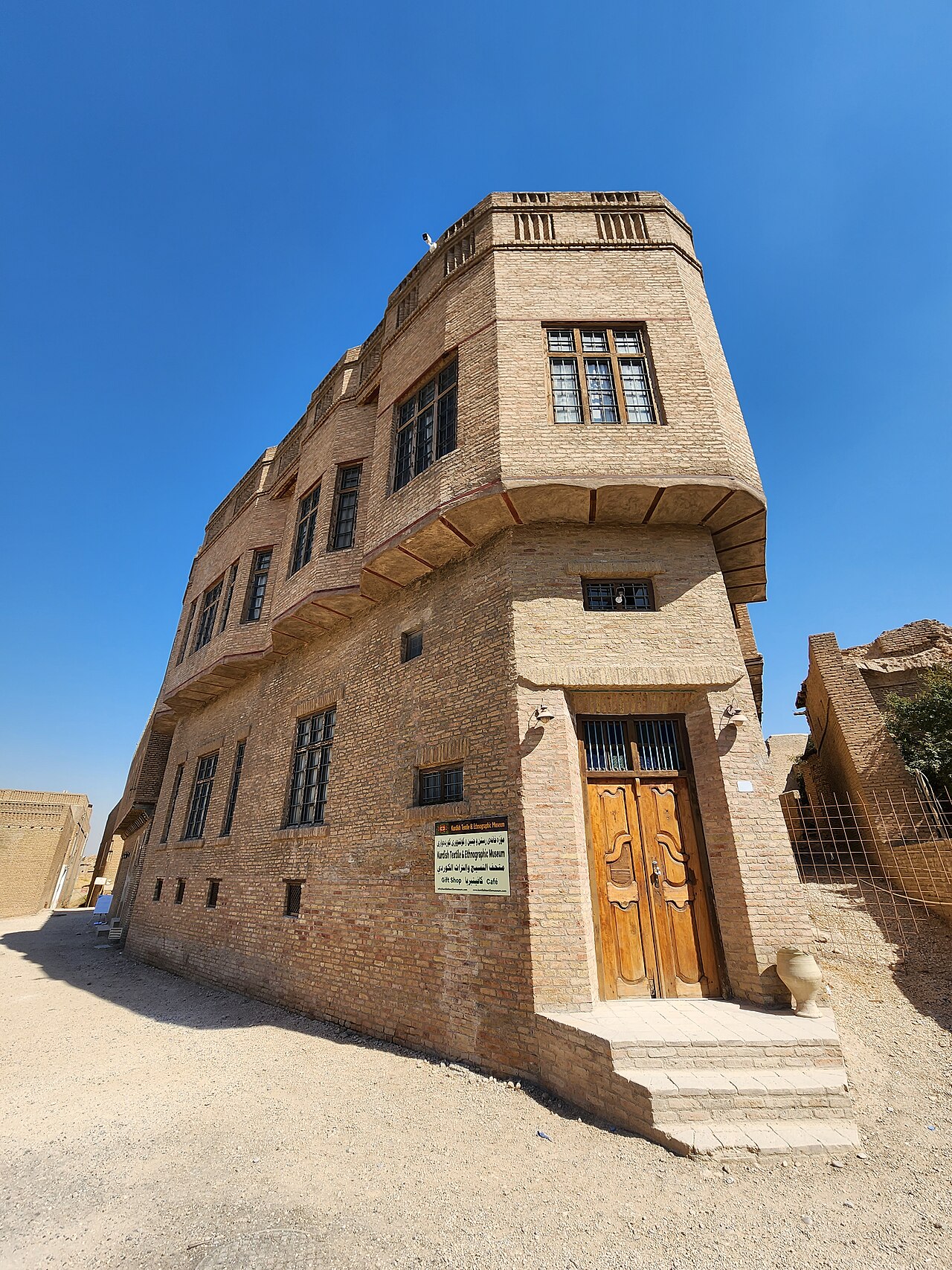
UNESCO describes Erbil Citadel as a fortified settlement built on an oval tell, formed through successive generations of occupation and rebuilding. Its visible urban fabric includes nineteenth-century facades and a fan-like street pattern associated with the late Ottoman period. The citadel entered the World Heritage List in 2014. [2] The textile museum occupies a historic brick building within this settlement. Its location allows the history of domestic objects to be read alongside the city’s surviving architecture. The dated exterior photograph records the museum building in 2022.
What field research reveals about the collection
Reyhane Mirabootalebi’s 2021 dissertation draws on museum visits and interviews conducted in 2018. She describes textiles from settled and semi-nomadic groups, with labels giving type, date and tribal associations in Kurdish, Arabic and English. Examples included pieces associated with Bradost, Herki, Dizai and Jaf communities. [3] Her observations also show the importance of provenance: staff sometimes knew an object’s maker or previous owner.

Woven objects had different jobs
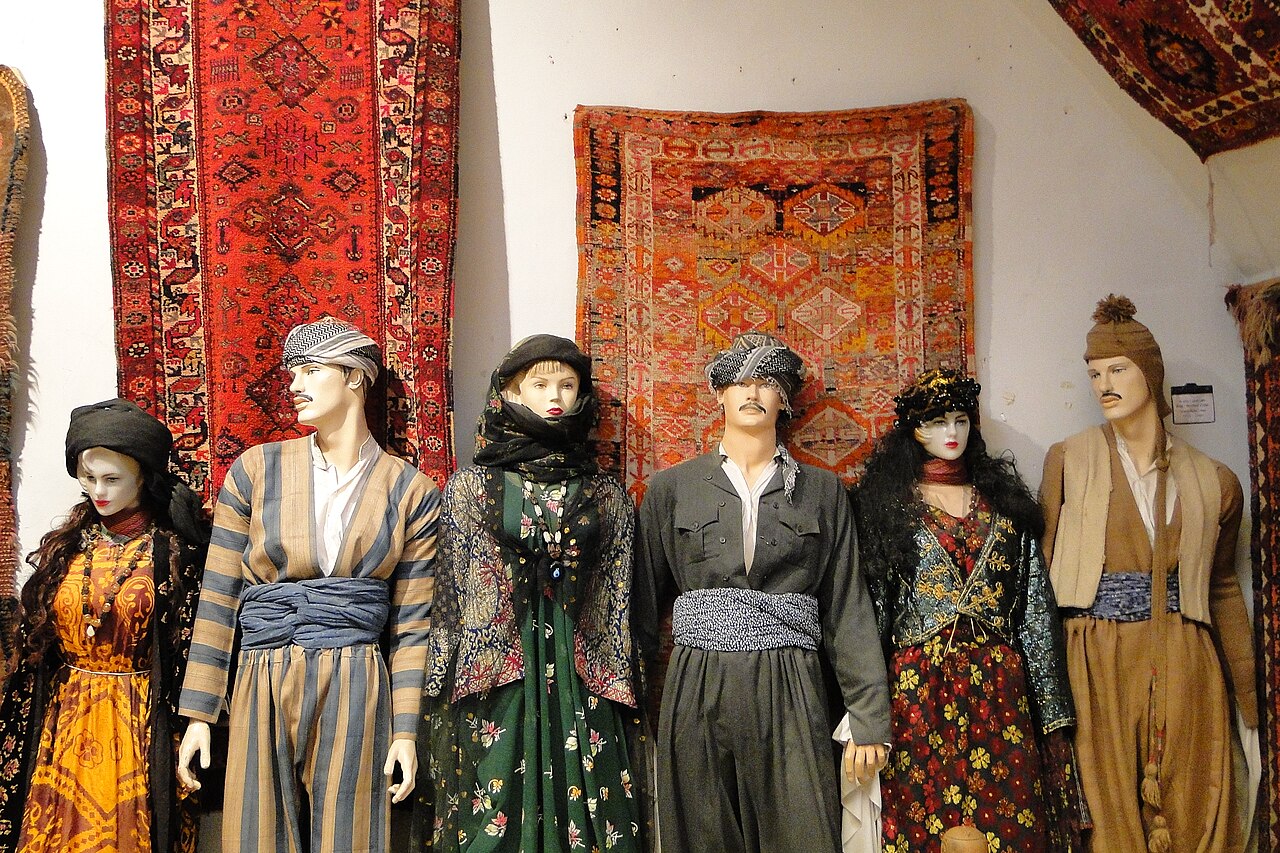
During her visit reported in Geographical in 2022, Hadani Ditmars interviewed Sipan and described objects including a saddlebag, a baby carrier and a mattress. [4] These examples help explain why a textile collection includes more than carpets made for floors. A woven piece may have carried possessions, supported a child, furnished a dwelling or served an aesthetic purpose. The costume photograph offers another view of textile use, showing complete outfits with belts, head coverings, patterned fabrics and contrasting cuts. Recognising function makes it easier to compare objects without assuming that a repeated motif always has one universal meaning.
Natural dyes involve knowledge as well as colour
Evan Mati and Hugo de Boer’s 2010 study investigated dye-plant knowledge through interviews and recognition and sorting tasks with people in the Soran district and weaving teachers and students in Erbil. They found that detailed practical knowledge persisted among experienced older people but was eroding, and they emphasised transfer between generations. [5] The study provides a concrete research basis for understanding why conserving samples alone is insufficient. Locating a plant, preparing material and producing a colour involve learned practices and local knowledge as well as a finished dyed thread.
Weaving projects and their funding limits
Mirabootalebi traces a museum weaving project that began in 2008, bringing experienced artisans and younger trainees together. Her account says funding difficulties forced that programme to stop in 2014; during her 2018 visit she found no active workshops. [3] This dated evidence supports recognition of the teaching initiative and its limits. Preserving a collection and sustaining paid craft training require different resources. These historical accounts do not establish the availability of demonstrations today.
Sources and further reading
- Anne-Marie Deisser and Lolan Sipan, Decorative Art or Art Practice? The Conservation of Textiles in the Kurdish Autonomous Region of Iraq, Studies in Conservation 57/sup1 (2012), S80–S86; public abstract and museum’s conservation account.
- UNESCO World Heritage Centre, Erbil Citadel, inscribed 2014; archaeological mound, late Ottoman urban fabric and architectural setting.
- Reyhane Mirabootalebi, Kurdish Flatweaves and Weavers: Cultural Interweaving and Unraveling, PhD dissertation, University of Delaware, 2021, pp.92–94 and 102–104; first-hand museum research and interviews in 2018.
- Hadani Ditmars, Restoring Erbil’s Ancient Citadel, Geographical, 17 July 2022; museum visit and interview with Lolan Sipan on textile uses and collecting.
- Evan Mati and Hugo de Boer, Contemporary Knowledge of Dye Plant Species and Natural Dye Use in Kurdish Autonomous Region, Iraq, Economic Botany 64 (2010), 137–148, DOI 10.1007/s12231-010-9118-z; public abstract and fieldwork methods.