Tur: The Son of Faridun Who Slew Iraj
- Sherko Sabir

- 2 hours ago
- 13 min read

Introduction
Tur is one of the most fateful figures of the Shahnameh, the Persian Book of Kings: the son of the great hero-king Faridun whose envy and fratricide set in motion the long and bitter wars between Iran and Turan that fill more than half the epic. It was Tur who, with his brother Salm, murdered their noble younger brother Iraj, and so opened a blood-feud between two branches of one family that would run for generations.
Given the eastern land of Turan when his father divided the world among his three sons, Tur grew envious that the choicest portion, the heartland of Iran, had gone to the youngest brother Iraj. Consumed by greed and jealousy, Tur slew Iraj and sent his head to their father, an act of fratricide that the epic presents as the very origin of the great enmity. From Tur would descend the Turanians, the legendary eastern people who became Iran's eternal rivals, including the dread king Afrasiab; and Tur himself would in the end fall to Iraj's avenging grandson, Manuchehr.
Like all the figures of the Book of Kings, Tur belongs to the shared epic heritage of the Iranian peoples, a tradition the Kurds hold in common with the Persians, the Lurs, and others of the Iranic world. To know Tur is to encounter the figure at the very root of the epic's central conflict, the envious brother whose fratricide began the wars of Iran and Turan, and the legendary ancestor of a whole people. His tale is a study of the destructive power of envy and the long, terrible consequences of a single crime.
Contents
Who Is Tur?
Tur, also spelled Tour, is a figure of the Shahnameh, one of the three sons of the great hero-king Faridun. When Faridun divided the world among his sons, Tur received the eastern land of Turan, but he grew envious of his younger brother Iraj, who had been given the heartland of Iran. Together with his brother Salm, Tur conspired against Iraj, and it was Tur who struck the fatal blow, murdering his innocent younger brother and sending his head to their father Faridun. This act of fratricide, born of envy, began the long wars between Iran and Turan that form the central thread of the epic. Tur became the legendary ancestor of the Turanians, the eastern people who were Iran's great rivals, and he was eventually slain by Iraj's avenging grandson Manuchehr. He is remembered as the envious brother whose crime set the epic's great conflict in motion.
Son of Faridun
Tur was one of the three sons of Faridun, the great hero-king who had overthrown the serpent-tyrant Zahhak and restored justice to the world. Faridun had three sons: Salm, the eldest; Tur, the middle son; and Iraj, the youngest, who was also the noblest and wisest of the three.
The tradition relates a striking tale of how the brothers received their names and revealed their characters. Faridun, wishing to test his sons, is said to have confronted them in the form of a fearsome dragon. The eldest brother chose to flee from the danger, and so was named Salm; the middle son chose to stand and fight with fierce boldness, and so was named Tur, a name associated with daring or wildness; and the youngest showed a measured wisdom, neither rashly fleeing nor recklessly fighting, and so was named Iraj. In this test, Tur showed himself bold and warlike, but it was a boldness untempered by the wisdom and nobility that marked his younger brother Iraj. As a son of the great Faridun, Tur was a prince of the highest royal blood, the son of the king who had freed the world from tyranny; yet he inherited none of his father's nobility of soul, and his story would become one of envy and fratricide rather than of the justice for which Faridun was renowned. His identity as a son of Faridun, and a brother of the noble Iraj, is the foundation of his tragic and terrible role in the epic.
Key Takeaways
Tur is a son of the hero-king Faridun and brother of Iraj and Salm.
He was given the eastern land of Turan in the division of the world.
Envious of his brother Iraj, he conspired with Salm against him.
It was Tur who struck the blow, murdering the innocent Iraj.
His fratricide began the long wars between Iran and Turan.
He became ancestor of the Turanians and was slain by Manuchehr.
Quick Facts
Name: Tur (also Tour)
Role: Son of Faridun; murderer of Iraj
Father: Faridun, the great hero-king
Brothers: Salm (elder) and Iraj (younger)
Domain: Turan, the eastern land
His crime: The murder of his brother Iraj, out of envy
Consequence: The long wars of Iran and Turan
Descendants: The Turanians, including Afrasiab
His fate: Slain by Iraj's grandson Manuchehr
Heritage: Shared Iranic epic tradition
The Division of the World
The fateful tale of Tur begins with the division of the world by his father Faridun. Late in his long and glorious reign, Faridun resolved to divide his vast realm, which in the epic encompasses the whole world, among his three sons. To Salm, the eldest, he gave the western lands, the realm of Rum and the West; to Tur, the middle son, he gave the eastern lands, Turan and Chin; and to Iraj, the youngest, he gave the heartland and the choicest portion, the land of Iran itself, together with the crown, the royal throne, and the symbols of sovereignty.
This division was the seed of the tragedy. Iraj had been given not only Iran, the noblest land, but also the emblems of kingship and supremacy, marking him as the chief among the brothers, the bearer of the royal glory. Faridun had judged Iraj the worthiest of his sons, the noblest and wisest, and so had given him the highest portion. But to his elder brothers Tur and Salm, this seemed a grievous injustice: that the youngest should be set above them and given the crown and the heartland, while they were sent to the margins, east and west. Their resentment festered into a bitter envy, and the murmuring of their own followers, who declared that Iraj alone deserved the imperial rule, only inflamed their jealousy further. The division of the world, intended by Faridun to settle his realm among his heirs, instead kindled the envy that would lead to fratricide and to the long wars of Iran and Turan. In Tur, the middle son denied the crown, this envy would find its most violent expression.
Envy and the Murder of Iraj
Consumed by envy of their younger brother's favoured portion, Tur and Salm conspired against Iraj. The noble Iraj, however, had no wish for strife with his brothers. In the epic he is the very image of innocence and selflessness: learning of their resentment, he went to them willingly, even offering to give up the crown and the throne for the sake of peace, valuing his brothers' love above his own sovereignty.
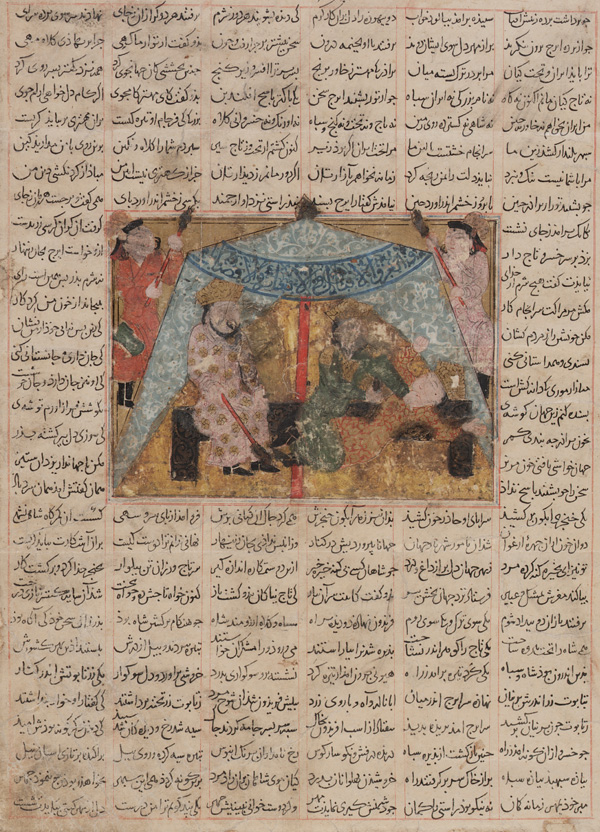
But the envy of the elder brothers had hardened into murderous hatred, and the noble offer of Iraj did not move them. In the tradition, it was Salm, the eldest, who incited the deed, but it was Tur whose hand struck the blow. In a rage, Tur fell upon his innocent and unresisting younger brother and murdered him in cold blood, and then, in a final cruelty, had the young prince's head severed and sent to their father Faridun. This fratricide, the murder of the noble and innocent Iraj by his envious brother Tur, is one of the foundational tragedies of the entire Shahnameh, the cold-blooded killing of childlike goodness by greed and envy. The epic dwells on the pathos of it: the guileless Iraj, who had offered everything for peace, slaughtered by the brother who could not master his jealousy. The grief of the aged Faridun, receiving the head of his beloved youngest son, is among the epic's most affecting scenes, and he prayed for a descendant of Iraj who might one day avenge the crime. The murder of Iraj by Tur is the seed from which the whole long tragedy of the wars of Iran and Turan would grow, the first and defining crime of envy in the epic.
Ancestor of the Turanians
From Tur descended the Turanians, the legendary eastern people who became the great rivals and enemies of Iran throughout the heroic age of the epic. As the son of Faridun who was given the eastern land of Turan, Tur was the eponymous ancestor of the Turanians, the people of Turan, just as his brother Iraj was the ancestor and name-giver of the Iranians.
Through the line of Tur came the kings and champions of Turan, including, in later generations, the dread king Afrasiab, the great archenemy of Iran, who was descended from Tur and who took up the ancient feud with a ferocity none of his forebears had shown. The wars between Iran and Turan, which fill so much of the Shahnameh, are thus at root a feud within a single family, between the descendants of Iraj on the one side and the descendants of Tur on the other, both springing from the great Faridun. It is important to understand, as the epic itself makes clear in its oldest layers, that the Turanians were originally conceived not as a foreign nation but as a branch of the same family, the eastern Iranian peoples descended from Faridun's own son Tur. The blood-feud that began with Tur's murder of Iraj was carried on by their descendants, the crime of the ancestor setting the two branches of the family at war for generations. Tur's role as the ancestor of the Turanians thus makes him not only the perpetrator of the first great crime but the founder of one whole side of the epic's central and enduring conflict.
The Vengeance of Manuchehr
The crime of Tur did not go unavenged, for the prayer of the grief-stricken Faridun for a descendant of Iraj to avenge the murder was in time answered. Iraj left a daughter, and from her line was born Manuchehr, whom Faridun raised as his heir and reared for the task of vengeance.
When Manuchehr came of age, Faridun equipped him with an army to avenge the murder of Iraj. Tur and Salm, learning of the rising power of Manuchehr, gathered their own forces and marched against Iran, and a series of great battles followed. In the course of this war of vengeance, Manuchehr met and slew both of his great-uncles. Tur, the murderer of Iraj, was killed by Manuchehr, and in a fitting and poetic justice, the tradition relates that Manuchehr beheaded Tur, just as Tur had beheaded the innocent Iraj, so that the crime was repaid in kind. The head of Tur was sent to the aged Faridun as proof that Iraj had been avenged. With the death of Tur, and afterward of Salm, the blood-debt for the murder of Iraj was at last settled, and Faridun, his vengeance accomplished, passed the rule of Iran to Manuchehr and died soon after. Yet the death of Tur, though it avenged Iraj, did not end the conflict he had begun: from it sprang the long wars between the Iranians and the Turanians, the descendants of the two branches of the family, that would run on for generations, until the reign of Kay Khosrow. The vengeance of Manuchehr closed the first chapter of the feud but opened the long age of the wars.
Symbolism and Meaning
Tur embodies, above all, the destructive power of envy and the terrible consequences of a single crime. His jealousy of his brother Iraj's favoured portion is the root of his fratricide, and the epic presents him, with his brother Salm, as the very embodiment of greed and envy, the passions that corrupt the soul and lead to the murder of innocence. In Tur, the Shahnameh offers a study of how envy can drive even a prince of the noblest blood to the most terrible of crimes, the murder of his own brother.
Tur embodies, too, the theme of fratricide and the cycle of vengeance that it sets in motion. His murder of Iraj is the first great crime of the epic's central narrative, and it begins a cycle of bloodshed and revenge, the killing that demands further killing, that runs through the generations of the wars of Iran and Turan. The epic uses the tale of Tur and his brothers to show how a single act of envy and violence can poison a whole family and set in motion conflicts that last for ages, the internalization of evil passing from one generation to the next. And as the ancestor of the Turanians, Tur embodies the origin of the epic's great division, the splitting of one family into two warring branches. In all this, Tur is a figure of profound and terrible significance, embodying the destructive power of envy, the crime of fratricide, the cycle of vengeance, and the origin of the central conflict of the Shahnameh. He is the envious brother whose single crime cast a shadow across the whole heroic age, a dark and fateful figure at the very root of the epic's great tragedy.
Tur and the Kurds
Tur, like all the figures of the Shahnameh, belongs to the shared epic and mythological heritage of the Iranian peoples, a tradition that the Kurds hold in common with the Persians, the Lurs, and others of the Iranic world. The great epic of Ferdowsi, with its kings and its tragedies, is the common inheritance of these peoples, who share in the ancient Iranian mythological tradition from which it springs. It is honest and accurate to understand Tur and his brothers as part of this shared heritage, rather than as uniquely Kurdish figures.
For the Kurds, as an Iranian people, the figures and tales of the Shahnameh are part of the wider cultural and mythological world to which they belong, and the epic and its figures hold a place in the broad Iranic heritage that the Kurds share. An especially important point of honesty concerns the Turanians, the people descended from Tur. In the oldest tradition, the Turanians were not a foreign nation but a branch of the Iranian family itself, the eastern Iranian peoples, and the wars of Iran and Turan were a feud among cousins, all descended from Faridun. Though Ferdowsi, reflecting the realities of his own later time, sometimes identified the Turanians with the Turks, this is an anachronism: in the legend, Turan is the land of Faridun's son Tur and his descendants, an Iranic people, and the Turanians should not be simply identified with any modern nation. In presenting Tur, then, we present not a specifically Kurdish figure but one of the foundational figures of the shared Iranian epic, the ancestor of a legendary people, belonging to the heritage that the Kurds hold in common with the other peoples of the Iranic world.
Debates and Misconceptions
Were the Turanians, the descendants of Tur, Turks? This is an important point of accuracy. In the oldest and original tradition, the Turanians were not Turks but a branch of the Iranian family, the eastern Iranian peoples, descended in the legend from Faridun's own son Tur. The wars of Iran and Turan were thus, at root, a feud among cousins, all Iranians and all descendants of Faridun. Although Ferdowsi, writing in a later age when Turkic peoples occupied the lands to Iran's north and east, sometimes identified the Turanians with the Turks, scholars recognize this as an anachronism. The Turanians of the legend are an Iranic people, and Tur is their ancestor; they should not be simply identified with any modern nation or ethnic group.
Is Tur a specifically Kurdish figure? No; like all the figures of the Shahnameh, he belongs to the shared epic heritage of the Iranian peoples, a tradition the Kurds hold in common with the Persians, the Lurs, and others of the Iranic world, rather than a uniquely Kurdish figure. As an Iranian people, the Kurds share in this broad heritage, and the figures of the epic, including Tur and his brothers Iraj and Salm, are part of the common Iranian tradition to which the Kurds, alongside their neighbours, are heirs.
Was Tur or Salm more responsible for the murder of Iraj? The tradition assigns roles to both brothers. Salm, the eldest, is generally presented as the instigator, the one whose envy first stirred and who incited the crime, while Tur, the middle son, was the one whose hand actually struck the fatal blow and killed Iraj. Both brothers were guilty, both shared in the envy and the conspiracy, and both were in the end slain by Manuchehr in vengeance. But it was Tur who committed the actual murder, and it is Tur whose name is given to the Turanians and who is most closely associated with the deed. The two brothers together embody the greed and envy that the epic sees as the root of the crime, Salm as the inciting mind and Tur as the striking hand, jointly responsible for the fratricide that began the great wars.
Related Topics
Iraj: the noble younger brother murdered by Tur
Faridun: the hero-king, father of Tur, Salm, and Iraj
Manuchehr: the grandson of Iraj who avenged him by slaying Tur
Afrasiab: the dread king of Turan, descended from Tur
Zahhak: the serpent-tyrant overthrown by Faridun
Nowzar: the later king in whose reign the wars resumed
Aghrirat: a later, righteous descendant in the house of Turan
The Shahnameh: the Persian Book of Kings, the great epic of Iran
Frequently Asked Questions
Who is Tur in the Shahnameh?
Tur is one of the three sons of the hero-king Faridun in the Shahnameh. When Faridun divided the world among his sons, Tur received the eastern land of Turan, but he grew envious of his younger brother Iraj, who was given the heartland of Iran. Together with his brother Salm, Tur conspired against Iraj, and it was Tur who murdered him, beginning the long wars of Iran and Turan. He became the ancestor of the Turanians and was eventually slain by Iraj's avenging grandson Manuchehr.
Why did Tur kill Iraj?
Tur killed Iraj out of envy. When their father Faridun divided the world, he gave the youngest son Iraj the choicest portion, the heartland of Iran, along with the crown and the symbols of sovereignty, judging him the worthiest of his sons. Tur and his brother Salm, given the eastern and western lands, resented that the youngest should be set above them, and their jealousy hardened into murderous hatred. Though Iraj offered to give up the crown for peace, Tur murdered his innocent brother in cold blood.
Who were the three sons of Faridun?
The three sons of Faridun were Salm, the eldest; Tur, the middle son; and Iraj, the youngest. The tradition tells that Faridun tested them in the form of a dragon: the eldest fled and was named Salm, the middle son fought boldly and was named Tur, and the youngest showed wise restraint and was named Iraj. Faridun gave the West to Salm, the East (Turan) to Tur, and the heartland of Iran, with the crown, to the noble Iraj, judging him the worthiest.
Who are the Turanians descended from?
The Turanians are descended from Tur, the son of Faridun who was given the eastern land of Turan. In the oldest tradition, they were not a foreign nation but a branch of the Iranian family, the eastern Iranian peoples, so that the wars of Iran and Turan were a feud among cousins, all descended from Faridun. Later kings of Turan, including the dread Afrasiab, came of the line of Tur. The Turanians should not be simply identified with any modern nation.
How did Tur die?
Tur was slain by Manuchehr, the grandson of the murdered Iraj, in the war of vengeance. Faridun had prayed for a descendant of Iraj to avenge the crime, and Manuchehr, born of Iraj's daughter's line and reared by Faridun, came of age and led an army against Tur and Salm. Manuchehr killed Tur, and in a poetic justice beheaded him as Tur had beheaded Iraj, sending his head to Faridun. With the deaths of Tur and Salm, the murder of Iraj was at last avenged.
Is Tur a Kurdish figure?
Tur belongs to the shared epic heritage of the Iranian peoples, a tradition the Kurds hold in common with the Persians, the Lurs, and others of the Iranic world, rather than a uniquely Kurdish figure. As an Iranian people, the Kurds share in this broad heritage, and the figures of the epic, including Tur and his brothers, are part of the common Iranian tradition to which the Kurds are heirs alongside their neighbours.
References and Further Reading
Comments