top of page

Barzu: The Grandson of Rostam

Illustrated banner of Kurdish and Iranic heritage evoking Barzu, the warrior grandson of Rostam in Persian epic, alongside the Newroz fire, the Simurgh and the tanbur


Introduction


Barzu is the mighty grandson of Rostam, a great hero of the Iranian epic tradition and the son of the tragic Sohrab, whose own story forms a kind of redemptive sequel to the heartbreaking tale of his father. Where Sohrab was slain by his own father Rostam in the most sorrowful of the epic's tragedies, his son Barzu, born after his death, would live to be reconciled with his great grandfather and to take his place among the heroes of Iran.


Barzu is the hero of his own epic poem, the Borzu-nama, one of the longest and most important of the epics that grew up around the Shahnameh. His tale follows a pattern familiar from his father's: raised in Turan in ignorance of his lineage, recruited by the Turanian king Afrasiab, and sent against Iran, Barzu came at last to fight his own grandfather Rostam without either knowing the other. But where the tale of Sohrab ended in death, that of Barzu was turned aside from tragedy at the last moment, when his identity was revealed in time, and grandfather and grandson were spared the repetition of the old sorrow.


Like all the figures of the Iranian epic, Barzu belongs to the shared heritage of the Iranian peoples, a tradition the Kurds hold in common with the Persians, the Lurs, and others of the Iranic world. To know Barzu is to encounter a hero whose tale answers the great tragedy of his father with a story of recognition and reconciliation, the grandson of Rostam who survived to carry on the heroic line, and one of the great champions of the wider epic cycle of the heroes of Sistan. His is a tale of tragedy turned to redemption.


Contents


Who Is Barzu?


Barzu, also spelled Borzu, is a hero of the Iranian epic tradition, the son of Sohrab and the grandson of the great Rostam. Born after the death of his father, who had been slain unknowing by Rostam, Barzu was raised in Turan in ignorance of his lineage, recruited into the army of the Turanian king Afrasiab, and sent against Iran. In a pattern echoing his father's tragedy, he came to fight his own grandfather Rostam without either recognizing the other, but his identity was revealed in time, averting a second filicidal tragedy, and he joined the Iranian heroes as a champion and heir of the line of Rostam. Barzu is the hero of his own epic, the Borzu-nama, one of the longest of the epics of the Sistani cycle that grew up around the Shahnameh, and he is remembered as a mighty warrior whose tale turned the sorrow of his father's death into a story of recognition and reconciliation.


Son of Sohrab, Grandson of Rostam


Barzu's identity is defined by his place in the heroic line of Sistan, as the son of Sohrab and the grandson of Rostam, the greatest hero of the Shahnameh. His father Sohrab was himself the son of Rostam by the princess Tahmineh, and the protagonist of the most heartbreaking of the epic's tragedies, slain in single combat by his own father, neither knowing the other until it was too late. Barzu was born of Sohrab, in the tradition by a woman named Shahru, after, or near the time of, his father's death.


This lineage places Barzu within the greatest heroic family of the Iranian epic, the House of Nariman, the line of Zal and Sam, that produced Rostam and his kin. Through his grandfather Rostam, Barzu was kin to the other heroes of that house, including Faramarz, Rostam's son and so Barzu's uncle, and the warrior-woman Banu Goshasp, Rostam's daughter. The defining feature of Barzu's lineage is that he is the surviving heir of the tragic Sohrab, the grandson born to carry on the line that seemed to have been cut off when Sohrab fell. In this, Barzu represents the continuation of the heroic blood of Rostam through the son of the very child Rostam had unknowingly slain, a poignant restoration of the line broken by the great tragedy. His identity as the son of Sohrab and grandson of Rostam is the foundation of his tale, and it sets the stage for the echo of his father's tragedy that lies at the heart of his story.


Key Takeaways


  • Barzu is the son of Sohrab and grandson of the great hero Rostam.

  • He was born after his father's death and raised in Turan.

  • He is the hero of his own epic, the Borzu-nama.

  • Sent by Afrasiab against Iran, he unknowingly fought his grandfather Rostam.

  • His identity was revealed in time, averting a second tragedy.

  • He joined the heroes of Iran as an heir of the line of Rostam.


Quick Facts


  • Name: Barzu (also Borzu)

  • Role: Hero of Iranian epic; grandson of Rostam

  • Father: Sohrab, the tragic son of Rostam

  • Grandfather: Rostam, the greatest hero of Iran

  • Mother: Shahru, in the tradition

  • His epic: The Borzu-nama, of the Sistani cycle

  • Raised in: Turan, in ignorance of his lineage

  • Key episode: Unknowingly fought his grandfather Rostam

  • Outcome: Recognized in time; joined the heroes of Iran

  • Heritage: Shared Iranic epic tradition


The Borzu-Nama


Barzu is the hero of his own dedicated epic poem, the Borzu-nama, also called the Barzu-nama, the Book of Borzu. This is a lengthy Persian epic of many thousands of couplets, one of the longest of all the post-Shahnameh epic poems, composed in the same meter and style as Ferdowsi's great epic, and traditionally attributed to a poet of the eleventh century.


The Borzu-nama belongs to the body of Persian epics known as the Sistani cycle, the cycle of poems devoted to the heroes of Sistan, the house of Rostam, which grew up around and after the great Shahnameh. Ferdowsi, in composing the Shahnameh, is believed to have drawn on an existing cycle of stories about the heroes of Sistan, but to have limited himself chiefly to its central hero, Rostam; the other heroes of the cycle, including the ancestors and descendants of Rostam, became the subjects of later epics composed by other poets. The Borzu-nama is among the most important of these, devoted to Rostam's grandson Barzu, and it includes a wealth of material from the Iranian legendary tradition not used by Ferdowsi, with battles, adventures, ordeals, and encounters with demons, fairies, and sorcerers. It serves, in effect, as a continuation and expansion of the Rostam and Sohrab story, answering the question of Sohrab's legacy by telling the tale of his surviving son. The existence and length of the Borzu-nama testify to the importance of Barzu in the wider epic tradition, a hero significant enough to be the subject of one of the longest of all the Persian epics, even though he does not figure in the main Shahnameh of Ferdowsi itself.


Raised in Turan


Like his father Sohrab before him, Barzu was raised away from his father's people, in ignorance of his true and noble lineage, a circumstance that would set the stage for the central drama of his tale. Born to his mother Shahru after Sohrab's death, Barzu grew up not knowing the identity of his father or the heroic blood that ran in his veins.


The young Barzu, grown to a mighty youth, was noticed for his evident strength and recruited into the service of the Turanian king Afrasiab, the great enemy of Iran, who sought to use the powerful young warrior against his foes. In the tradition, it was figures of Afrasiab's court, including the schemer Garsivaz, who brought Barzu to the Turanian king. At length Barzu forced his mother to reveal the identity of his father, learning that he was the son of Sohrab and the grandson of Rostam, and, in some versions, resolving to avenge his father's death at Rostam's hands. So Afrasiab sent Barzu with an army against Iran, hoping to wield the mighty grandson of Rostam as a weapon against the Iranian heroes, much as he had once hoped that Sohrab and Rostam might destroy one another. The raising of Barzu in Turan, in ignorance of his lineage, and his recruitment by Afrasiab against Iran, closely echo the circumstances of his father Sohrab's tragedy, and set the stage for the fateful encounter between grandfather and grandson that lies at the heart of Barzu's tale. The pattern of the tragedy seemed poised to repeat itself.


The Combat with Rostam


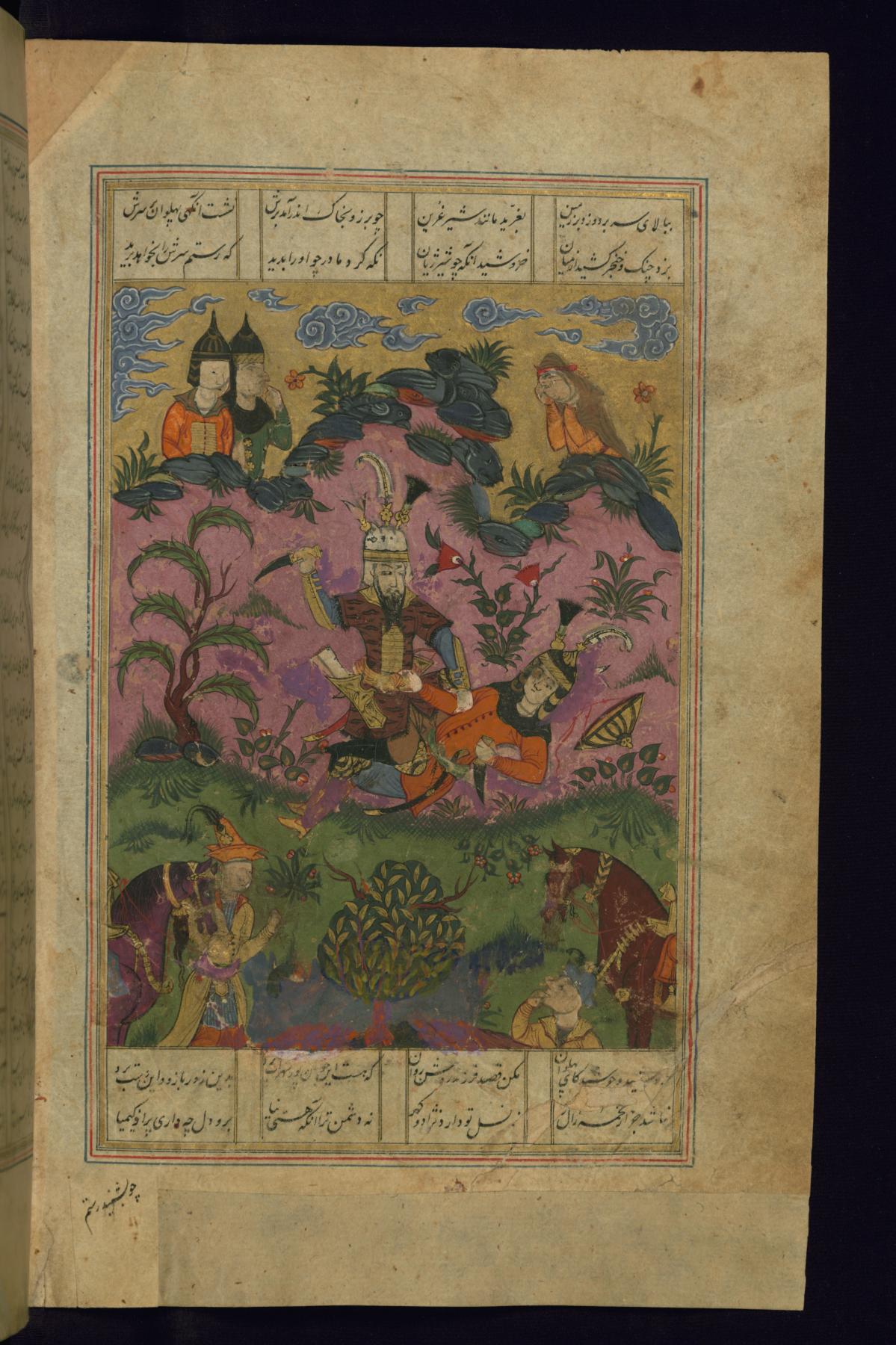
The central drama of Barzu's tale, and its great echo of his father's tragedy, is his combat with his own grandfather Rostam. Marching against Iran at the head of a Turanian force, Barzu first encountered and defeated Iranian heroes, taking some captive, until he was brought at last face to face with the greatest of all champions. Then grandfather and grandson met in combat, neither knowing the other, in a fateful echo of the duel of Rostam and Sohrab.


The combat was fierce, and the mighty Barzu proved so formidable that in the struggle he even broke the shoulder of the great Rostam, a measure of the tremendous strength of the grandson of the greatest hero. The tradition relates that Faramarz, Rostam's son, came to his father's aid, and that Barzu was at length captured. But the crucial turn came when Barzu's mother Shahru, who had followed her son, revealed his identity in time, so that Rostam learned that the mighty young warrior he faced was none other than his own grandson, the son of the Sohrab he had slain. With the recognition coming in time, the second tragedy was averted: where Rostam had killed his son Sohrab in ignorance, he was spared the killing of his grandson Barzu, the truth revealed before it was too late. This is the great difference between the tale of Barzu and that of his father: the recognition that came too late for Sohrab came in time for Barzu, turning what might have been a repetition of the old tragedy into a story of recognition and reconciliation. The combat with Rostam, and its averted tragedy, is the heart of Barzu's tale, the moment when the sorrowful pattern of the past was at last broken.


Hero of Iran


With his identity revealed and the tragedy averted, Barzu was reconciled with his grandfather Rostam and joined the heroes of Iran, taking his place as a champion and heir of the great line of Sistan. Where he had come as an enemy, sent by Afrasiab against Iran, he became a defender of the Iranian cause, his mighty strength now turned to the service of his grandfather's people.


As a hero of Iran, Barzu went on to further deeds and adventures, recounted at length in the Borzu-nama, fighting against the Turanians and their king Afrasiab, contending with demons and sorcerers, and undergoing the trials and ordeals that mark the careers of the great heroes. He took his place within the heroic line of Rostam as an heir and champion, the grandson who carried on the blood and the valour of the greatest of heroes after the tragic loss of Sohrab. In this, Barzu's tale completes the movement from tragedy to restoration: the line of Rostam, which had seemed to suffer a grievous wound in the death of Sohrab, was carried on through Sohrab's surviving son, who was reconciled with his grandfather and joined the heroes of Iran. Barzu thus stands as a figure of continuation and redemption, the heir who restored what the tragedy had threatened to destroy, and a worthy champion of the house of Rostam in his own right. His career as a hero of Iran, told in his own epic, secures his place among the great warriors of the wider Iranian epic tradition.


Symbolism and Meaning


Barzu embodies, above all, the turning of tragedy into reconciliation, and the continuation of the heroic line. His tale is consciously built as an answer to the great tragedy of his father Sohrab: where Sohrab was slain by his father through a recognition that came too late, Barzu was spared through a recognition that came in time, so that his story redeems and reverses the sorrow of his father's. In this, Barzu embodies the hope of restoration after loss, the healing of the wound that the death of Sohrab had dealt to the line of Rostam, and the triumph of recognition over the tragic ignorance that had destroyed his father.


Barzu embodies, too, the endurance and continuation of the heroic line across the generations. As the surviving grandson of Rostam, the heir born of the tragic Sohrab, he carries on the blood and valour of the greatest heroic house after it had seemed to suffer an irreparable loss, and his joining of the heroes of Iran represents the restoration of the line and the carrying forward of its glory. His tale also reflects the richness of the wider Iranian epic tradition beyond the Shahnameh, the great cycle of stories about the heroes of Sistan from which the epic tradition drew and to which it gave rise. In all this, Barzu is a meaningful figure, embodying the movement from tragedy to redemption, the continuation of the heroic line, and the depth of the Iranian epic heritage. He is the grandson who turned the sorrow of his father's death into a tale of reconciliation, and carried the heroic blood of Rostam into a new generation, a figure of hope and restoration in the great tradition of Iranian legend.


Barzu and the Kurds


Barzu, like all the figures of the Iranian epic, belongs to the shared epic and mythological heritage of the Iranian peoples, a tradition that the Kurds hold in common with the Persians, the Lurs, and others of the Iranic world. The great epic tradition, with its heroes and its tales, is the common inheritance of these peoples, who share in the ancient Iranian mythological tradition from which it springs. It is honest and accurate to understand Barzu and the heroes of Sistan as part of this shared heritage, rather than as uniquely Kurdish figures.


For the Kurds, as an Iranian people, the figures and tales of the Shahnameh and the wider epic tradition are part of the cultural and mythological world to which they belong, and the heroes hold a place in the broad Iranic heritage that the Kurds share. The figure of Barzu, the grandson of Rostam and hero of the Borzu-nama, is part of the common store of Iranian epic tradition, known and valued across the Iranic lands. In presenting Barzu, then, we present not a specifically Kurdish hero but one of the great champions of the shared Iranian epic and its wider Sistani cycle, belonging to the heritage that the Kurds hold in common with the other peoples of the Iranic world. This honest framing places Barzu accurately within the broad and rich tradition of Iranian epic to which the Kurds, as an Iranic people, are heirs alongside their neighbours, a tradition that extends well beyond the Shahnameh itself into the great cycle of epics of the heroes of Sistan.


Debates and Misconceptions


Is Barzu in the Shahnameh itself? This is an important point of accuracy. Barzu is not a figure of Ferdowsi's main Shahnameh, but the hero of a separate, later epic, the Borzu-nama, one of the poems of the Sistani cycle that grew up around the Shahnameh. While his father Sohrab and grandfather Rostam are central figures of the Shahnameh, Barzu's own story is told in the dedicated Borzu-nama and the wider epic cycle. It is honest to present him as a major hero of the wider Iranian epic tradition, a continuation of the Shahnameh's Rostam and Sohrab story, rather than as a figure of the main Shahnameh itself. This reflects the way the Iranian epic tradition extends well beyond Ferdowsi's poem into a rich body of related epics about the heroes of Sistan.


Is Barzu a specifically Kurdish hero? No; like all the figures of the Iranian epic, he belongs to the shared heritage of the Iranian peoples, a tradition the Kurds hold in common with the Persians, the Lurs, and others of the Iranic world, rather than a uniquely Kurdish figure. As an Iranian people, the Kurds share in this broad heritage, and the heroes of the epic and its wider cycles are part of the common Iranian tradition. It would be inaccurate to claim Barzu as specifically Kurdish; he is, rather, one of the great heroes of the shared Iranian epic to which the Kurds, alongside their neighbours, are heirs.


Why does Barzu's tale so closely resemble Sohrab's? The resemblance is deliberate and meaningful. The tale of Barzu is consciously built as a continuation and a kind of answer to the tragedy of Rostam and Sohrab, repeating the pattern of the hero raised in ignorance of his lineage, recruited by Afrasiab, and sent against Iran to fight his own kin without recognition. But where Sohrab's tale ends in death through a recognition that comes too late, Barzu's is turned aside from tragedy by a recognition that comes in time. This echoing is the very point of the tale: it allows the tradition to revisit the great tragedy and, this time, to avert it, turning sorrow into reconciliation and giving the line of Rostam a restoration after its grievous loss. The resemblance is thus not a flaw but the heart of the tale's meaning, a deliberate and redemptive echo of the epic's most famous tragedy.


  • Sohrab: the tragic father of Barzu, slain by Rostam

  • Rostam: the greatest hero of Iran, grandfather of Barzu

  • Faramarz: the son of Rostam, who came to his father's aid

  • Banu Goshasp: the warrior-daughter of Rostam, of the same house

  • Tahmineh: the mother of Sohrab, grandmother of Barzu

  • Afrasiab: the Turanian king who sent Barzu against Iran

  • Zal: the patriarch of the House of Nariman

  • The Shahnameh: the Persian Book of Kings, the great epic of Iran


Frequently Asked Questions


Who is Barzu?


Barzu, also spelled Borzu, is a hero of the Iranian epic tradition, the son of Sohrab and the grandson of the great Rostam. Born after his father's death and raised in Turan in ignorance of his lineage, he was recruited by the Turanian king Afrasiab and sent against Iran, where he unknowingly fought his own grandfather Rostam. His identity was revealed in time, averting a second tragedy, and he joined the heroes of Iran. He is the hero of his own epic, the Borzu-nama.


What is the Borzu-nama?


The Borzu-nama (Book of Borzu), also called the Barzu-nama, is a lengthy Persian epic of many thousands of couplets, one of the longest of all the post-Shahnameh epic poems, composed in the same meter and style as Ferdowsi's epic and traditionally attributed to an eleventh-century poet. It belongs to the Sistani cycle of poems devoted to the heroes of Sistan, and tells the adventures of Barzu, the grandson of Rostam, serving as a continuation of the Rostam and Sohrab story.


How is Barzu related to Rostam?


Barzu is the grandson of Rostam. He is the son of Sohrab, who was himself the son of Rostam by the princess Tahmineh. Sohrab was the protagonist of the most famous tragedy of the Shahnameh, slain in single combat by his own father Rostam, neither knowing the other. Barzu was born of Sohrab, in the tradition by a woman named Shahru, and so carried on the heroic line of Rostam after the tragic death of his father.


Did Barzu fight his grandfather?


Yes. Sent by Afrasiab against Iran, Barzu came at last to fight his own grandfather Rostam, neither knowing the other, in an echo of the duel of Rostam and Sohrab. The combat was fierce, and Barzu even broke Rostam's shoulder. But the crucial difference from his father's tale is that Barzu's identity was revealed in time, when his mother Shahru disclosed it, so that the second tragedy was averted and grandfather and grandson were reconciled rather than the one slaying the other.


Is Barzu in the main Shahnameh?


No. Barzu is not a figure of Ferdowsi's main Shahnameh, but the hero of a separate, later epic, the Borzu-nama, one of the poems of the Sistani cycle that grew up around the Shahnameh. His father Sohrab and grandfather Rostam are central figures of the Shahnameh, but Barzu's own story is told in the dedicated Borzu-nama and the wider epic cycle. He is best understood as a major hero of the wider Iranian epic tradition and a continuation of the Rostam and Sohrab story.


Is Barzu a Kurdish hero?


Barzu belongs to the shared epic heritage of the Iranian peoples, a tradition the Kurds hold in common with the Persians, the Lurs, and others of the Iranic world, rather than a uniquely Kurdish figure. As an Iranian people, the Kurds share in this broad heritage, and the heroes of the epic and its wider cycles are part of the common Iranian tradition to which the Kurds are heirs alongside their neighbours.


References and Further Reading


Comments


bottom of page