Jalil Khayat Mosque opened in Erbil in January 2007. Its family-funded construction, varied architectural influences and spaces for worship, teaching and community gatherings explain its place in the modern city.
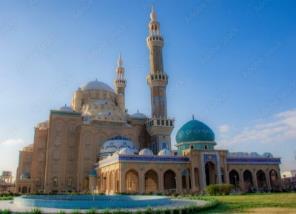
The family project and the opening
In May 2019, the founder’s son Kamiran told Al Jazeera that the foundation stone was laid in 1997 and the mosque opened in January 2007. Jalil Khayat died before completion; his family continued construction and financed its operation. [1] The account places family patronage at the centre of the building’s history.
A mosque complex, rather than a single hall
Cihan University–Erbil’s report of its 17 February 2026 design visit identifies gardens, ablution facilities, a central courtyard, an events hall and the main prayer hall. Students examined the mihrab, minbar, columns, arches, minarets and central dome. [2] These spaces connect preparation for prayer with circulation, communal worship and gatherings. The mihrab and minbar, which the visit singled out, belong to the religious organisation of the interior; the surrounding rooms and outdoor areas show why a mosque complex needs more than a monumental façade.
How researchers describe the architecture
Architects Hassan Mahmood Kasim, Lana Abubakr Ali and Faris Ali Mustafa included Jalil Khayat in a study of 32 contemporary Erbil mosques. Table 10 places it in their “Hybrid Islamic” group: buildings combining elements from different Islamic architectural traditions. The study contrasts this approach with local traditional, rationalist and modernist designs. [3] This is an analytical classification, rather than a claim that the mosque reproduces one older building exactly. It provides a useful way to understand the combination of dome, minarets, arcades and ornament visible in the photograph.
Ornament, craftspeople and regional references
A November 2007 Al Etihad report, based in part on an interview with the mosque’s imam Bashir Khalil al-Haddad, described Moroccan and Turkish designers and craftspeople, with Ottoman and Maghrebi influences and Damascene ornament. [4] The report places the decoration within several regional traditions. Such named contributions are more informative than simply calling the building grand or beautiful: they show how a modern Erbil commission brought together forms and skills associated with other centres of Islamic architecture.
Worship and learning
Al Jazeera’s 2019 reporting describes a separate women’s prayer space, Qur’an courses, funeral gatherings and Friday preaching in Kurdish and Arabic. These are dated observations of the mosque’s religious and community life. [1] The university’s 2026 visit adds another documented use: students discussing geometry, lighting, materials and the integration of decoration into a sacred interior. [2] Together, the reports show a working institution as well as an architectural subject. A supervised student visit does not itself establish general visitor hours or access arrangements.
A modern building in a much older city
The mosque’s 2007 opening belongs to a different period from Erbil’s historic citadel. UNESCO’s listing concerns the citadel’s mound, urban fabric and long development; it was inscribed in 2014. [5] The two places help readers distinguish modern patronage from the city’s older built heritage. Jalil Khayat’s significance lies in its documented religious functions, family initiative and architectural choices. Its modern date and varied design connect religious patronage with the changing built environment of Erbil.
Sources and further reading
- Imad al-Shammari, Al Jazeera, on-site reporting and interviews, 27 May 2019.
- Cihan University–Erbil, Interior Design Engineering field visit, 19 February 2026.
- Kasim, Ali and Mustafa, The effects of material, structural characteristics, and construction technology on the identity of contemporary mosques in Erbil city, Production Engineering Archives 31(4), 2025, pp.426–447, Tables 8 and 10.
- Al Etihad, مآذن الوسطية, mosque reporting and imam interview, 7 November 2007.
- UNESCO World Heritage Centre, Erbil Citadel, inscription 2014.