top of page

Jli Kurdi: The Traditional Dress of the Kurds

Illustrated banner of Kurdish and Iranic heritage evoking traditional Kurdish dress, the jli kurdi, alongside the Newroz fire, the Simurgh and the tanbur


Introduction


The traditional dress of the Kurds, known in Kurdish as jli Kurdi, is among the most beautiful and most distinctive expressions of Kurdish culture and identity: a colorful, layered national costume worn across all the Kurdish lands, rich in embroidery, varied from region to region, and worn with deep pride. From the handwoven wool of the men's shal u shapik to the flowing, shimmering dresses of the women, Kurdish dress is a living art, carrying in its colors, fabrics, and forms the heritage of a people and the traditions of their many regions.


Far more than mere clothing, Kurdish dress is a powerful marker of identity. In its colors and cuts it could once tell a person's region, tribe, social status, and station in life, and today, worn at Newroz, at weddings, and at national celebrations, it is a proud assertion of Kurdish identity and a treasured symbol of cultural heritage. The wearing of the traditional dress, especially on the great days of the Kurdish calendar, is itself an act of cultural affirmation, a visible declaration of belonging to the Kurdish people and their ancient culture.


A living tradition still cherished and worn across Kurdistan and in the diaspora, Kurdish dress is among the most beloved and most visible of all Kurdish customs. To know it is to appreciate the artistry, the regional richness, and the deep meaning woven into the costume of a people, the bright colors and intricate embroidery that have adorned the Kurds across the generations, and that continue to express, in cloth and thread, the identity and pride of the Kurdish nation. It is the heritage of a people worn upon the body, a beautiful and enduring emblem of who the Kurds are.


Contents


What Is Jli Kurdi?


Jli Kurdi, meaning simply Kurdish clothes or Kurdish dress, is the traditional national costume of the Kurdish people: a colorful, layered, and richly decorated style of dress, distinct for men and women, worn across all the Kurdish lands and varying in its particulars from region to region. For men, it centers on the shal u shapik, a handwoven jacket and baggy trousers, with a waist sash and headdress; for women, on the flowing kras dress with its long triangular sleeves, worn with a vest or coat, a belt, and abundant ornament. Made of wool, silk, velvet, and other fabrics, and often richly embroidered, Kurdish dress reflects the lifestyle, the regions, and the identity of the Kurdish people. Once everyday wear, it is today worn above all on festive and ceremonial occasions, and it remains one of the most cherished and distinctive symbols of Kurdish culture and identity.


A Costume of Many Layers


A defining feature of traditional Kurdish dress, for both men and women, is its construction in several layers, a costume built up of multiple garments worn together. Rather than a single piece, the traditional outfit is an ensemble: trousers, an underdress or shirt, an outer dress or jacket, a vest or coat, a belt or sash, a headdress, and various accessories, all combining to form the complete attire.


This layering reflects both the practical needs and the aesthetic richness of Kurdish dress. Practically, the layers suited the mountainous environment and its cold, the wool and felt of the outer garments giving warmth, while the structure allowed for adjustment to the seasons. Aesthetically, the layering creates the rich, full, and elaborate appearance characteristic of Kurdish costume, with the different garments, colors, and fabrics combining into a striking whole, and the embroidery and ornament displayed across the layers. The building up of the costume from its many pieces, each with its own name, form, and purpose, is part of the artistry of Kurdish dress, and learning the names and roles of the layers, the trousers, the dress, the vest, the coat, the sash, the headdress, is to learn the vocabulary of one of the most elaborate and beautiful of traditional costumes. The complete, layered ensemble, worn in full, is the traditional Kurdish dress in its glory.


Key Takeaways


  • Jli Kurdi is the traditional, colorful, layered national dress of the Kurds.

  • Men's dress centers on the shal u shapik, a handwoven jacket and baggy trousers.

  • Women's dress centers on the flowing kras with long triangular sleeves.

  • The costume is built of many layers, with a sash, headdress, and ornament.

  • Styles, colors, and cuts vary widely from region to region.

  • It is a proud symbol of Kurdish identity, worn at Newroz and celebrations.


Quick Facts


  • Name: Jli Kurdi (Kurdish dress)

  • Men's core: The shal u shapik (jacket and baggy trousers)

  • Men's trousers: Sharwal, tapering at the ankle

  • Men's sash: A long waist sash wound many times

  • Men's headwear: The cemedani headscarf or klaw cap

  • Women's dress: The kras, with long triangular sleeves

  • Women's layers: Underdress, vest or coat (kawa), belt

  • Fabrics: Wool, felt, cotton, silk, and velvet

  • Character: Colorful and embroidered; varies by region

  • Today: Worn at Newroz, weddings, and celebrations


The Dress of Kurdish Men


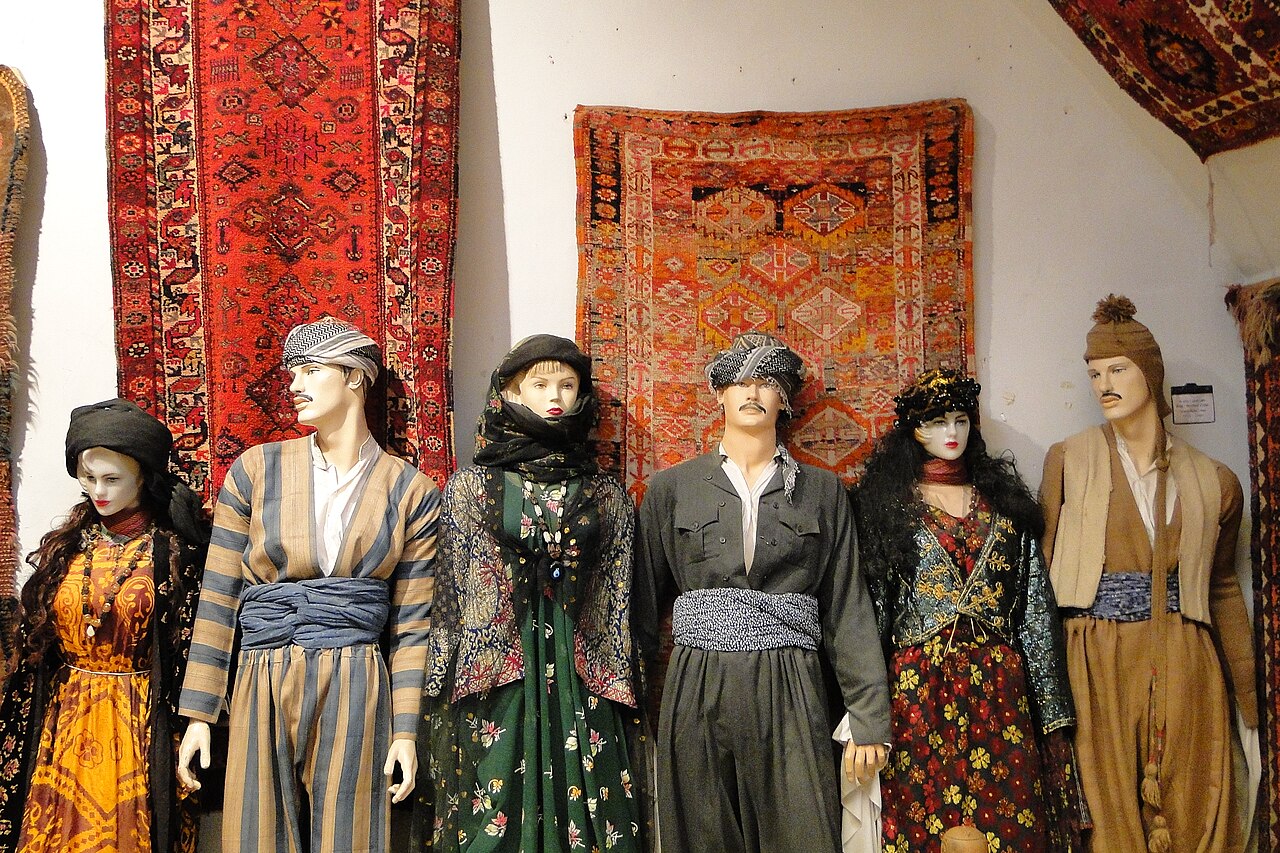
The traditional dress of Kurdish men centers on the ensemble known as the shal u shapik, the handwoven jacket and trousers that are the heart of the male costume. The shapik is the jacket and the shal the trousers, traditionally made of wool, often handwoven on looms in techniques passed down through generations. The trousers, broadly cut and gathered, taper toward the ankle, and are worn with a shirt and the fitted jacket, the whole forming the characteristic silhouette of the Kurdish man's dress.


A distinctive and essential element of the male costume is the waist sash, a long piece of cloth, in some cases many meters in length, wound several times around the waist over the jacket and trousers. This sash both completes the outfit and traditionally served practical purposes, and it is one of the marks of the Kurdish man's traditional dress. The outfit is topped by a headdress: in many regions a headscarf, the cemedani or jamana, wound about the head, or a cap, the klaw. On the feet are worn traditional shoes, often the klash, the handmade cloth-and-leather shoes of Kurdistan. The men's dress tends, in its colors, toward more sober and earthen tones, browns, greys, blacks, whites, and blues, in contrast to the bright colors of the women's costume, though it is no less rich in its craftsmanship. The complete male costume, the shal u shapik with its sash, headdress, and shoes, is among the most recognizable and dignified of traditional dress, well suited to the mountain life of the Kurds and worn with pride on the great occasions of Kurdish life.


The Dress of Kurdish Women


The traditional dress of Kurdish women is among the most beautiful and colorful of all traditional costumes, a layered ensemble centered on the flowing dress known as the kras. The kras is a long, often floor-length dress, frequently made of light, sheer, and shimmering fabric, with long sleeves that end in a flared, dangling triangle, a distinctive feature of the Kurdish woman's dress, which may be knotted behind the back or wrapped about the arms. The kras is often richly decorated with embroidery or sequins.


Beneath and over the kras are worn the other layers of the costume. Beneath are an underdress and wide trousers; over the kras is worn a short vest or jacket, known by names such as helek or salta, or instead a long, often elaborately decorated coat, the kawa. The outfit is girded at the waist by a belt, sometimes of metal, or a sash, and may be completed by a sheer cloth thrown over the shoulders. The whole is crowned by a headdress, often a decorated cap, the klaw, or a headscarf. And the women's costume is richly adorned with jewelry: necklaces, bracelets, earrings, rings, and other ornaments, with married women often displaying the gold received at their wedding. The women's dress is famously vivid and colorful, found in nearly every hue, and rich in embroidery and ornament, making it a dazzling display of color and craft. Among some communities, the colors are more restrained; the Yazidi in particular favour more sober and especially white dress. The complete women's costume, layered, colorful, embroidered, and adorned, is among the most splendid expressions of Kurdish traditional art.


Color, Fabric, and Embroidery


The beauty of Kurdish dress lies greatly in its colors, its fabrics, and its embroidery. The women's costume above all is famed for its brilliant colors, found in nearly every shade, the bright and shimmering dresses creating a dazzling effect, especially when many are gathered at a celebration. The men's dress, by contrast, favours more sober and earthen tones, though it is rich in the quality of its weaving and tailoring.


The fabrics of Kurdish dress reflect both the materials of the land and the occasion of wearing. Wool and felt, warm and suited to the mountain cold, are traditional for the men's shal u shapik and for coats; cotton for trousers and everyday wear; and fine fabrics such as silk and velvet for the women's dresses and the more elaborate garments, especially those worn on festive occasions. The weaving was traditionally done by hand on looms, in techniques and patterns passed down through generations of artisans. Embroidery and ornament are central to the richness of the costume: the dresses, jackets, and other garments are often decorated with intricate embroidery, sequins, and patterns, the needlework displaying both the skill of the maker and, in former times, the status and region of the wearer. This combination of vivid color, fine fabric, and intricate embroidery makes Kurdish dress a living art, the costume not merely worn but crafted, each piece a work of traditional artistry carrying the patterns and techniques of the Kurdish textile heritage.


Regional Styles


Kurdish dress is not uniform across the Kurdish lands but varies richly from region to region, so that the traditional costume of one area differs in its cut, color, and details from that of another. This regional variety is one of the defining features of Kurdish dress, reflecting the diversity of the Kurdish regions and the distinct traditions of their peoples, and a knowledgeable eye can read in the particulars of a costume the region from which it comes.


Among the well-known regional styles are those associated with areas such as Hakkari, with its particular forms of the men's and women's dress, and the styles of the Sorani-speaking regions of southern and eastern Kurdistan, among many others. The styles differ in the cut of the garments, the way the trousers and dresses are made, the colors and fabrics favoured, the form of the headdress, and the details of ornament. In former times, these regional differences, along with the particular caps and headscarves, served to identify the wearer's region and community, the dress functioning almost as a map of belonging. While the broad elements, the men's shal u shapik and sash, the women's kras and its layers, are shared across the Kurdish lands, their particular forms vary widely, so that Kurdish dress encompasses a rich diversity of regional and local styles. This variety is part of the wealth of the tradition, the shared Kurdish costume flowering into many regional forms, each preserving the particular heritage of its place.


Dress as Identity


Traditional Kurdish dress has always been far more than clothing; it is a powerful marker and expression of identity. In former times, the particulars of a person's dress, the colors, the cut, the headdress, the ornament, could reveal a great deal about them: their region and tribe, their social status and wealth, and their station in life, whether married or unmarried, so that the costume served as a visible language of identity and belonging.


In our own time, as the traditional dress has passed from everyday wear to festive and ceremonial use, it has taken on a powerful role as a symbol of Kurdish national and cultural identity. To wear the traditional Kurdish dress, especially at Newroz, at weddings, and at national celebrations, is to make a proud and visible declaration of Kurdish identity and belonging, an affirmation of pride in Kurdish heritage. In times and places where Kurdish identity has faced pressure or suppression, the wearing of the traditional dress has carried added meaning as an assertion of cultural identity and resistance. The dress has become one of the most visible emblems of the Kurdish people, worn with pride across the divided Kurdish lands and in the diaspora as a shared symbol of a common heritage and identity. In this, Kurdish dress is bound up with the very identity of the Kurdish people, the heritage of a nation worn upon the body and displayed with pride to the world.


Symbolism and Meaning


Kurdish dress embodies, above all, the identity and heritage of the Kurdish people, worn upon the body. In its colors, forms, and regional varieties, it carries the traditions, the artistry, and the belonging of the Kurds, and it serves as one of the most visible and powerful expressions of Kurdish identity. To wear the traditional dress is to embody and display one's Kurdishness, to carry the heritage of the people in the most immediate and visible way.


The dress embodies, too, the artistry and the regional richness of Kurdish culture. As a living art of weaving, tailoring, and embroidery, it expresses the skill and creativity of Kurdish artisans and the beauty of the Kurdish textile tradition, the vivid colors and intricate needlework making the costume a work of art. In its rich regional variety, it embodies the diversity of the Kurdish lands and the distinct traditions of their peoples, the many local styles together forming the wealth of the shared tradition. And in its endurance, its passage from everyday wear to a cherished symbol of identity worn proudly at the great occasions of Kurdish life, it embodies the resilience and continuity of Kurdish culture, the costume of the ancestors carried forward and worn with renewed meaning by each generation. Kurdish dress is thus a deeply meaningful tradition, in which identity, artistry, regional heritage, and cultural continuity are woven together into the most visible and beautiful of emblems, the national costume of a people worn with enduring pride.


Kurdish Dress and the Kurds


Traditional dress is among the most distinctively and characteristically Kurdish of all cultural expressions, the national costume of the Kurdish people, worn across all the Kurdish lands and instantly recognizable as a mark of Kurdish identity. With its particular forms, the men's shal u shapik, the women's kras, the rich colors and embroidery, and its many regional styles, Kurdish dress is a deeply rooted and cherished part of the heritage of the Kurdish people, bound up with their identity, their regions, and their history.


For the Kurds, the traditional dress is a treasured inheritance and a proud emblem of identity. Worn at the great occasions of Kurdish life, at Newroz, at weddings, at national celebrations, it is a visible affirmation of Kurdish heritage and belonging, and across the divided Kurdish lands and in the diaspora it serves as a shared symbol that connects Kurds everywhere in a common identity. In recent times, the traditional dress has seen renewed pride and popularity, worn with deliberate pride as an assertion of Kurdish culture and identity, and celebrated as a precious part of the Kurdish heritage. The bright colors and intricate embroidery of Kurdish dress, the splendid costumes worn at Newroz and at celebrations, are among the most beautiful and most visible expressions of the Kurdish spirit, the heritage of the Kurdish nation worn with pride and displayed to the world. It is one of the most beloved and enduring of all the living traditions of the Kurds.


Debates and Misconceptions


Is there a single Kurdish national dress? Not exactly; rather, there is a shared tradition of Kurdish dress with many regional variations. The broad elements, the men's shal u shapik and sash, the women's kras and its layers, are common across the Kurdish lands and give Kurdish dress its recognizable character, so that one may speak of a Kurdish national costume in a general sense. But the particular forms, colors, cuts, and details vary widely from region to region, so that there is no single uniform dress but a rich diversity of regional styles within the shared tradition. It is honest to present Kurdish dress as a shared tradition with strong common elements and a great wealth of regional variety, rather than as a single fixed national costume.


Is Kurdish dress still worn today? Traditional Kurdish dress, once everyday attire, is today worn above all on festive and ceremonial occasions, at Newroz, weddings, festivals, and national celebrations, rather than as daily clothing in most settings. In this sense its role has changed, from everyday wear to a cherished symbol worn on special occasions. Yet it remains very much a living tradition, worn with pride and indeed with renewed popularity in recent times as an expression of Kurdish identity, and crafted, sold, and treasured across the Kurdish lands and the diaspora. It is honest to recognise both the shift from everyday to ceremonial wear and the genuine vitality of the tradition today, which is far from a mere relic and remains a living and proudly worn part of Kurdish culture.


Do the colors of Kurdish dress have fixed meanings? While Kurdish dress is famed for its vivid colors, and while colors and patterns could carry associations of region, status, and occasion, it is best to be cautious about assigning fixed, universal meanings to particular colors. The significance of color in Kurdish dress is real but varies by region, community, and context, and the costume's meanings lie as much in its regional forms, its embroidery, and its role as a marker of identity as in any fixed color symbolism. One notable point is that while most Kurdish dress is brightly colored, some communities favour more restrained colors, the Yazidis in particular being known for more sober and especially white dress. It is honest to present the colors of Kurdish dress as rich and meaningful but varying by region and community, rather than as a fixed code of universal meanings.


  • Newroz: the Kurdish new year, when traditional dress is proudly worn

  • The govend: the Kurdish circle dance, danced in traditional dress

  • Deq: the traditional tattoos that adorned Kurdish women

  • Shahmaran: a beloved motif of Kurdish design and ornament

  • The Pir Shalyar festival: an ancient Kurdish ceremony of the Hawraman

  • Buka Barane: the Kurdish Rain Bride, dressed in traditional clothing

  • Yazidism: the faith whose people favour more sober dress

  • Kurdish folklore: the wider world of Kurdish custom and tradition


Frequently Asked Questions


What is jli Kurdi?


Jli Kurdi, meaning Kurdish clothes or dress, is the traditional national costume of the Kurdish people: a colorful, layered, richly decorated style of dress, distinct for men and women and varying from region to region. For men it centers on the shal u shapik, a handwoven jacket and baggy trousers with a waist sash and headdress; for women on the flowing kras dress with long triangular sleeves, worn with a vest or coat, a belt, and abundant ornament. Once everyday wear, it is today worn above all on festive occasions.


What do Kurdish men wear?


The traditional dress of Kurdish men centers on the shal u shapik, a handwoven jacket (shapik) and baggy trousers (shal), traditionally of wool, the trousers tapering toward the ankle. A long waist sash, sometimes many meters long, is wound several times around the waist. The outfit is topped by a headdress, a wound headscarf (cemedani) or a cap (klaw), and traditional shoes such as the klash. Men's dress tends toward sober, earthen tones, in contrast to the bright colors of the women's costume.


What do Kurdish women wear?


The traditional dress of Kurdish women centers on the kras, a long, often sheer and shimmering dress with long sleeves ending in a flared triangle, richly embroidered or sequined. Beneath are an underdress and wide trousers; over it a short vest (helek) or a long coat (kawa); and the outfit is girded with a belt or sash and crowned with a decorated cap or headscarf. It is adorned with abundant jewelry. The women's dress is famously vivid and colorful, though some communities, such as the Yazidis, favour more sober dress.


Why does Kurdish dress vary by region?


Kurdish dress varies from region to region because the costume reflects the diversity of the Kurdish lands and the distinct traditions of their peoples. The styles differ in the cut of the garments, the colors and fabrics favoured, the form of the headdress, and the details of ornament, with well-known styles associated with areas such as Hakkari and the Sorani regions. In former times, these differences served to identify the wearer's region and community, the dress functioning almost as a map of belonging.


Is Kurdish traditional dress still worn?


Yes, though its role has changed. Once everyday attire, traditional Kurdish dress is today worn above all on festive and ceremonial occasions, at Newroz, weddings, festivals, and national celebrations, rather than as daily clothing in most settings. Yet it remains a living tradition, worn with pride and renewed popularity as an expression of Kurdish identity, and crafted, sold, and treasured across the Kurdish lands and the diaspora. It is far from a mere relic.


Why is Kurdish dress important to identity?


Kurdish dress is a powerful marker and expression of identity. In former times its particulars revealed a person's region, tribe, status, and station. Today, worn at Newroz, weddings, and national celebrations, it is a proud and visible declaration of Kurdish identity and belonging, and in times of pressure on Kurdish identity, wearing it has carried added meaning as cultural assertion. It has become one of the most visible emblems of the Kurdish people, a shared symbol connecting Kurds across the divided lands and the diaspora.


References and Further Reading


Comments


bottom of page