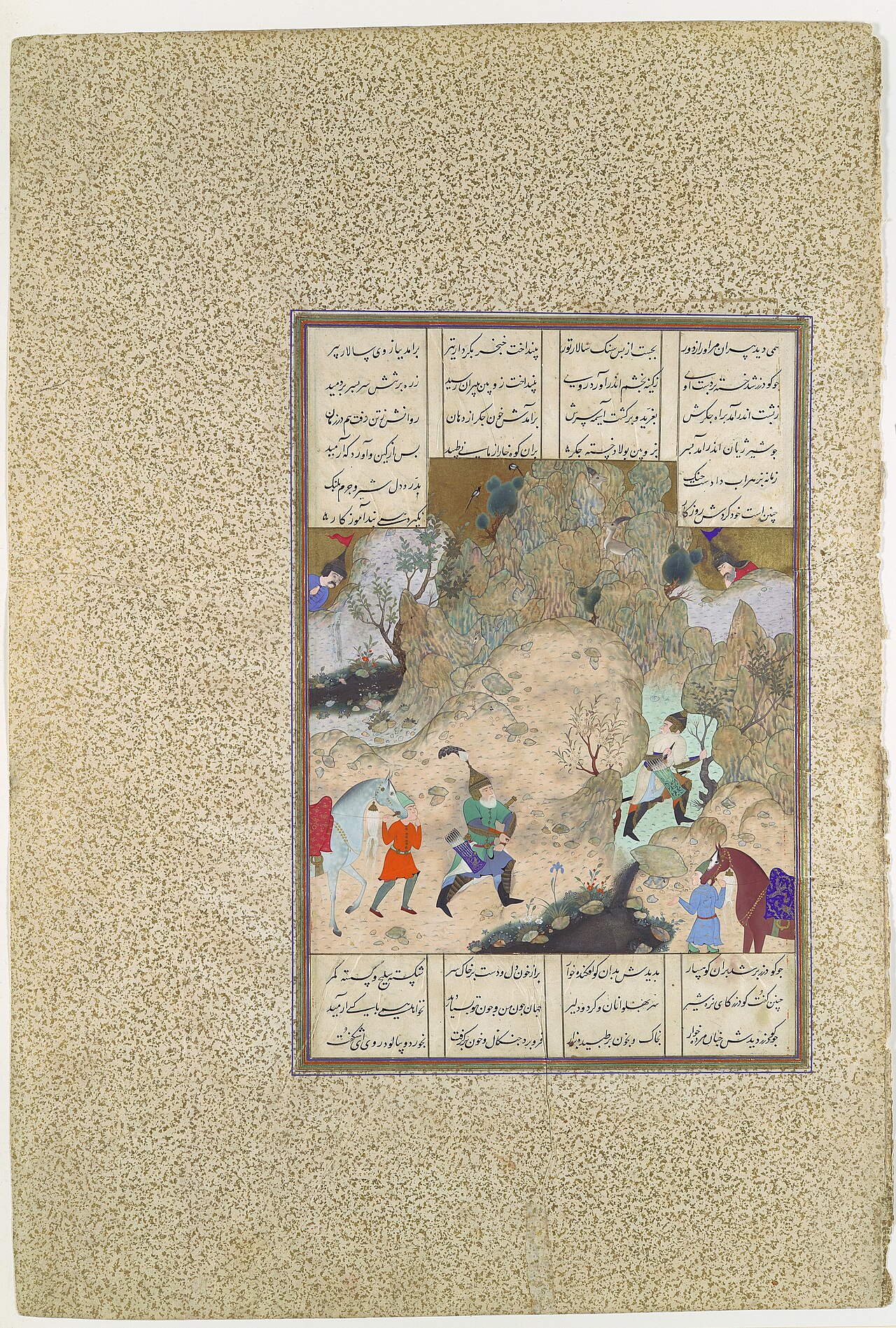
Piran Viseh: The Noble Vizier of the Shahnameh
- Sherko Sabir

- 4 hours ago
- 12 min read

Introduction
In the long and bitter wars between Iran and Turan that fill so much of the Shahnameh, the great Persian Book of Kings, the Turanians are most often the enemy, and their king Afrasiab the very embodiment of the foe. Yet amid all the Turanian host there shines one figure of such wisdom, mercy and honour that he stands almost alone: Piran, son of Vise, the noble vizier and commander of Turan, who sought peace where others sought war and showed compassion where others showed cruelty.
Piran Viseh is one of the most remarkable and beloved characters in the whole epic, and a rare thing in it: an enemy portrayed with deep sympathy and admiration. Wise counsellor and mighty commander, he laboured throughout his life to make peace between the two realms, protected the innocent at the risk of his own safety, and remained faithful to his king even in a cause he knew to be unjust. In him the epic shows that nobility and virtue are not the possession of one side alone.
Belonging to the shared epic heritage of the Iranian peoples, a tradition the Kurds hold in common with the Persians and others of the Iranic world, the figure of Piran is among the most morally rich of all the Shahnameh's creations. He is the honourable man caught in a tragic loyalty, the peacemaker in an age of war, the enemy whom even his foes came to mourn. To know Piran is to know the epic at its most humane, where the line between friend and foe is crossed by the bonds of honour and pity.
Contents
Who Was Piran Viseh?
Piran Viseh, meaning Piran son of Vise, is a Turanian figure in the Shahnameh, the wise vizier and commander-in-chief of Afrasiab, the king of Turan. Described as a wise and intelligent man who sought to bring peace between Iran and Turan, he is one of only a very few Turanians whom the epic portrays in a wholly positive light. He plays a vital role in the great cycle of Siyavash and Kay Khosrow, protecting the innocent and counselling peace, and he meets at last a tragic death in battle, faithful to his king to the end and mourned even by his enemies.
The House of Vise
Piran belonged to the House of Vise, the most important and powerful of the Turanian clans in the Shahnameh, a great family descended, in the epic's genealogy, from Tur, the ancestor of the Turanians. His father was Vise, a leading figure and commander among the Turanians, and Piran was the foremost of his many sons, a family that included a number of the great warriors of Turan. As the head of his generation of this mighty house, Piran held a position of the highest eminence in the Turanian realm.
Piran was himself a king in his own right, ruling the land of Khotan, as well as serving as the spahbed, or commander-in-chief, and chief minister of Afrasiab. He was thus among the very greatest of the Turanian lords, second in the realm only to the king himself, a commander of armies and a counsellor of state. Yet for all his power and his high birth among the enemies of Iran, Piran was distinguished not by ferocity but by wisdom, moderation and a deep sense of honour, qualities that set him apart from the harsher figures of the Turanian court and made him the noblest representative of his people in the epic.
Key Takeaways
Piran Viseh was the wise vizier and commander-in-chief of Turan.
He served Afrasiab but constantly sought peace between Iran and Turan.
He is one of very few Turanians portrayed positively in the epic.
He protected the family of the murdered prince Siyavash.
He sheltered and raised the young Kay Khosrow in secret.
Loyal to his king to the end, he died in battle and was mourned by his foes.
Quick Facts
Name: Piran Viseh (Piran son of Vise)
Source: The Shahnameh; also Tabari and Tha'alibi
Role: Vizier and commander-in-chief (spahbed) of Turan
Realm: King of Khotan; chief minister of Afrasiab
Family: The House of Vise, the chief Turanian clan
Character: Wise, honourable, a seeker of peace
Key deeds: Protecting Farangis and raising Kay Khosrow
Death: Killed by Gudarz at the battle of Davazdah Rokh
Remembered for: Being mourned by his enemy Kay Khosrow
Symbol: Wisdom, honour, and tragic loyalty
Vizier and Commander of Turan
As the spahbed and chief minister of Afrasiab, Piran stood at the very summit of Turanian power. He was the king's most trusted counsellor and the commander of his armies, a figure of immense authority whose voice carried great weight in the affairs of the realm. In the many wars between Iran and Turan, it was often Piran who led the Turanian forces, a formidable and skilful general as well as a wise statesman.
But Piran's true distinction lay in the use he made of his great position. Where a lesser man might have used such power for ambition or cruelty, Piran used his influence again and again on the side of moderation, mercy and peace. He counselled his king toward wisdom, restrained the worst impulses of the Turanian court where he could, and sought always to limit the bloodshed between the two realms. In a court that harboured schemers and hotheads, Piran was the steady voice of reason and humanity, and it is this, far more than his rank or his prowess in arms, that has made him so beloved a figure in the epic.
The Peace-Seeker
Above all, Piran is remembered as a seeker of peace. Throughout the long enmity between Iran and Turan, he laboured to bring the two realms to reconciliation and to spare both peoples the horrors of endless war. It was Piran, ever the optimist for peace, who welcomed the exiled prince Siyavash to Turan and urged Afrasiab to receive him with honour, hoping that the noble young Iranian might become a bridge between the two lands rather than a cause of further strife.
To bind Siyavash to Turan and to seal the friendship, Piran gave the prince his own daughter, Jarireh, in marriage, and treated him as a beloved kinsman. For a time it seemed that Piran's vision of peace might be realised, with the pure Iranian prince honoured in Turan and a lasting reconciliation in prospect. That this hope was destroyed, and Siyavash murdered, was no fault of Piran's but the work of the schemer Garsivaz and the weakness of Afrasiab. Through it all, Piran remained the advocate of peace and moderation, the one great Turanian who saw that the endless war served no one and sought tirelessly to end it.
Protector of Siyavash's Family
Piran's noblest deeds were his acts of protection toward the family of the murdered Siyavash. When Afrasiab, having put the prince to death, turned his fear upon the prince's pregnant widow Farangis and sought to destroy her unborn child, it was Piran who intervened. At the risk of his own standing, he interceded with the king, took Farangis under his protection, and sheltered her until her child could be safely born.
That child was Kay Khosrow, the future king of Iran, and Piran continued to shield him through the perils of his childhood, having him raised in secret and protecting him from Afrasiab's suspicion. When the king demanded to see the boy, fearing the prophecy that he would avenge his father, it was by Piran's wise counsel, advising the child to feign a witless simplicity, that Kay Khosrow disarmed the tyrant and saved his life. In protecting Farangis and Kay Khosrow, the Turanian Piran preserved the very prince who would one day lead Iran to victory over Turan, an irony the epic presents as the working of a higher justice, achieved through the mercy of a good man among the enemy.
Loyalty and the Great War
The murder of Siyavash set in motion the great war of vengeance, when the grown Kay Khosrow, come at last to the throne of Iran, led his armies against Turan to avenge his father's blood. In this terrible conflict Piran found himself bound by a tragic loyalty: though he had loved Siyavash, protected his family, and sought peace all his life, he was the commander of Turan and the servant of his king, and when war came he did his duty and took the field against Iran.
Here lies the deep tragedy of Piran. He was a good man bound to a flawed and ultimately doomed cause, loyal to a sovereign whose crimes he had not committed and whose wars he had striven to prevent. Honour held him to his king and his people even when their cause was unjust, and so the great peace-seeker was drawn into the very war he had laboured to avoid, fighting at last not for any wrong of his own but out of fidelity to the realm he served. It is a portrait of the painful conflict between personal virtue and the loyalty owed to one's own side, drawn with rare moral subtlety.
The Death of Piran
Piran met his end in the great war, at the battle known as Davazdah Rokh, the Twelve Champions, in which the chief warriors of Iran and Turan met in single combat. There Piran faced Gudarz, the aged and valiant commander of the Iranian host, and in their duel the noble Turanian was at last slain. So fell the wisest and most honourable of the lords of Turan, killed in a war he had never wanted, faithful to his king to the end.
What followed is one of the most moving moments in the whole epic. When Kay Khosrow, the king of Iran and the very child Piran had once saved, came upon the body of his enemy, he did not exult but mourned. Remembering the mercy Piran had shown his mother and himself, and honouring the nobility of the man, Kay Khosrow grieved for his fallen foe and ordered that his body be treated with the greatest reverence, washed with musk and ambergris and laid honourably to rest. That the king of Iran should mourn a commander of the enemy is the epic's final tribute to Piran, a recognition that honour and virtue transcend the divisions of war, and that a noble enemy may be more worthy of grief than many a friend.
Symbolism and Meaning
Piran Viseh embodies the ideals of wisdom, honour and the pursuit of peace, and he stands as the epic's great proof that nobility belongs to no single nation. As a Turanian, an enemy of Iran, who is yet portrayed with profound admiration, he shows that the moral world of the epic is not a simple division of good Iranians and evil Turanians, but a subtler vision in which virtue and vice are found on both sides. He is the honourable foe, the good man among the enemy, a figure who complicates and deepens the whole moral landscape of the tale.
Most of all, Piran symbolises the tragic nobility of loyalty. He is the good man bound to a flawed cause, faithful to his king even unto death in a war he had striven to prevent, and his fate poses one of the epic's most searching questions: what is owed to one's own side when that side is in the wrong? In his lifelong labour for peace, his mercy to the innocent, and his honourable death mourned by his enemy, Piran stands as one of literature's great portraits of integrity caught in tragic circumstance. To contemplate Piran is to contemplate the possibility of honour and humanity even amid the bitterest of wars.
Piran and the Kurds
Piran belongs to the shared epic heritage of the Iranian peoples, the tradition of the Shahnameh that the Kurds hold in common with the Persians and other Iranic peoples. As an Iranic people with deep roots in this cultural world, the Kurds are heirs to its great cycle of tales, including the story of Siyavash and Kay Khosrow in which Piran plays so noble a part. His figure is part of this common inheritance of epic narrative shared across the Iranian world.
It is honest to say that Piran, like the other figures of the Shahnameh's legendary cycles, is part of this wider Iranic tradition rather than a specifically Kurdish character; indeed, in the epic he is a lord of Turan, the rival realm. Yet the ideals he embodies, wisdom, honour, mercy and the love of peace, are cherished across the whole Iranian cultural world, including among the Kurds, who have long treasured the great epic and its moral vision. In the figure of Piran, the shared heritage offers a timeless portrait of the honourable man and the tragic nobility of loyalty, whose moral depth speaks to all the peoples who have loved the Book of Kings.
Debates and Misconceptions
Is Piran a hero or a villain? Neither in the simple sense. As a commander of Turan, he is on the enemy side in the wars with Iran, yet he is portrayed throughout as wise, merciful and honourable, one of only a very few Turanians the epic praises. He is best understood not as hero or villain but as the noble enemy, the good man on the opposing side, a figure who shows that the epic's moral world is richer than a simple division of good and evil between the two nations.
Why did Piran fight for Turan if he sought peace? Because he was bound by loyalty to his king and his people. Piran laboured all his life for peace and protected the innocent, including the family of Siyavash, but when war came he remained faithful to his sovereign Afrasiab and did his duty as commander of Turan. This is the very heart of his tragedy: a good man held by honour to a flawed cause. The epic presents this not as hypocrisy but as the painful conflict between personal virtue and the loyalty owed to one's own side.
Is the story of Piran history? No; Piran belongs to the legendary cycles of the Shahnameh, not to documented history, though he is mentioned in other early sources such as Tabari and Tha'alibi. He is a figure of the epic's heroic age, a tradition rich in moral meaning but belonging to the realm of legend rather than fact. His tale is to be appreciated for its profound exploration of honour, loyalty and the tragedy of war, and as one of the epic's most admired portraits of a noble character, rather than as a record of real events.
Related Topics
Afrasiab: the king of Turan whom Piran served as vizier and commander
Siyavash: the exiled prince whom Piran welcomed and whose family he protected
Kay Khosrow: the king whom Piran saved as a child and who mourned his death
Farangis: the widow of Siyavash whom Piran sheltered from Afrasiab
Rostam: the great Iranian hero of the wars against Turan
Sudabeh: the queen whose schemes first drove Siyavash toward Turan
The Shahnameh: the epic Book of Kings in which Piran's tale is told
Frequently Asked Questions
Who was Piran Viseh in the Shahnameh?
Piran Viseh, meaning Piran son of Vise, was the wise vizier and commander-in-chief of Turan in the Shahnameh, serving King Afrasiab. King of Khotan and head of the great House of Vise, he was a powerful lord who used his influence to seek peace between Iran and Turan and to protect the innocent. He is one of very few Turanians the epic portrays in a wholly positive light, and he plays a key role in the cycle of Siyavash and Kay Khosrow.
What did Piran do for Siyavash and his family?
Piran welcomed the exiled prince Siyavash to Turan, urged Afrasiab to honour him, and gave him his own daughter Jarireh in marriage. After Siyavash was murdered, Piran protected his pregnant widow Farangis from Afrasiab's wrath and sheltered her until her son was born. He then secretly protected and helped raise that son, Kay Khosrow, shielding the future king of Iran from the suspicion of the Turanian king.
How did Piran die?
Piran was killed in the great war of vengeance that followed the murder of Siyavash. At the battle of Davazdah Rokh, the battle of the Twelve Champions, in which the chief warriors of Iran and Turan met in single combat, Piran faced the aged Iranian commander Gudarz and was slain by him. He died loyal to his king, in a war he had long striven to prevent.
Why did Kay Khosrow mourn his enemy Piran?
Because Kay Khosrow remembered the mercy Piran had shown him. It was Piran who had protected his mother Farangis and sheltered and saved Kay Khosrow himself as a child. Honouring this kindness and the nobility of the man, the king of Iran grieved for his fallen enemy and ordered that Piran's body be treated with great reverence, washed with musk and ambergris and laid honourably to rest, a moving tribute to an honourable foe.
Why is Piran such an admired character?
Piran is admired because he embodies wisdom, honour, mercy and the love of peace, and because he is that rare thing in the epic, an enemy portrayed with deep sympathy. He shows that nobility belongs to no single side, and his tragic loyalty, holding faithful to a flawed cause out of honour, makes him one of the epic's most morally rich and humane figures. In Persian culture he has become a symbol of wisdom and the honourable man.
Was Piran a Kurdish figure?
Piran belongs to the shared Iranic epic tradition rather than to one people alone. The Shahnameh is the common heritage of the Iranian peoples, and the Kurds, as one of those peoples, share its characters with the Persians and others. In the epic Piran is in fact a lord of Turan, the rival realm, so he is best understood as a figure of this wider Iranic inheritance, cherished across the whole cultural world to which the Kurds belong, rather than as a specifically Kurdish character.
References and Further Reading
Comments