Sudabeh: The Queen Behind the Tragedy of Siyavash
- Dala Sarkis

- 4 hours ago
- 11 min read

Introduction
Among the women of the Shahnameh, the great Persian Book of Kings, Sudabeh stands apart. Where Rudaba, Tahmineh and Gordafarid are remembered for love or courage, Sudabeh is remembered for a darker and more troubling role: the queen whose consuming passion for her stepson, and the false accusation that followed his refusal, set in motion one of the epic's most heartbreaking tragedies, the ruin of the pure prince Siyavash.
Yet Sudabeh is no simple villain. She is one of the most complex and consequential female figures in the whole epic, a woman of beauty, passion and will, capable both of fierce loyalty and of terrible destruction. Her story is a study in the dangers of unchecked desire and of weak and capricious kingship, for the tragedy she sets in motion is not hers alone: it is shared by the husband whose feebleness allowed her to escape justice, and whose own faults helped drive his son to death.
Belonging to the shared epic heritage of the Iranian peoples, a tradition the Kurds hold in common with the Persians and others of the Iranic world, the tale of Sudabeh is among the most powerful and morally searching episodes of the Shahnameh. To know her is to know the epic at its most tragic, where passion, jealousy and weakness combine to destroy the innocent, and where the line between victim and villain is drawn with a subtlety that has fascinated readers for a thousand years.
Contents
Who Was Sudabeh?
Sudabeh, also spelled Sodabeh, is a queen in the Persian epic Shahnameh. She was a princess of the kingdom of Hamavaran who became the wife of Kay Kavus, the King of Iran, and thus the stepmother of the prince Siyavash. She is most famous, and most infamous, for conceiving a passion for her virtuous stepson, and, when he refused her, for falsely accusing him of assaulting her. The tragedy that followed, including Siyavash's trial by fire and eventual exile and death, makes Sudabeh one of the most consequential and morally complex women in the entire epic.
Princess of Hamavaran
Sudabeh was the daughter of the king of Hamavaran, a land which the epic places among the kingdoms encountered by Kay Kavus in his campaigns. When the King of Iran came against Hamavaran, its king submitted, and it was suggested to Kay Kavus that he take the king's beautiful daughter Sudabeh as his wife. The marriage was arranged, and Sudabeh, renowned for her beauty, came to the court of Iran as its queen.
Yet the beginning of her story shows a side of Sudabeh often forgotten in light of what came later: her loyalty. When her own father treacherously turned on Kay Kavus, capturing and imprisoning him, Sudabeh stood by her husband rather than her father. She refused to abandon Kay Kavus in his captivity, remaining loyal to him through his imprisonment, and was reckoned, in this, a true and faithful wife. This early loyalty is an important part of her character, for it shows that Sudabeh was no mere schemer from the first, but a woman of strong will and fierce attachments, whose later passions would prove as destructive as her early loyalty had been admirable.
Key Takeaways
Sudabeh was a princess of Hamavaran who became Queen of Iran.
She was the wife of Kay Kavus and stepmother of Siyavash.
Early on she showed great loyalty, standing by her captive husband.
She later conceived a consuming passion for her stepson Siyavash.
When he refused her, she falsely accused him, leading to a trial by fire.
Her actions helped drive the pure prince Siyavash into exile and death.
Quick Facts
Name: Sudabeh (also Sodabeh)
Source: The Shahnameh, the Persian Book of Kings
Origin: Princess of the kingdom of Hamavaran
Husband: Kay Kavus, King of Iran
Stepson: Siyavash, the pure prince
Famous for: Her passion for Siyavash and her false accusation
Key episode: The trial by fire of Siyavash
Early trait: Loyalty to her husband during his captivity
Fate: Executed by the hero Rostam after Siyavash's death
Parallels: Compared to Phaedra of Greek myth and Helen of the Iliad
Queen of Iran
As the wife of Kay Kavus, Sudabeh held the high station of queen of Iran, the consort of the Kayanian king and a woman of great influence at the court. She was beloved of her husband, who, as events would show, was deeply attached to her and reluctant ever to act against her. Beautiful, strong-willed and passionate, Sudabeh was a powerful presence in the royal household, and her position gave her both the standing and the opportunity that her later actions would so disastrously exploit.
Into this court came the young Siyavash, the king's son by an earlier union, who had been raised far away by the great hero Rostam and trained in every art of war and kingship. When he returned to his father's court, a youth of rare beauty and rarer virtue, he was received with delight: the men admired his accomplishments and the women his looks. But among those who beheld the handsome young prince was his own stepmother, the queen Sudabeh, and in her the sight of him kindled a passion that would prove the undoing of them all.
The Passion for Siyavash
Sudabeh conceived a consuming and forbidden passion for her stepson Siyavash. Under the pretext of allowing him to visit his sisters and the women of the royal household, she contrived to bring him to her private quarters, and there she revealed her true feelings, pressing her love upon him and seeking to draw him into a relationship. By some accounts she went so far as to propose that they do away with the aged king and rule together, offering the young prince both herself and the throne.
But Siyavash was renowned above all for his purity and virtue, and he rejected her advances utterly. Bound by his honour, his loyalty to his father, and his own chastity, he refused to betray the king or to yield to a passion he regarded as shameful. His refusal, however, placed Sudabeh in a perilous position, for she now feared that he might reveal her conduct to Kay Kavus and expose her. Her thwarted passion curdled into fear and then into a vengeful resolve, and the spurned queen determined to strike first, to destroy the innocent youth before he could destroy her. It is here that Sudabeh passes from a woman overcome by desire into the author of a deliberate and deadly slander.
The False Accusation
To protect herself and to revenge herself upon the prince who had spurned her, Sudabeh resorted to a terrible falsehood. She tore her own garments, marked herself as though she had been attacked, and went to Kay Kavus crying out that Siyavash had assaulted her. In a single stroke she turned the truth upon its head, casting the innocent youth as the aggressor and herself as the victim, and confronting the king with the most painful of accusations against his own son.
Kay Kavus was thrown into anguish and doubt. Torn between his love for his wife and his regard for his son, the king sought to discover the truth of the matter. The accusation could not simply be dismissed, for it touched the honour of the queen and the throne, yet Siyavash steadfastly maintained his innocence. To resolve the impossible conflict between the queen's charge and the prince's denial, Kay Kavus turned to the ancient ordeal by which, it was believed, the innocent could be distinguished from the guilty: a trial by fire. The fate of the pure prince would be decided in the flames.
The Trial by Fire
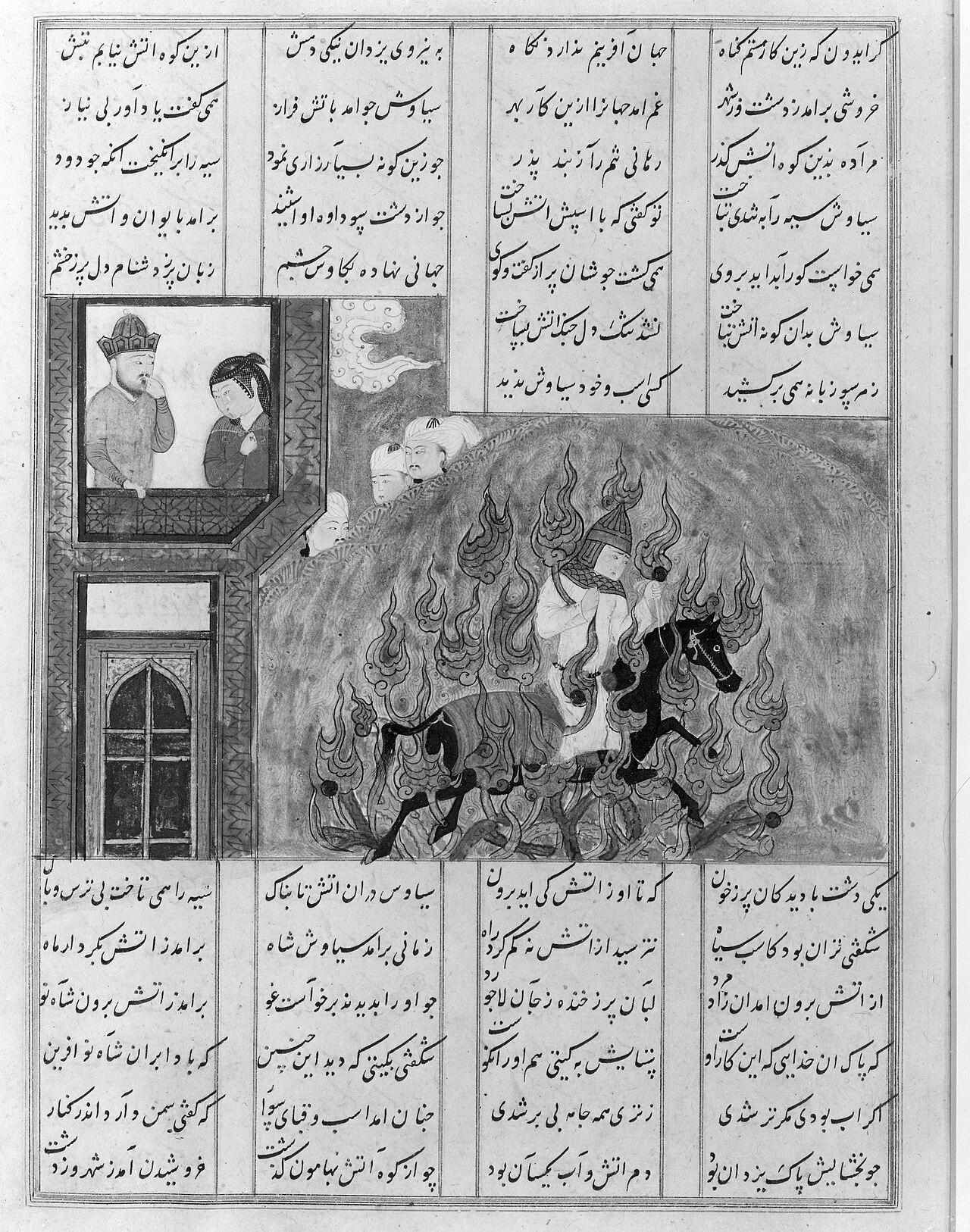
To prove his innocence, Siyavash agreed to undergo the trial by fire, the ordeal in which, by the belief of the age, the sacred fire would not harm the innocent. A great mountain of wood was set ablaze, and before the watching court the young prince, clad in white and mounted upon a black horse, rode straight into the towering wall of flame. The court held its breath as he vanished amid the fire.
Then, to the wonder and joy of all, Siyavash emerged from the far side of the blaze unharmed, neither he nor his horse touched by the flames, his white garments unstained by smoke. The sacred fire had declared his innocence and, by the same token, the falsehood of Sudabeh's accusation. The prince was vindicated utterly, and the guilt of the queen laid bare for all to see. By the justice of the age, Sudabeh now stood condemned by the very ordeal she had provoked, and it seemed that the schemer would at last face the punishment her slander deserved.
The Road to Tragedy
Yet the tragedy was not averted, and here the deeper fault passes to Kay Kavus himself. Though Sudabeh's guilt was proven and the king at first resolved to put her to death, his love for her overcame his judgement. Siyavash, with characteristic mercy, even pleaded for her life, and the weak-willed king, mindful too of his alliance with her powerful father, allowed himself to be mollified and pardoned the guilty queen. Sudabeh escaped justice, and her continued presence and intrigues at court made the prince's position unbearable.
Unable to remain safely at a court where his slanderer was protected, and estranged from a father whose suspicion and weakness he could no longer trust, Siyavash chose exile. He departed for the land of Turan, the realm of Afrasiab, where, after a time of honour, he was at last treacherously murdered, one of the great tragedies of the epic. His death was avenged in time by his son Kay Khosrow. As for Sudabeh, retribution came at last from the hero Rostam, who, in his grief and fury at the death of the prince he had raised, dragged the queen from her palace and put her to death, holding her guilty of the whole catastrophe.
Symbolism and Meaning
Sudabeh embodies the destructive power of unchecked passion and the ruin it can bring upon the innocent. In her, the epic explores the terrible consequences of desire turned to vengeance, of a love refused that becomes a deadly hatred. She is a cautionary figure, a warning of how passion and intrigue, unrestrained by conscience, can topple even the most virtuous and shatter kingdoms, leaving blood debts and broken lives in their wake. Her false accusation is one of the epic's starkest images of innocence wronged.
Yet her deepest meaning lies in her complexity and in the way she shares the blame with Kay Kavus. The tragedy of Siyavash is not the work of a single wicked woman but of a chain of faults: Sudabeh's guilty passion and slander, and the king's capricious, weak-willed nature that pardoned her guilt and drove his son away. In this the epic shows a profound moral vision, in which the boundaries of good and evil are blurred and responsibility is shared. Sudabeh is at once villain and, in her early loyalty and her human passion, a figure of tragic complexity, one of the most searching portraits of a flawed and dangerous woman in all of epic literature.
Sudabeh and the Kurds
Sudabeh belongs to the shared epic heritage of the Iranian peoples, the tradition of the Shahnameh that the Kurds hold in common with the Persians and other Iranic peoples. As an Iranic people with deep roots in this cultural world, the Kurds are heirs to its great cycle of tales, including the tragedy of Siyavash in which Sudabeh plays so fateful a part. Her story is part of this common inheritance of epic narrative shared across the Iranian world.
It is honest to say that Sudabeh, like the other figures of the Shahnameh's legendary cycles, is part of this wider Iranic tradition rather than a specifically Kurdish character. Yet the tale of Siyavash, the pure prince wronged and martyred, has resonated powerfully across the whole Iranian cultural world, including among the Kurds, as one of the most beloved and mourned of all the epic's stories. In the figure of Sudabeh, the shared heritage offers a portrait of human passion and frailty at its most consequential, a story whose moral depth and tragic power belong to all the peoples who have cherished the great Book of Kings.
Debates and Misconceptions
Is Sudabeh simply a villain? It is too simple to see her so. While her false accusation is a grave and deliberate wrong, the epic presents Sudabeh as a complex figure: a woman of fierce loyalty in her early life, who stood by her captive husband, as well as of destructive passion later. Moreover, the tragedy is not hers alone. Scholars have long noted that Kay Kavus bears deep responsibility, for it was his weak and capricious nature, and his pardoning of the guilty queen out of love, that truly drove Siyavash into exile and death. Blame, in this tragedy, is shared.
Is the story of Sudabeh history? No; Sudabeh belongs to the legendary cycles of the Shahnameh, not to documented history. She is a figure of the epic's heroic age, a tradition rich in moral and dramatic meaning but belonging to the realm of legend rather than fact. Her tale is to be appreciated as a profound exploration of passion, jealousy, weakness and the suffering of the innocent, rather than as a record of real events.
Does her story resemble other tales? Yes, and notably so. Scholars have often observed that the tale of Sudabeh and Siyavash closely parallels the Greek myth of Phaedra and Hippolytus, in which a queen falsely accuses her chaste stepson after he refuses her, and the great Iranica scholarship has compared the beautiful, passionate Sudabeh to Helen of the Iliad. These parallels reflect the recurrence of such themes across the great epic traditions, and the artistic kinship that scholars have long recognised between the Shahnameh and the epics of the ancient world.
Related Topics
Siyavash: the pure prince whom Sudabeh wronged, the victim of the tragedy
Kay Kavus: the king of Iran, husband of Sudabeh and father of Siyavash
Rostam: the great hero who raised Siyavash and executed Sudabeh
Kay Khosrow: the son of Siyavash, who avenged his father's death
Afrasiab: the Turanian king in whose land Siyavash was killed
Tahmineh: another woman of the epic, in poignant contrast to Sudabeh
The Shahnameh: the epic Book of Kings in which Sudabeh's tale is told
Frequently Asked Questions
Who was Sudabeh in the Shahnameh?
Sudabeh was a queen in the Shahnameh, a princess of the kingdom of Hamavaran who became the wife of Kay Kavus, King of Iran, and the stepmother of the prince Siyavash. She is most famous for conceiving a passion for her stepson and, when he refused her, falsely accusing him of assault, an accusation that led to his trial by fire and helped drive him into exile and a tragic death.
What did Sudabeh do to Siyavash?
Sudabeh conceived a forbidden passion for her stepson Siyavash and tried to seduce him, but he refused her out of virtue and loyalty to his father. Fearing exposure and seeking revenge, she falsely accused him of assaulting her, tearing her own garments to support the lie. This led to Siyavash undergoing a trial by fire to prove his innocence, and ultimately contributed to his exile and murder.
What was the trial by fire?
The trial by fire was an ordeal by which, in the belief of the age, the innocent could be distinguished from the guilty, since the sacred fire was thought not to harm the pure. To answer Sudabeh's accusation, Siyavash rode on a black horse through a great wall of fire and emerged unharmed, his white garments unstained. This proved his innocence and, by the same token, the falsehood of Sudabeh's charge.
What happened to Sudabeh in the end?
Although her guilt was proven by Siyavash's trial by fire, Kay Kavus pardoned her out of love, which allowed the tragedy to unfold and the prince to go into exile, where he was murdered. After Siyavash's death, the hero Rostam, in grief and fury, held Sudabeh responsible for the whole catastrophe and put her to death, dragging her from her palace and executing her in public.
Was Sudabeh entirely to blame for the tragedy?
No. While Sudabeh's passion and false accusation were a grave wrong, the epic and its scholars place much of the blame on Kay Kavus as well. It was the king's weak and capricious nature, and his decision to pardon the guilty queen out of love, that truly drove Siyavash into exile and death. The tragedy is understood as a chain of shared faults rather than the work of one wicked woman alone.
Does Sudabeh's story resemble any other myths?
Yes. The tale of Sudabeh and Siyavash closely parallels the Greek myth of Phaedra and Hippolytus, in which a queen falsely accuses her chaste stepson after he rejects her advances. Scholars have also compared the beautiful and passionate Sudabeh to Helen of the Iliad. These parallels reflect the recurrence of such themes across the great epic traditions of the ancient world and the artistic kinship between the Shahnameh and other epics.
References and Further Reading
Comments