Shaghad: The Betrayer of Rostam
- Sherko Sabir

- 3 hours ago
- 14 min read

Introduction
Shaghad is the great villain of the death of Rostam, the dark figure whose jealousy and treachery brought about the fall of the mightiest hero of the Shahnameh. A half-brother of Rostam, born of the house of Zal but cursed with an envious heart, Shaghad conspired to destroy the hero who had won all the glory he himself craved, and by his treachery he succeeded where no enemy in open battle ever could.
The tale of Shaghad is among the most sombre and affecting of the whole epic, for it tells how the invincible Rostam, who had triumphed over every foe and monster across a long lifetime of heroism, met his end not in glorious combat but through the betrayal of his own brother. Allied with the King of Kabul, Shaghad contrived a deadly trap, a hidden pit lined with poisoned spears, into which the unsuspecting Rostam and his faithful horse Rakhsh would fall. Yet even in death the great hero was not wholly undone, for with his last strength he took his revenge upon the treacherous brother who had destroyed him.
Like all the figures of the Book of Kings, Shaghad belongs to the shared epic heritage of the Iranian peoples, a tradition the Kurds hold in common with the Persians, the Lurs, and others of the Iranic world. To know Shaghad is to know one of the epic's darkest figures and one of its most tragic episodes, the betrayal that brought low the greatest of heroes. His is a name bound forever to treachery and envy, the brother whose jealousy could not bear another's glory, and whose dark deed marked the end of an age of heroism in the Shahnameh.
Contents
Who Is Shaghad?
Shaghad, also spelled Shoghad, is a figure of the Shahnameh, the half-brother of the great hero Rostam and the instrument of his death. He was a son of Zal, the lord of the House of Nariman and father of Rostam, born of a lesser wife, and so a half-brother to the mightiest champion of Iran. But where Rostam was the glory of his house and the greatest hero of the age, Shaghad was consumed by jealousy of his brother's high status, and at last he found the opportunity to act upon his malice. Conspiring with the King of Kabul, he contrived the treacherous death of Rostam in a pit of poisoned spears, though the dying hero slew him in return. Shaghad is remembered as the betrayer of Rostam, the envious brother whose treachery brought about the fall of the greatest of all the heroes of the Shahnameh.
A Brother Consumed by Envy
The root of Shaghad's treachery, as the epic presents it, was jealousy: a consuming envy of his brother Rostam, whose towering fame and high status Shaghad could not endure. Born of the same noble house, the line of Zal and the mighty Sam, but of a lesser station, Shaghad lived all his life in the shadow of his brother's surpassing glory, and this shadow bred in him a bitter resentment.
The epic draws Shaghad as a man poisoned by envy, watching as Rostam received all the honour, glory, and love that he himself craved and never won. While Rostam stood as the protector of Iran and the greatest hero of the age, his name resounding through the land with every new triumph, Shaghad held only a small and obscure station, and every report of his brother's latest glory fed his resentment until it grew into a deadly hatred. In this portrait of consuming envy, the Shahnameh offers a study of one of the darkest of human passions, the jealousy that cannot bear another's greatness and that festers into the will to destroy. Shaghad's envy is the seed of the whole tragedy, the inner corruption that makes him willing to betray his own brother and the greatest hero of his people. In him, the epic shows how envy, left to fester, can turn a man into a traitor and a murderer, and how the destruction of even the mightiest hero can come not from any foe but from the poisoned heart of one of his own blood.
Key Takeaways
Shaghad is the half-brother of Rostam in the Shahnameh and the cause of his death.
He was a son of Zal, born of a lesser wife, consumed by jealousy of Rostam.
He conspired with the King of Kabul to contrive Rostam's death.
He lured Rostam into a hidden pit lined with poisoned spears.
The dying Rostam slew Shaghad with a last arrow before he died.
He belongs to the shared Iranic epic heritage the Kurds hold in common with others.
Quick Facts
Name: Shaghad (also Shoghad)
Role: The betrayer of Rostam in the Shahnameh
Father: Zal, of the House of Nariman
Relation to Rostam: Half-brother, by a lesser wife
Ally: The King of Kabul
Motive: Jealousy of Rostam's glory and status
His scheme: A hidden pit lined with poisoned spears
Victims: Rostam, his horse Rakhsh, and his brother Zavareh
His end: Slain by the dying Rostam's last arrow
Heritage: Shared Iranic epic tradition
The Conspiracy with Kabul
Shaghad's envy found its opportunity in alliance with the King of Kabul. According to the epic, Shaghad was connected to the court of Kabul, and there, far from the great stronghold of Rostam in Sistan, he and the King of Kabul together hatched their conspiracy against the hero. The two devised a treacherous plan to bring about Rostam's death, not by open challenge, which no one could hope to win against the invincible champion, but by stealth and cunning.
The plot was laid with deadly care. Shaghad would lure Rostam to Kabul, drawing him in by the bonds of brotherhood and the appearance of hospitality, so that the unsuspecting hero, who could not readily believe in treachery from his own brother, would come without his full guard. There, a deadly trap was prepared: a series of deep pits dug along the way that Rostam and his horse would ride, their bottoms set with sharpened, poisoned spears and blades, and then concealed so that no eye would detect them. The whole scheme depended upon Rostam's trust and his noble inability to suspect betrayal from his own blood, and upon the careful concealment of the deadly pits. In this conspiracy of Shaghad and the King of Kabul, the epic shows treachery at its most calculated and cold, the plotting of the death of a great hero through deceit and a hidden trap, since no honest force could ever have brought him down. It is one of the darkest schemes in all the Shahnameh, the more terrible for being devised by the hero's own brother.
The Pit of Spears
The trap was sprung as Shaghad had planned. Lured to Kabul by his brother and received with every show of warmth and hospitality, Rostam was at length led out, and as he rode, he and his faithful horse Rakhsh came upon the concealed pits. The great horse, sensing danger, hesitated, but the trap had been laid too well, and horse and rider fell together into a pit lined with the sharpened, poisoned spears. So the mightiest hero of Iran, who had survived every peril of a long heroic life, was brought down at last by his brother's treachery, mortally wounded in the deadly pit along with his beloved Rakhsh.
The fall into the pit of spears is one of the most sorrowful moments in all the Shahnameh, the terrible image of the greatest of heroes, invincible in open combat, undone by a hidden trap and the betrayal of his own blood. With him perished his faithful steed Rakhsh, the companion of all his exploits, and in the wider tragedy his brother Zavareh too was slain by Shaghad's treachery. That Rostam, who had triumphed over demons, monsters, and the mightiest warriors, should meet his end not in glorious battle but in a concealed pit, betrayed by his brother, gives his death a peculiar pathos and bitterness. The epic does not shrink from this dark and sorrowful ending, but presents it in its full tragedy, the fall of the hero through treachery rather than in honourable combat, a sombre close to a life of unmatched glory. The pit of spears stands as one of the great and terrible images of the Book of Kings.
The Last Revenge of Rostam
Yet even in his dying, the great Rostam was not wholly undone, and the epic grants him a final act of vengeance against the brother who had destroyed him. Mortally wounded at the bottom of the pit, the hero, knowing his end was near, resolved to take his revenge upon Shaghad. By a ruse, he asked his treacherous brother for his bow and two arrows, that he might, as he said, defend himself against any wild beast as he lay dying.
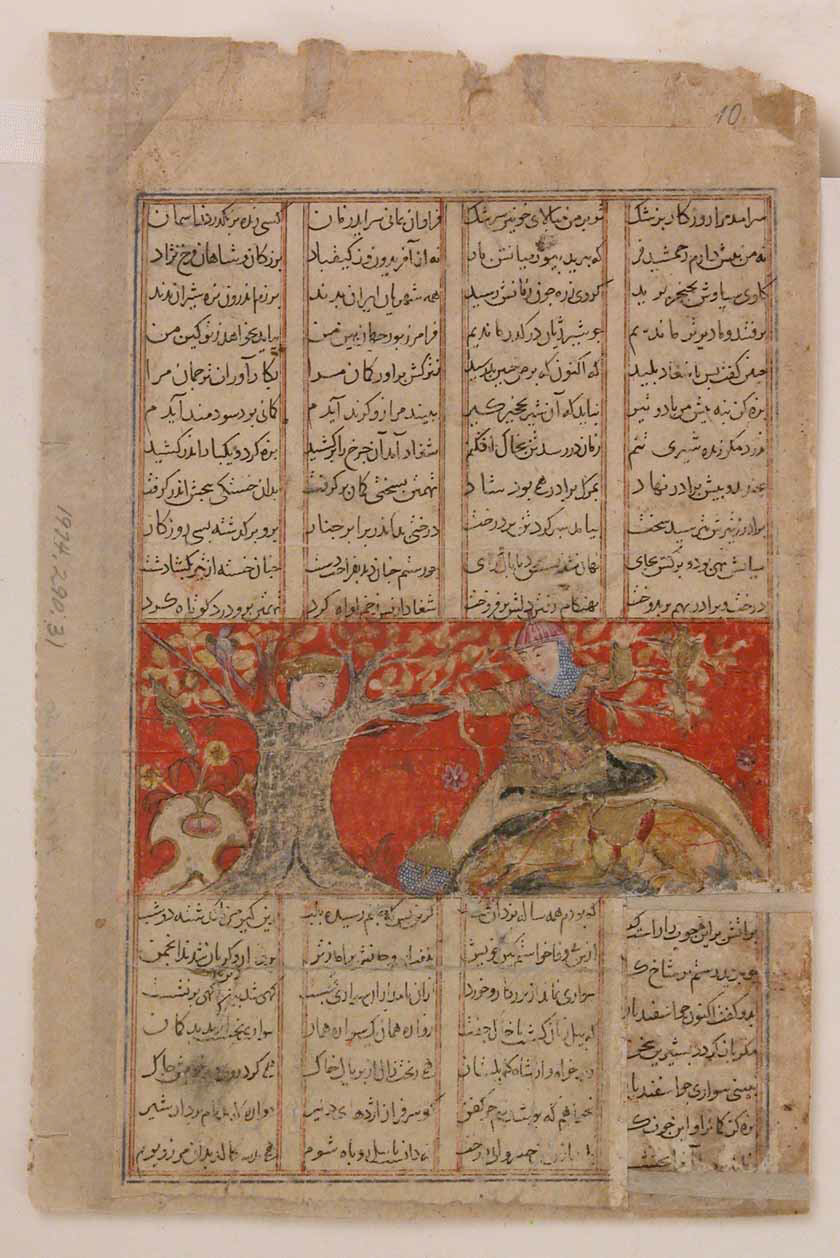
Shaghad, perhaps thinking the request harmless from a dying man, or unable to refuse his brother's last wish, brought the bow and arrows. But as soon as Rostam had them in his hands, Shaghad, seized by sudden fear, fled and sought to hide himself behind the trunk of a great tree. With the last of his failing strength, the dying Rostam drew his bow and loosed an arrow with such force that it pierced clean through the trunk of the tree and struck Shaghad on the other side, pinning and slaying the treacherous brother where he hid. So Shaghad met his death at the hands of the very brother he had betrayed, killed by the dying Rostam's final arrow. This last act of vengeance, the dying hero summoning his ebbing strength for one final, fatal shot, gives the tragedy a measure of grim justice: the betrayer does not outlive his victim, but is slain by him even in death. It is a fitting and memorable end to the dark tale, the treacherous Shaghad destroyed by the hero he had destroyed, before Rostam himself breathed his last.
The Avenging of Rostam
The death of Rostam through Shaghad's treachery did not go unavenged, for the hero left behind a son who took up the cause of vengeance. Faramarz, the valiant son of Rostam and heir to the glory of his heroic line, on learning of his father's treacherous murder, gathered an army and marched upon Kabul to avenge the great hero.
In the campaign of vengeance, Faramarz fell upon Kabul and exacted retribution for the death of his father, punishing the King of Kabul and those who had shared in the treachery that brought Rostam down. So the betrayal of Shaghad, though it succeeded in destroying the greatest of heroes, was answered by the vengeance of Rostam's son, and the treachery did not go unpunished. The avenging of Rostam by Faramarz forms the aftermath of the dark tale of Shaghad, the restoration of a measure of justice after the great wrong, and the carrying forward of the cause of Rostam's house into the next generation. Yet for all the vengeance, the greatest of heroes was gone, and his death marked the passing of an age. The sorrow of his loss was carried to his aged father Zal in Zabulistan, and the Shahnameh laments the fall of the mighty Rostam, betrayed and murdered by his own brother, as one of the great tragedies of the heroic age, even as his death was avenged by his son.
Symbolism and Meaning
Shaghad embodies, above all, the destructive power of envy and the horror of treachery against one's own. In his consuming jealousy of his brother's glory, festering into the will to destroy, he stands as the epic's great study of envy, the dark passion that cannot bear another's greatness and that corrupts a man into a traitor and murderer. His betrayal of his own brother, and the greatest hero of his people, makes him an emblem of treachery at its most terrible, the violation of the deepest bonds of blood and loyalty.
The tale of Shaghad embodies, too, the epic's sense of the tragic vulnerability of even the greatest hero, and the bitter truth that the mightiest may be brought down not by any worthy foe but by treachery from within. That the invincible Rostam, who triumphed over every enemy and monster, should fall at last to his own brother's envy, gives the story a profound and sombre meaning: that no strength, however great, is proof against betrayal, and that the deadliest danger may come not from without but from within one's own house. In this, the death of Rostam through Shaghad's treachery carries a tragic weight that resonates through the whole epic, marking the end of the great age of heroes. And in the dying Rostam's slaying of Shaghad, and the later vengeance of Faramarz, the epic affirms a measure of justice, the betrayer punished and the great wrong answered, even amid the sorrow of the hero's fall. Shaghad thus embodies the dark themes of envy, treachery, and the tragic vulnerability of greatness that give the death of Rostam its enduring and sombre power.
Shaghad and the Kurds
Shaghad, like all the figures of the Shahnameh, belongs to the shared epic and mythological heritage of the Iranian peoples, a tradition that the Kurds hold in common with the Persians, the Lurs, and others of the Iranic world. The great epic of Ferdowsi, with its heroes and villains and its tragic tales, is the common inheritance of these peoples, who share in the ancient Iranian mythological tradition from which it springs. It is honest and accurate to understand Shaghad and the tale of Rostam's death as part of this shared heritage, rather than as uniquely Kurdish material.
For the Kurds, as an Iranian people, the figures and tales of the Shahnameh are part of the wider cultural and mythological world to which they belong, and the epic holds a place in the broad Iranic heritage that the Kurds share. The story of the death of Rostam, betrayed by his envious brother Shaghad, is part of the common store of Iranian epic tradition, known and valued across the Iranic lands as one of the great and sorrowful tales of the heroic age. In presenting Shaghad, then, we present not a specifically Kurdish figure but one of the dark figures of the shared Iranian epic, the betrayer whose treachery brought down the greatest of heroes, belonging to the heritage that the Kurds hold in common with the other peoples of the Iranic world. This honest framing places Shaghad and the tale of Rostam's death accurately within the broad and rich tradition of Iranian epic to which the Kurds, as an Iranic people, are heirs alongside their neighbours.
Debates and Misconceptions
Is Shaghad a specifically Kurdish figure? No; it is important to be clear and honest on this point. Shaghad is a figure of the Persian Shahnameh and belongs to the shared epic heritage of the Iranian peoples, a tradition the Kurds hold in common with the Persians, the Lurs, and others of the Iranic world, rather than a uniquely Kurdish figure. As an Iranian people, the Kurds share in this broad Iranic heritage, and the figures and tales of the epic, including the dark tale of Shaghad and the death of Rostam, are part of the common Iranian tradition. It would be inaccurate to claim Shaghad as specifically Kurdish; he belongs, rather, to the shared Iranian epic to which the Kurds, alongside their neighbours, are heirs.
Why could Shaghad succeed where no enemy could? This is part of the meaning of the tale. Rostam was invincible in open combat, having triumphed over every foe, monster, and even the mighty Esfandiyar, so that no honest force could ever have brought him down. Shaghad succeeded precisely because he did not meet Rostam in open battle but resorted to treachery, exploiting the bonds of brotherhood and Rostam's noble inability to suspect betrayal from his own blood, and contriving a hidden trap. The tale thus turns on the bitter irony that the greatest of heroes, unconquerable by any worthy foe, could be brought down only by treachery from within his own house. This is central to the tragic meaning of his death.
Is the tale of Shaghad historical? Like the other tales of the Shahnameh's heroic age, the story of Shaghad and the death of Rostam belongs to the realm of epic and legend rather than documented history. Rostam and his house, and the tale of his betrayal and death, are part of the legendary tradition of Iran, shaped over centuries of oral and literary transmission and given their classic form by Ferdowsi. While the epic tradition may preserve distant echoes of ancient memory, it is best to understand Shaghad and the death of Rostam as belonging to the world of legend and epic, a great and tragic tale of the heroic age, rather than as a record of literal historical events. Its significance lies in its power as a story of envy, treachery, and the fall of a hero, not in any claim to history.
Related Topics
Rostam: the greatest hero of the Shahnameh, slain by Shaghad's treachery
The Shahnameh: the Persian Book of Kings, the great epic of Iran
Zal: the father of Rostam and Shaghad, lord of the House of Nariman
Faramarz: the son of Rostam who avenged his father's death
Sohrab: the son of Rostam, slain by his own father in another tragedy
Sam: the mighty ancestor of the House of Nariman
Esfandiyar: the great hero Rostam fought in another tragic tale
The Simurgh: the wondrous bird, protector of Rostam's house
Frequently Asked Questions
Who is Shaghad in the Shahnameh?
Shaghad, also spelled Shoghad, is the half-brother of the great hero Rostam in the Shahnameh and the instrument of his death. He was a son of Zal, the lord of the House of Nariman, born of a lesser wife, and so a half-brother to the mightiest champion of Iran. Consumed by jealousy of Rostam's glory, he conspired with the King of Kabul to contrive the hero's death in a pit of poisoned spears, though the dying Rostam slew him in return. He is remembered as the betrayer of Rostam.
How did Shaghad bring about Rostam's death?
Shaghad, allied with the King of Kabul, devised a treacherous trap. He lured Rostam to Kabul under the guise of brotherhood and hospitality, while along the way deep pits were dug and their bottoms set with sharpened, poisoned spears, then concealed. As Rostam rode out, he and his faithful horse Rakhsh fell into the hidden pit and were mortally wounded. So the invincible hero, whom no enemy could defeat in open combat, was brought down by his brother's treachery and a concealed trap.
How did Shaghad die?
Even mortally wounded in the pit, Rostam took his revenge. By a ruse, he asked Shaghad for his bow and two arrows, saying he wished to defend himself against wild beasts as he lay dying. Shaghad brought them, but as soon as Rostam had the bow, Shaghad fled and hid behind the trunk of a great tree. With his last strength, Rostam loosed an arrow that pierced clean through the tree and slew Shaghad on the other side. So the betrayer was killed by the very brother he had destroyed.
Why was Shaghad jealous of Rostam?
Shaghad was born of the same noble house as Rostam, the line of Zal and Sam, but of a lesser station, and he lived all his life in the shadow of his brother's surpassing glory. While Rostam stood as the protector of Iran and the greatest hero of the age, Shaghad held only a small and obscure station, and every report of his brother's triumphs fed his resentment until it grew into a deadly hatred. The epic presents him as a man poisoned by envy that could not bear another's greatness.
Was Rostam's death avenged?
Yes. Rostam's son Faramarz, the heir to his heroic line, on learning of his father's treacherous murder, gathered an army and marched upon Kabul to avenge him, punishing the King of Kabul and those who shared in the treachery. So Shaghad's betrayal, though it destroyed the greatest of heroes, was answered by the vengeance of Rostam's son, and the treachery did not go unpunished, even though the mighty Rostam was gone and his death marked the passing of an age.
Is Shaghad a Kurdish figure?
Shaghad is a figure of the Persian Shahnameh and belongs to the shared epic heritage of the Iranian peoples, a tradition the Kurds hold in common with the Persians, the Lurs, and others of the Iranic world, rather than a uniquely Kurdish figure. As an Iranian people, the Kurds share in this broad Iranic heritage, and the figures and tales of the epic, including the tale of Shaghad and the death of Rostam, are part of the common Iranian tradition to which the Kurds are heirs alongside their neighbours.
References and Further Reading
Comments